Jordan Gerald, Malla Ashok, Iyer Srividya N
Prevention and Early Intervention Program for Psychosis, Douglas Mental Health University Institute, Verdun, QC, Canada.
Department of Psychiatry, McGill University, Montreal, QC, Canada.
Front Psychiatry. 2019 Jul 15;10:480. doi: 10.3389/fpsyt.2019.00480. eCollection 2019.
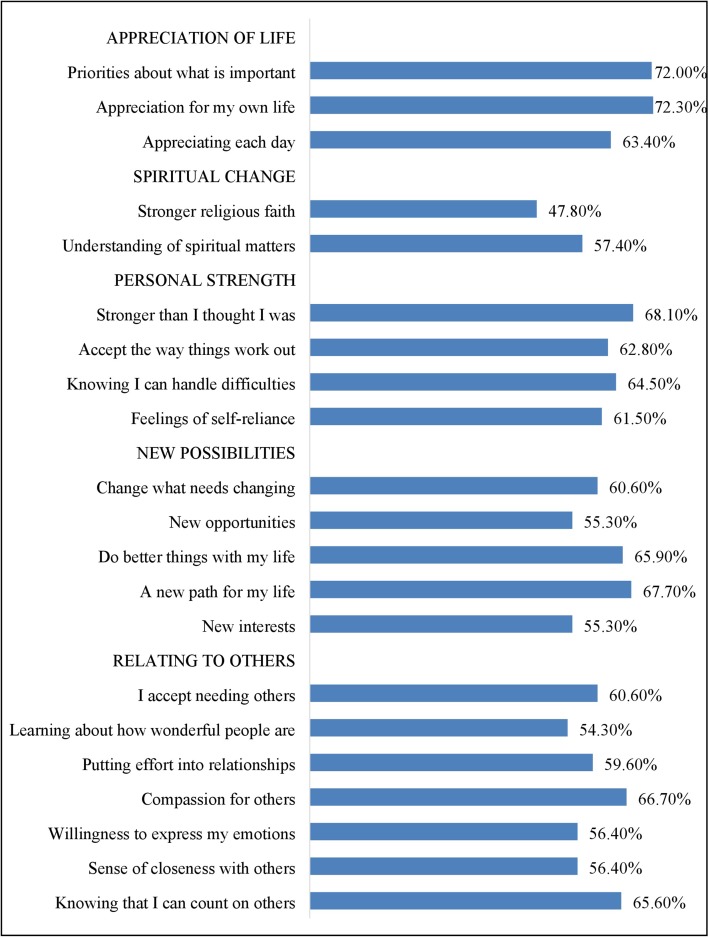
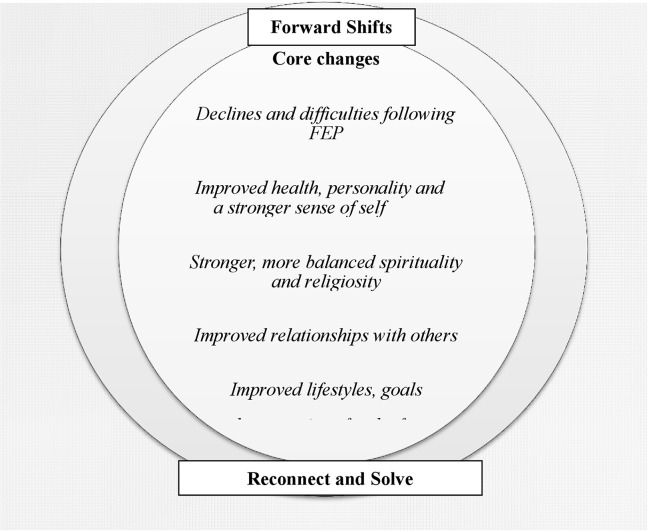
A first episode of psychosis is often a traumatic experience that may also lead to positive change, a phenomenon that has received little attention. This knowledge gap may impede service providers' capacity to foster positive change among service users. To investigate aspects of positive change among persons receiving early intervention services for psychosis. The study objective was addressed using a mixed methods convergent design, which entailed simultaneously employing qualitative and quantitative methods. This study was conducted at a specialized early intervention service for psychosis based in Montreal, Quebec, Canada. Participants included service users receiving services at an early intervention service for psychosis. Participants had to be fluent in English or French, be clinically stable enough to take part in the study, and have received at least 6 months of treatment. Participants were conveniently sampled in the quantitative component and purposefully sampled in the qualitative component. The quantitative component was carried out using a cross-sectional survey design. Ninety-four participants completed the Posttraumatic Growth Inventory, a widely used measure of positive change. Data on the extent and domains of posttraumatic growth were summarized using descriptive statistics. The qualitative component was carried out using a qualitative descriptive approach. Semistructured interviews were conducted with 12 participants. Data were analyzed using thematic analysis. Findings from both components were integrated using a weaving method in the discussion section. Quantitative results indicated that most participants reported a moderate amounts of posttraumatic growth. A greater appreciation of life was the most commonly endorsed domain, whereas spiritual growth was the least commonly endorsed domain. The qualitative results revealed that in addition to suffering, participants experienced positive changes, such as improved health and personality, and a stronger sense of self; stronger, more balanced religiosity and spirituality; improved relationships with others; and improved lifestyles, goals, and expectations for the future. Positive change may be a common phenomenon in the aftermath of first episode psychosis. The study findings may provide hope to those who have experienced a first episode of psychosis and can inform efforts by early intervention services to provide recovery-oriented, growth-focused care.
首次精神病发作通常是一次创伤性经历,也可能带来积极改变,然而这一现象却很少受到关注。这种知识空白可能会阻碍服务提供者在服务使用者中促进积极改变的能力。为了调查接受精神病早期干预服务的人群中积极改变的各个方面。本研究目标采用混合方法收敛设计来实现,即同时运用定性和定量方法。本研究在加拿大魁北克省蒙特利尔市一家专门的精神病早期干预服务机构进行。参与者包括在精神病早期干预服务机构接受服务的使用者。参与者必须精通英语或法语,临床状况足够稳定以参与研究,并且已经接受了至少6个月的治疗。在定量部分采用便利抽样,在定性部分采用目的抽样。定量部分采用横断面调查设计。94名参与者完成了创伤后成长量表,这是一种广泛使用的积极改变测量工具。使用描述性统计对创伤后成长的程度和领域数据进行了总结。定性部分采用定性描述方法。对12名参与者进行了半结构化访谈。使用主题分析法对数据进行了分析。在讨论部分,使用交织法将两个部分的结果进行了整合。定量结果表明,大多数参与者报告有中等程度的创伤后成长。对生活有了更大的领悟是最常被认可的领域,而精神成长是最不常被认可的领域。定性结果显示,除了遭受痛苦外,参与者还经历了积极的变化,如健康和个性的改善、更强的自我意识;更强、更平衡的宗教信仰和精神性;与他人关系的改善;以及生活方式、目标和对未来期望的改善。积极改变可能是首次精神病发作后的常见现象。研究结果可能会给那些经历过首次精神病发作的人带来希望,并为早期干预服务机构提供以康复为导向、以成长为重点的护理工作提供参考。