Chen Kun, Zhao Yangyu, Li Shufang, Chen Lian, Wang Nan, Zhang Kai, Wang Yan, Zhang Jue
Academy for Advanced Interdisciplinary Studies, Peking University, Beijing, China.
Obstetrics and Gynecology, Peking University Third Hospital, Beijing, China.
Front Neurol. 2019 Jul 17;10:760. doi: 10.3389/fneur.2019.00760. eCollection 2019.
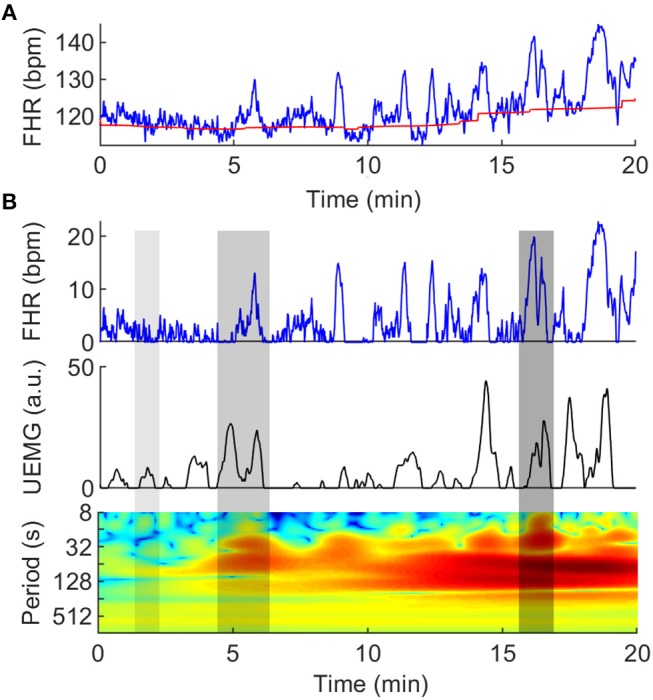
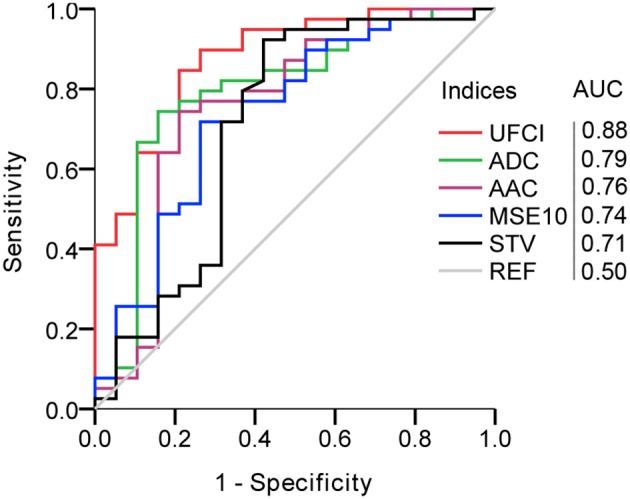
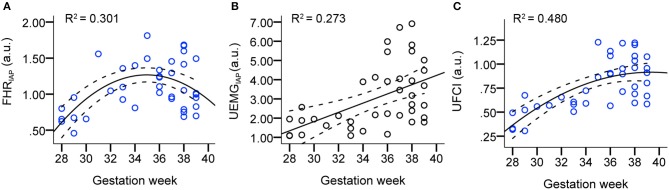
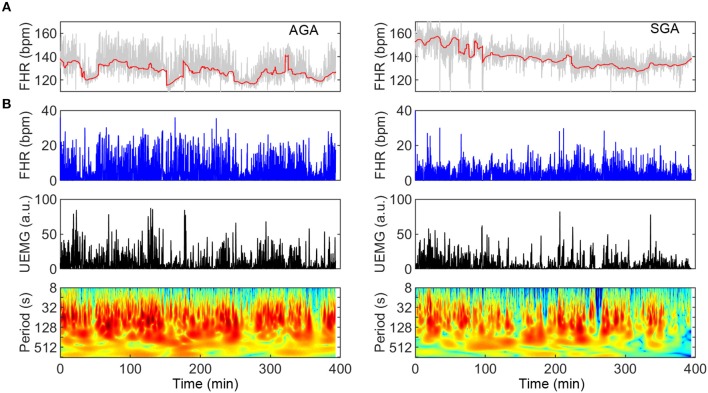
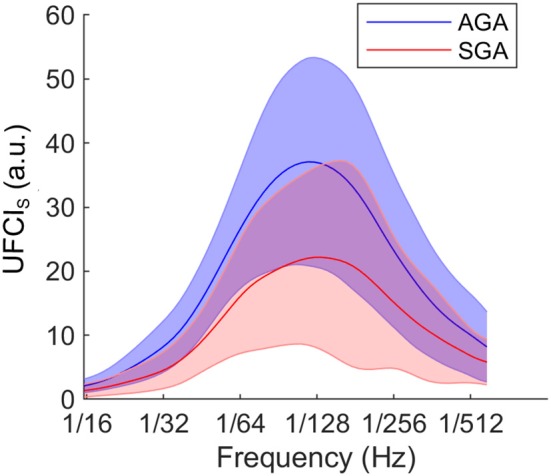
Fetal nerve maturation is a dynamic process, which is reflected in fetal movement and fetal heart rate (FHR) patterns. Classical FHR variability (fHRV) indices cannot fully reflect their complex interrelationship. This study aims to provide an alternative insight for fetal neural development by using the coupling analysis of uterine electromyography (UEMG) and FHR acceleration. We investigated 39 normal pregnancies with appropriate for gestational age (AGA) and 19 high-risk pregnancies with small for gestational age (SGA) at 28-39 weeks. The UEMG and FHR were recorded simultaneously by a trans-abdominal device during the night (10 p.m.-8 a.m.). Cross-wavelet analysis was used to characterize the dynamic relationship between FHR and UEMG. Subsequently, a UEMG-FHR coupling index (UFCI) was extracted from the multiscale coupling power spectrum. We examined the gestational-age dependency of UFCI by linear/quadratic regression models, and the ability to screen for SGA using binary logistic regression. Also, the performances of classical fHRV indices, including short-term variation (STV), averaged acceleration capacity (AAC), and averaged deceleration capacity (ADC), time- and frequency- domain indices, and multiscale entropy (MSE), were compared as references on the same recordings. The results showed that UFCI provided a stronger age predicting value with R = 0.480, in contrast to the best value among other fHRV indices with R = 0.335, by univariate regression models. Also, UFCI achieved superior performance for predicting SGA with the area under the curve (AUC) of 0.88, compared with 0.79 for best performance of other fHRV indices. The present results indicate that UFCI provides new information for early detection and comprehensive interpretation of intrauterine growth restriction in prenatal diagnosis, and helps improve the screening of SGA.
胎儿神经成熟是一个动态过程,这反映在胎儿运动和胎儿心率(FHR)模式中。经典的FHR变异性(fHRV)指标不能完全反映它们之间复杂的相互关系。本研究旨在通过子宫肌电图(UEMG)与FHR加速的耦合分析,为胎儿神经发育提供另一种见解。我们调查了39例孕龄合适(AGA)的正常妊娠和19例孕龄小(SGA)的高危妊娠,孕周为28 - 39周。夜间(晚上10点至早上8点)使用经腹装置同时记录UEMG和FHR。采用交叉小波分析来表征FHR与UEMG之间的动态关系。随后,从多尺度耦合功率谱中提取UEMG - FHR耦合指数(UFCI)。我们通过线性/二次回归模型研究UFCI的孕周依赖性,以及使用二元逻辑回归筛选SGA的能力。此外,还比较了经典fHRV指标的性能,包括短期变异(STV)、平均加速能力(AAC)、平均减速能力(ADC)、时域和频域指标以及多尺度熵(MSE),作为同一记录的参考。结果表明,通过单变量回归模型,UFCI提供了更强的年龄预测值,R = 0.480,相比之下,其他fHRV指标中的最佳值R = 0.335。此外,与其他fHRV指标的最佳性能AUC为0.79相比,UFCI在预测SGA方面表现更优,AUC为0.88。目前的结果表明,UFCI为产前诊断中宫内生长受限的早期检测和综合解释提供了新信息,并有助于改善SGA的筛查。