Jena University Hospital, Biomagnetic Center, Hans Berger Department of Neurology, Jena, Germany.
PLoS One. 2013 Sep 18;8(9):e74431. doi: 10.1371/journal.pone.0074431. eCollection 2013.
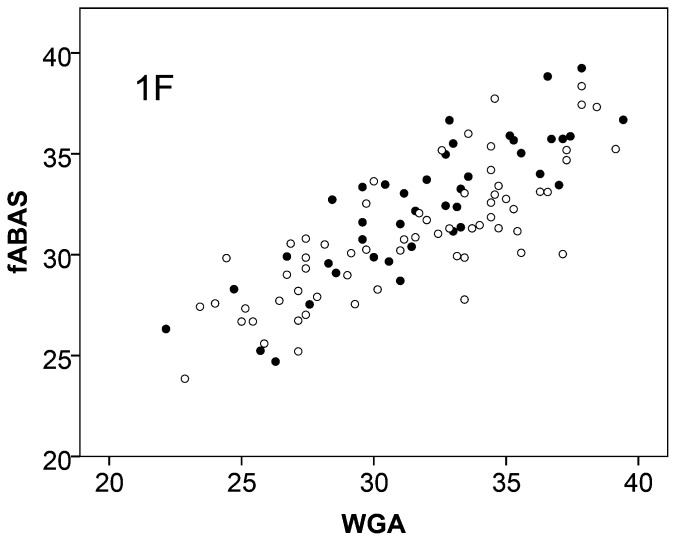
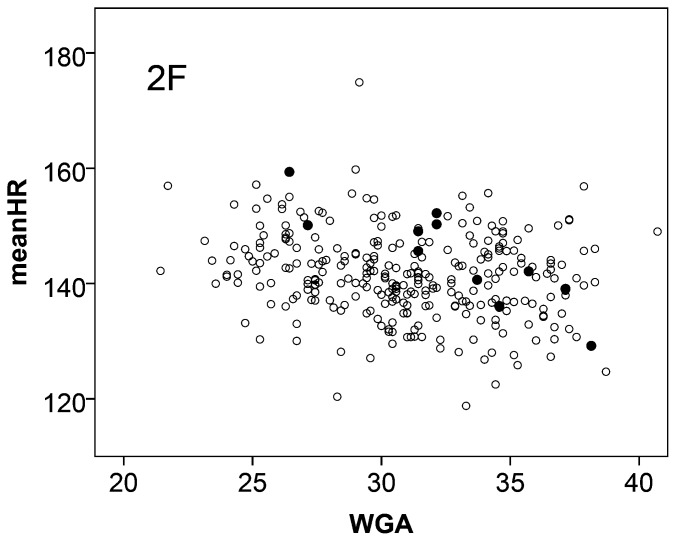
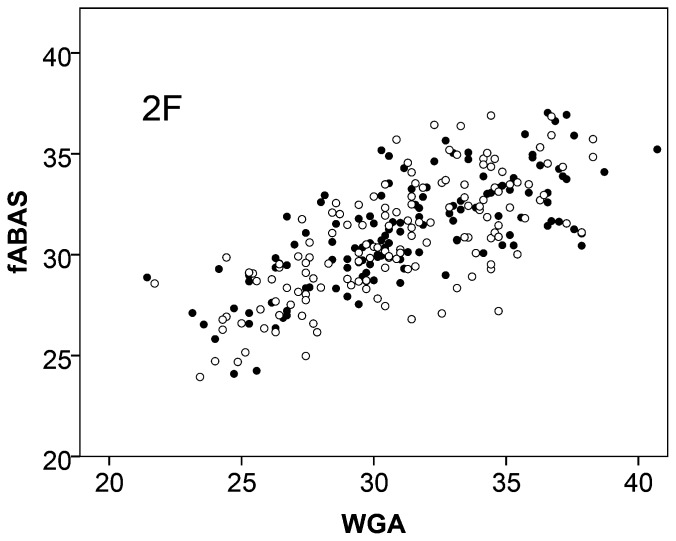
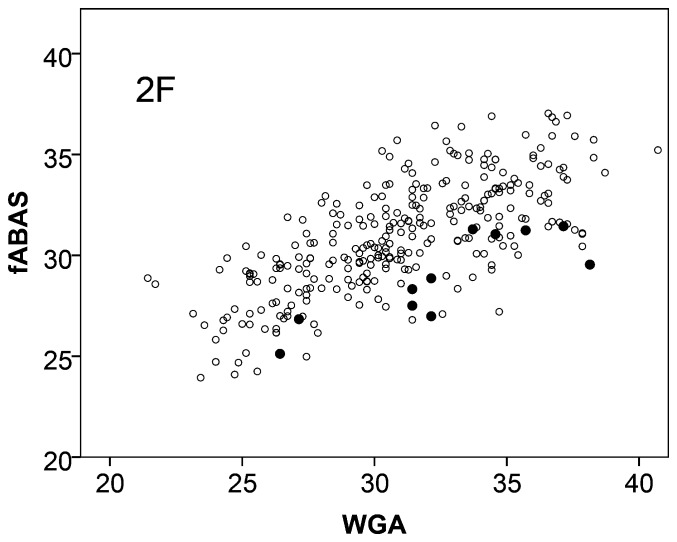
Fetal brain development involves the development of the neuro-vegetative (autonomic) control that is mediated by the autonomic nervous system (ANS). Disturbances of the fetal brain development have implications for diseases in later postnatal life. In that context, the fetal functional brain age can be altered. Universal principles of developmental biology applied to patterns of autonomic control may allow a functional age assessment. The work aims at the development of a fetal autonomic brain age score (fABAS) based on heart rate patterns. We analysed n = 113 recordings in quiet sleep, n = 286 in active sleep, and n = 29 in active awakeness from normals. We estimated fABAS from magnetocardiographic recordings (21.4-40.3 weeks of gestation) preclassified in quiet sleep (n = 113, 63 females) and active sleep (n = 286, 145 females) state by cross-validated multivariate linear regression models in a cross-sectional study. According to universal system developmental principles, we included indices that address increasing fluctuation range, increasing complexity, and pattern formation (skewness, power spectral ratio VLF/LF, pNN5). The resulting models constituted fABAS. fABAS explained 66/63% (coefficient of determination R(2) of training and validation set) of the variance by age in quiet, while 51/50% in active sleep. By means of a logistic regression model using fluctuation range and fetal age, quiet and active sleep were automatically reclassified (94.3/93.1% correct classifications). We did not find relevant gender differences. We conclude that functional brain age can be assessed based on universal developmental indices obtained from autonomic control patterns. fABAS reflect normal complex functional brain maturation. The presented normative data are supplemented by an explorative study of 19 fetuses compromised by intrauterine growth restriction. We observed a shift in the state distribution towards active awakeness. The lower WGA dependent fABAS values found in active sleep may reflect alterations in the universal developmental indices, namely fluctuation amplitude, complexity, and pattern formation that constitute fABAS.
胎儿大脑发育涉及到由自主神经系统(ANS)介导的神经-植物性(自主)控制的发育。胎儿大脑发育的障碍会对出生后生命中的疾病产生影响。在这种情况下,胎儿的功能性大脑年龄可能会发生变化。将发育生物学的普遍原理应用于自主控制模式可能允许进行功能年龄评估。这项工作旨在基于心率模式开发胎儿自主脑龄评分(fABAS)。我们分析了安静睡眠中的 n=113 次记录,活跃睡眠中的 n=286 次记录,以及活跃觉醒中的 n=29 次记录。我们从 21.4-40.3 孕周的磁心图记录中估计 fABAS,这些记录在横断面研究中通过交叉验证的多元线性回归模型预先分类为安静睡眠(n=113,63 名女性)和活跃睡眠(n=286,145 名女性)状态。根据普遍的系统发育原则,我们纳入了反映波动范围增大、复杂性增加和模式形成的指标(偏度、功率谱比 VLF/LF、pNN5)。由此产生的模型构成了 fABAS。fABAS 在安静状态下解释了 66/63%(训练和验证集的决定系数 R²)的年龄方差,而在活跃睡眠状态下则解释了 51/50%。通过使用波动范围和胎儿年龄的逻辑回归模型,安静和活跃睡眠被自动重新分类(94.3/93.1%的正确分类)。我们没有发现相关的性别差异。我们得出结论,基于从自主控制模式中获得的普遍发育指标,可以评估功能性脑龄。fABAS 反映了正常复杂的功能性大脑成熟。所提供的正常数据补充了一项对 19 名宫内生长受限胎儿的探索性研究。我们观察到状态分布向活跃觉醒转移。在活跃睡眠中发现的较低的 WGA 依赖的 fABAS 值可能反映了普遍发育指标的变化,即构成 fABAS 的波动幅度、复杂性和模式形成的变化。