Osorio Héctor, Mettert Erin, Kiley Patricia, Dopson Mark, Jedlicki Eugenia, Holmes David S
Center for Bioinformatics and Genome Biology, Fundación Ciencia y Vida, Santiago, Chile.
Department of Biomolecular Chemistry, University of Wisconsin-Madison, Madison, WI, United States.
Front Microbiol. 2019 Jul 19;10:1642. doi: 10.3389/fmicb.2019.01642. eCollection 2019.
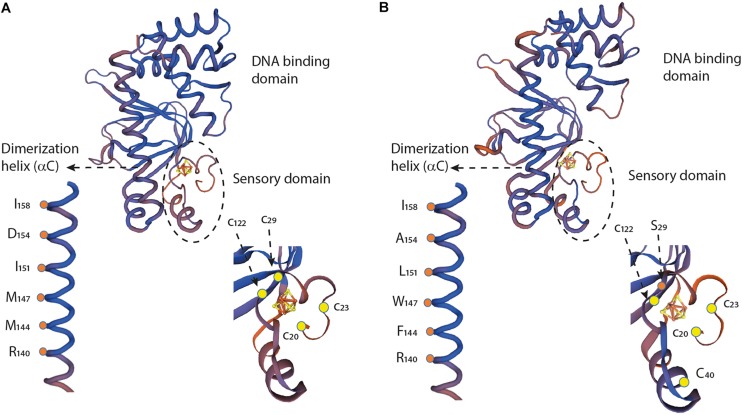
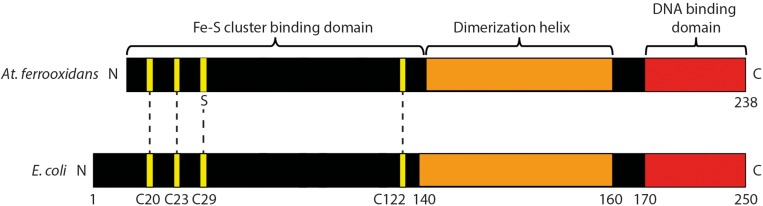
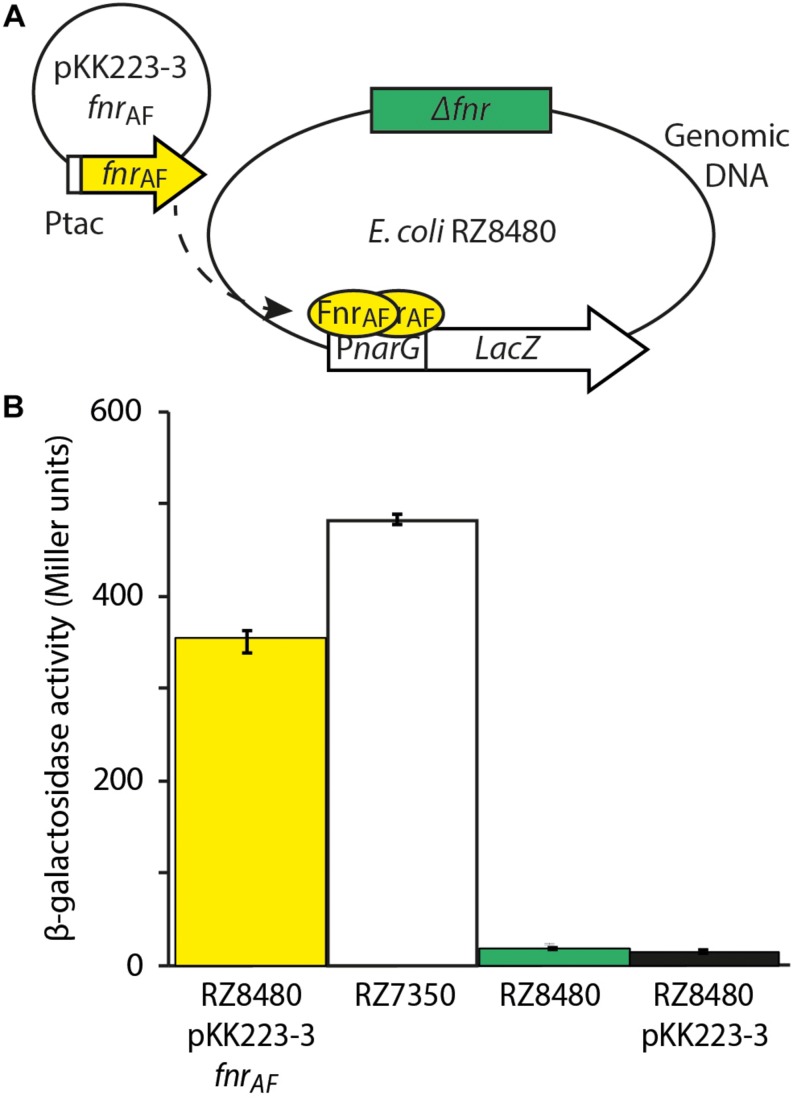
The ability to conserve energy in the presence or absence of oxygen provides a metabolic versatility that confers an advantage in natural ecosystems. The switch between alternative electron transport systems is controlled by the fumarate nitrate reduction transcription factor (FNR) that senses oxygen via an oxygen-sensitive [4Fe-4S] iron-sulfur cluster. Under O limiting conditions, FNR plays a key role in allowing bacteria to transition from aerobic to anaerobic lifestyles. This is thought to occur via transcriptional activation of genes involved in anaerobic respiratory pathways and by repression of genes involved in aerobic energy production. The Proteobacterium is a model species for extremely acidophilic microorganisms that are capable of aerobic and anaerobic growth on elemental sulfur coupled to oxygen and ferric iron reduction, respectively. In this study, an FNR-like protein (FNR) was discovered in that exhibits a primary amino acid sequence and major motifs and domains characteristic of the FNR family of proteins, including an effector binding domain with at least three of the four cysteines known to coordinate an [4Fe-4S] center, a dimerization domain, and a DNA binding domain. Western blotting with antibodies against FNR (FNR) recognized FNR. FNR was able to drive expression from the FNR-responsive promoter P, suggesting that it is functionally active as an FNR-like protein. Upon air exposure, FNR demonstrated an unusual lack of sensitivity to oxygen compared to the archetypal FNR. Comparison of the primary amino acid sequence of FNR with that of other natural and mutated FNRs, including FNR, coupled with an analysis of the predicted tertiary structure of FNR using the crystal structure of the related FNR from as a template revealed a number of amino acid changes that could potentially stabilize FNR in the presence of oxygen. These include a truncated N terminus and amino acid changes both around the putative Fe-S cluster coordinating cysteines and also in the dimer interface. Increased O stability could allow to survive in environments with fluctuating O concentrations, providing an evolutionary advantage in natural, and engineered environments where oxygen gradients shape the bacterial community.
无论有无氧气存在都能保存能量的能力提供了一种代谢多功能性,这在自然生态系统中赋予了一种优势。交替电子传递系统之间的转换由延胡索酸硝酸盐还原转录因子(FNR)控制,该因子通过一个对氧敏感的[4Fe-4S]铁硫簇感知氧气。在氧气有限的条件下,FNR在使细菌从需氧生活方式转变为厌氧生活方式中起关键作用。据认为,这是通过厌氧呼吸途径相关基因的转录激活以及需氧能量产生相关基因的抑制来实现的。变形杆菌是极端嗜酸微生物的模式物种,它们分别能够在与氧气和铁离子还原偶联的元素硫上进行需氧和厌氧生长。在这项研究中,在变形杆菌中发现了一种FNR样蛋白(FNR),它具有FNR蛋白家族的主要氨基酸序列以及主要基序和结构域,包括一个效应物结合结构域,其中四个半胱氨酸中的至少三个已知可配位一个[4Fe-4S]中心,一个二聚化结构域和一个DNA结合结构域。用抗变形杆菌FNR(FNR)的抗体进行的蛋白质印迹法识别出了FNR。FNR能够驱动来自FNR响应性启动子P的表达,这表明它作为一种FNR样蛋白在功能上是活跃的。与原型FNR相比,暴露于空气中时,FNR对氧气表现出异常的不敏感性。将FNR的主要氨基酸序列与其他天然和突变的FNR(包括FNR)的序列进行比较,并以来自嗜热栖热菌的相关FNR的晶体结构为模板对FNR的预测三级结构进行分析,发现了一些可能在氧气存在下稳定FNR的氨基酸变化。这些变化包括截短的N末端以及在假定的铁硫簇配位半胱氨酸周围以及二聚体界面中的氨基酸变化。增加的氧气稳定性可以使变形杆菌在氧气浓度波动的环境中生存,这在自然环境和工程环境中提供了一种进化优势,在这些环境中氧气梯度塑造了细菌群落。