Department of Virology and Immunology, Auckland City Hospital, Auckland, New Zealand.
Department of Clinical Immunology, Auckland City Hospital, Auckland, New Zealand.
Front Immunol. 2019 Jul 17;10:1541. doi: 10.3389/fimmu.2019.01541. eCollection 2019.
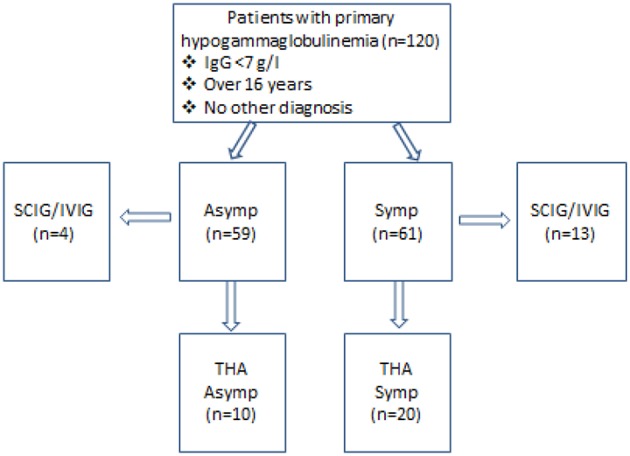
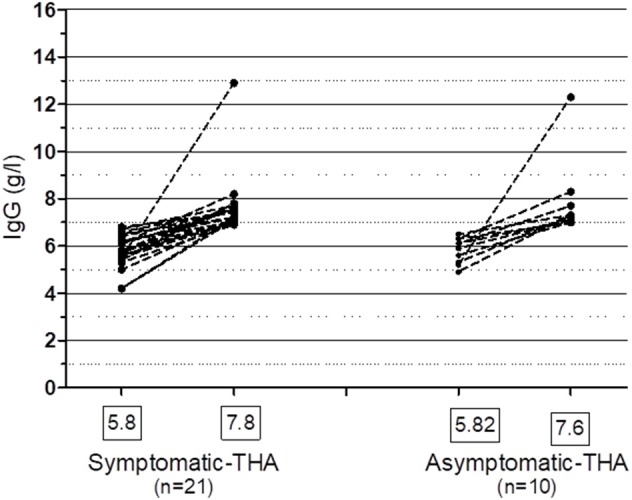
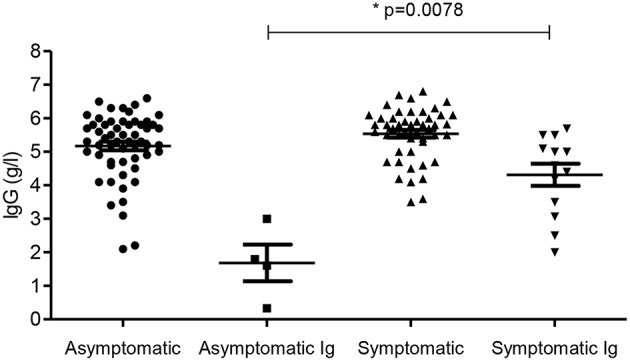
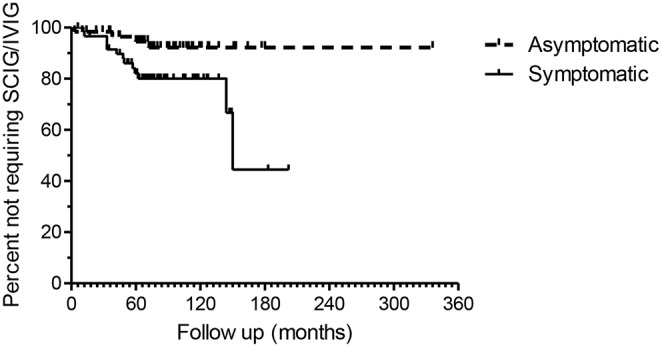
Adults with primary hypogammaglobulinemia are frequently encountered by clinicians. Where IgG levels are markedly decreased, most patients are treated with subcutaneous or intravenous immunoglobulin (SCIG/IVIG), because of the presumed risk of severe infections. The natural history of untreated severe asymptomatic hypogammaglobulinemia is thus unknown. Similarly, there are no long-term prospective studies examining the natural history of patients with moderate reductions in IgG. In 2006, we began a prospective cohort study of patients with symptomatic and asymptomatic reductions in IgG who were not immediately commenced on SCIG/IVIG. Over the course of 12 years, 120 patients were enrolled in the NZ hypogammaglobulinemia study (NZHS) including 59 who were asymptomatic. Five patients with profound primary hypogammaglobulinemia (IgG < 3 g/l), who were not on regular SCIG/IVIG have remained well for a mean duration of 139 months. This study has also shown most asymptomatic patients with moderate hypogammaglobulinemia (IgG 3.0-6.9 g/l) have been in good health for a mean observation period of 96 months. We have only identified one asymptomatic patient with moderate hypogammaglobulinemia who experienced progressive decline in IgG levels to <3 g/l and was accepted for IVIG replacement. Prospective monitoring has shown that none have suffered catastrophic infections or any of the severe autoimmune or inflammatory sequelae associated with Common Variable Immunodeficiency Disorders (CVID). Unexpectedly, 18.1% of asymptomatic and 41.6% of symptomatic hypogammaglobulinemic patients spontaneously increased their IgG into the normal range (≥7.0 g/l) on at least one occasion, which we have termed transient hypogammaglobulinemia of adulthood (THA). In this study, vaccine challenge responses have correlated poorly with symptomatic state and long-term prognosis including subsequent SCIG/IVIG treatment. In spite of our favorable experience, we recommend patients with severe asymptomatic hypogammaglobulinemia are treated with SCIG/IVIG because of the potential risk of severe infections. Patients with moderate asymptomatic hypogammaglobulinemia have a good prognosis. Patients with symptomatic hypogammaglobulinemia are a heterogeneous group where some progress to SCIG/IVIG replacement, while many others spontaneously recover. This study has implications for the diagnosis and treatment of CVID.
原发性低丙种球蛋白血症患者常被临床医生遇到。在 IgG 水平明显降低的情况下,由于严重感染的风险,大多数患者接受皮下或静脉免疫球蛋白(SCIG/IVIG)治疗。因此,未经治疗的严重无症状低丙种球蛋白血症的自然病史尚不清楚。同样,也没有长期前瞻性研究检查 IgG 减少的患者的自然病史。2006 年,我们开始对无症状和有症状的 IgG 减少但未立即开始接受 SCIG/IVIG 治疗的患者进行前瞻性队列研究。在 12 年的时间里,有 120 名患者入组新西兰低丙种球蛋白血症研究(NZHS),其中 59 名患者无症状。5 名 IgG<3g/L 的严重原发性低丙种球蛋白血症患者,未接受常规 SCIG/IVIG 治疗,平均 139 个月病情良好。这项研究还表明,大多数 IgG 中度减少(3.0-6.9g/L)的无症状患者平均 96 个月观察期内身体健康状况良好。我们只发现 1 名 IgG 中度减少(3.0-6.9g/L)的无症状患者 IgG 水平逐渐下降至<3g/L,接受 IVIG 替代治疗。前瞻性监测显示,他们均未发生灾难性感染或任何与常见可变免疫缺陷疾病(CVID)相关的严重自身免疫或炎症后遗症。出乎意料的是,18.1%的无症状和 41.6%的有症状低丙种球蛋白血症患者至少有一次 IgG 自动升高至正常范围(≥7.0g/L),我们称之为成人暂时性低丙种球蛋白血症(THA)。在这项研究中,疫苗挑战反应与症状状态和长期预后相关性差,包括随后的 SCIG/IVIG 治疗。尽管我们的经验良好,但我们建议对严重无症状低丙种球蛋白血症患者进行 SCIG/IVIG 治疗,因为存在严重感染的风险。无症状中度低丙种球蛋白血症患者预后良好。有症状的低丙种球蛋白血症患者是一组异质性患者,其中一些进展为 SCIG/IVIG 替代治疗,而许多患者则自发恢复。这项研究对 CVID 的诊断和治疗有影响。