Department of Orthopedics, The First Affiliated Hospital of Chongqing Medical University, Chongqing, China.
School of Public Health and Community Medicine, Chongqing Medical University, Chongqing, China.
Front Immunol. 2019 Jul 15;10:1573. doi: 10.3389/fimmu.2019.01573. eCollection 2019.
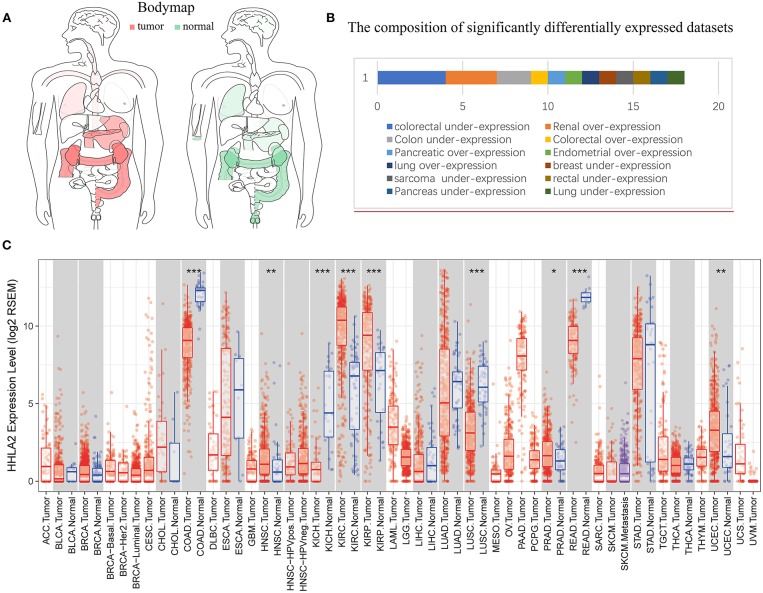
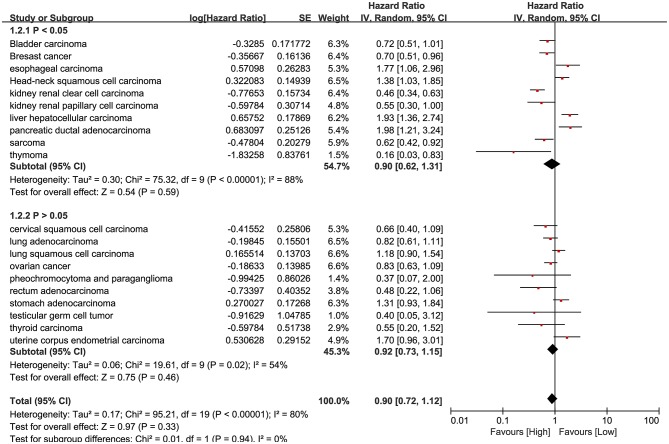
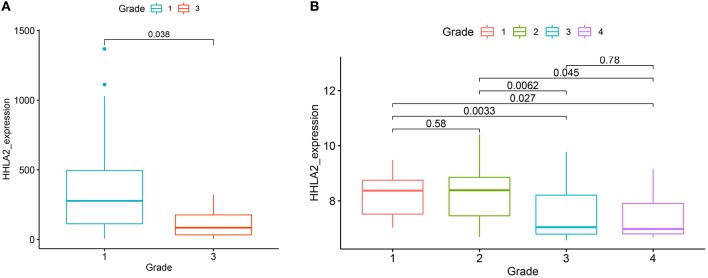
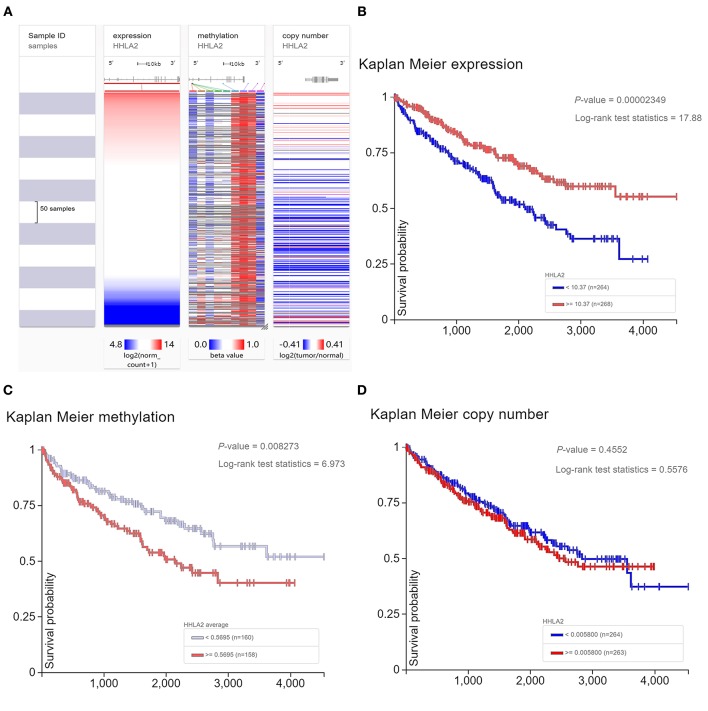
Immunological checkpoint inhibitors have been immensely successfully applied in the treatment of cancer, however, a portion of tumor patients can't benefit from checkpoint therapy. The low PD-1/CTLA-4 positive rate and involvement of multiple immunosuppressive pathways are thought to be one of the reasons for treatment failure in non-responding patients. A new immune checkpoint molecule, HHLA2, which was widely expressed in PD-1 negative human tumors, may be a promising target for the improvement of recent immune therapy. Yet, the prognostic value and transcriptional regulatory mechanisms of HHLA2 remains unclear. In this study, we aimed to evaluate the prognostic value and transcriptional regulation mechanism of HHLA2 according to clinical and experimental data from multiple databases, including cBioPortal, TCGA, Cistrome, TIMER, Oncomine, Kaplan-Meier, GeneXplain. It was found that the expression of HHLA2 was significantly elevated in renal tumors, and significantly decreased in colorectal tumors. Pan-cancer survival analysis indicates that HHLA2 was an independent prognostic factor in 9/20 of human cancers. Especially in renal clear cell carcinoma ( = 3.0E-7). Through plotting survival curve in Kaplan-Meier Plotter, it was found that hypomethylation of HHLA2 DNA was a favorable prognostic factor for KIRC patients. Yet, the copy number variant of HHLA2 was not significantly correlated with the overall survival of KIRC patients. Finally, by analyzing the motif of HHLA2 co-expression genes, we identified 15 transcription factors that may be involved in the regulation of the HHLA2 co-expression network. Among these transcription factors, BATF in B lymphocyte and SMAD in monocyte were confirmed to be able to directly bind to HHLA2 DNA according to chip-seq experimental data from Cistrome database.
免疫检查点抑制剂在癌症治疗中取得了巨大成功,然而,一部分肿瘤患者无法从中受益于检查点治疗。低 PD-1/CTLA-4 阳性率和涉及多个免疫抑制途径被认为是导致无应答患者治疗失败的原因之一。HHLA2 是一种新的免疫检查点分子,广泛表达于 PD-1 阴性的人类肿瘤中,可能是改善近期免疫治疗的有前途的靶点。然而,HHLA2 的预后价值和转录调控机制尚不清楚。在这项研究中,我们旨在根据包括 cBioPortal、TCGA、Cistrome、TIMER、Oncomine、Kaplan-Meier、GeneXplain 在内的多个数据库的临床和实验数据,评估 HHLA2 的预后价值和转录调控机制。结果发现,HHLA2 在肾肿瘤中的表达显著升高,而在结直肠肿瘤中的表达显著降低。泛癌生存分析表明,HHLA2 是 9/20 种人类癌症的独立预后因素。特别是在肾透明细胞癌中(=3.0E-7)。通过在 Kaplan-Meier Plotter 中绘制生存曲线,发现 HHLA2 的 DNA 低甲基化是 KIRC 患者的有利预后因素。然而,HHLA2 的拷贝数变异与 KIRC 患者的总生存无显著相关性。最后,通过分析 HHLA2 共表达基因的基序,我们确定了 15 个可能参与 HHLA2 共表达网络调控的转录因子。在这些转录因子中,B 淋巴细胞中的 BATF 和单核细胞中的 SMAD 根据 Cistrome 数据库中的 chip-seq 实验数据被证实能够直接结合 HHLA2 的 DNA。