Adib Sasan Darius, Herlan Stephan, Ebner Florian H, Hirt Bernhard, Tatagiba Marcos, Honegger Juergen
Department of Neurosurgery, University of Tübingen, Tübingen, Germany.
Department of Clinical Anatomy and Cell Analysis, University of Tübingen, Tübingen, Germany.
Front Surg. 2019 Jul 16;6:40. doi: 10.3389/fsurg.2019.00040. eCollection 2019.
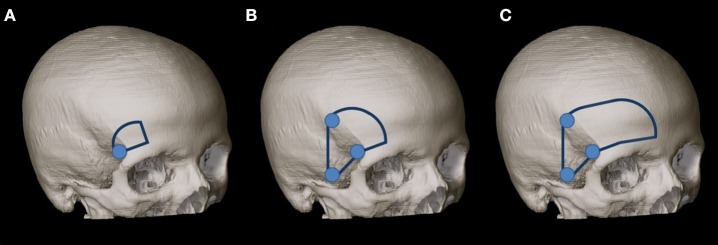
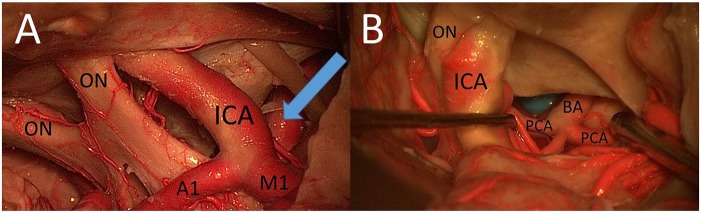
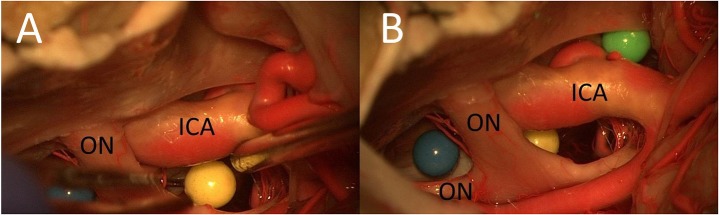
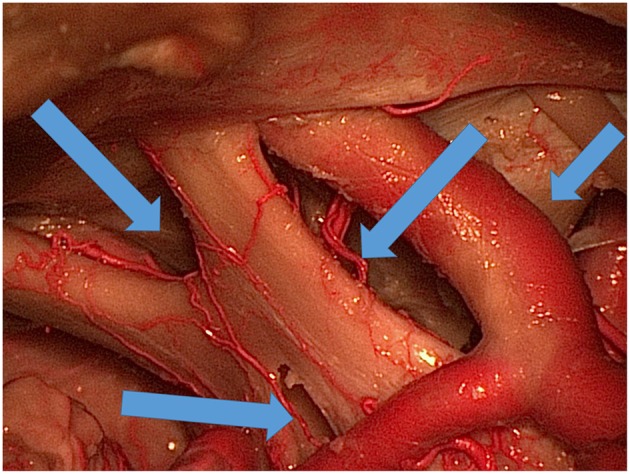
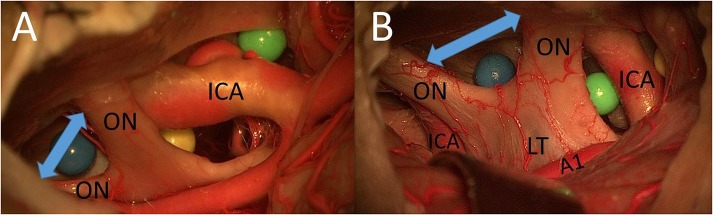
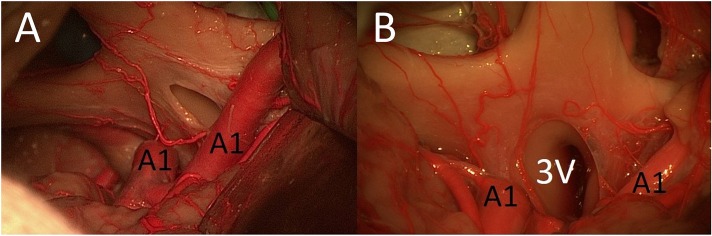
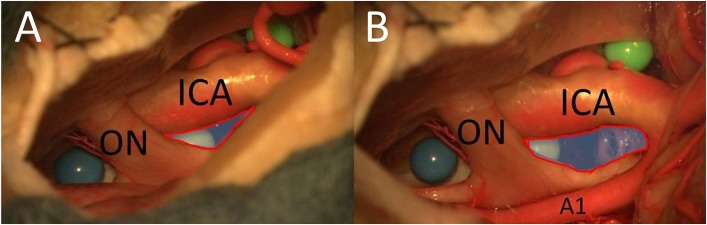
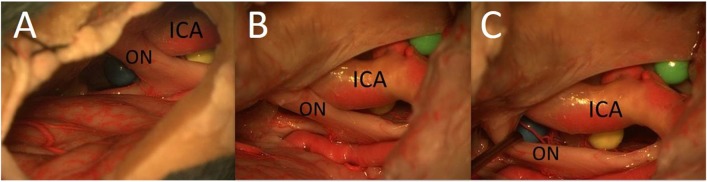
The mini-supraorbital (MSO) and pterional (PT) approaches have been compared in a number of studies focusing on the treatment of aneurysms, craniopharyngiomas, and meningiomas. The goal of this study was to analyze the surgical exposure to different artificial lesions through interoptic (IO), trans-lamina terminalis (TLT), opticocarotid triangle (OCT), and caroticosylvian (CS) windows from the MSO, frontomedial (FM), and PT perspectives. The MSO, PT, and FM approaches were performed sequentially in two fixed cadaver heads. Three colored spheres were placed around the optic chiasm: (1) between the optic nerves; (2) between the optic nerve and the internal carotid artery; and (3) between the internal carotid artery and the oculomotor nerve. The surgical exposures to these structures by using the IO, TLT, OCT, and CS windows were compared. (1) IO window: from the MSO and PT approaches, the total surgical exposure mainly allows visualization of contralateral lesions. The FM approach was superior for exploration of both sides of the area between the optic nerves. (2) TLT pathway: the MSO and PT approaches mainly expose the contralateral third ventricle wall. (3) OCT window: the PT approach allows exposure of a larger part of the sphere between the optic nerve and the internal carotid artery than the MSO approach. (4) CS window: the PT approach allows a better exposure of lateral structures such as the oculomotor nerve and of the medial prepontine area in comparison to the MSO approach. Simulation of the surgical situation with artificial lesions is a good model for comparing surgical perspectives and for analyzing feasibility of lesion exposure and resection.
在许多针对动脉瘤、颅咽管瘤和脑膜瘤治疗的研究中,已对眶上缘内侧(MSO)入路和翼点(PT)入路进行了比较。本研究的目的是从MSO、额内侧(FM)和PT视角,分析通过视交叉间(IO)、终板经路(TLT)、视颈三角(OCT)和颈内动脉-大脑外侧裂(CS)窗口对不同人工病灶的手术显露情况。在两个固定的尸体头部依次进行MSO、PT和FM入路。在视交叉周围放置三个彩色球体:(1)位于视神经之间;(2)位于视神经与颈内动脉之间;(3)位于颈内动脉与动眼神经之间。比较使用IO、TLT、OCT和CS窗口对这些结构的手术显露情况。(1)IO窗口:从MSO和PT入路来看,总的手术显露主要能看到对侧病灶。FM入路在探查视神经之间区域的两侧方面更具优势。(2)TLT路径:MSO和PT入路主要显露对侧第三脑室壁。(3)OCT窗口:与MSO入路相比,PT入路能显露视神经与颈内动脉之间球体的更大一部分。(4)CS窗口:与MSO入路相比,PT入路能更好地显露动眼神经等外侧结构以及脑桥前内侧区域。用人工病灶模拟手术情况是比较手术视角以及分析病灶显露和切除可行性的良好模型。