Department of Environmental & Occupational Health Sciences, School of Public Health, University of Washington, Seattle, Washington.
Division of Endocrinology, Metabolism and Molecular Medicine, Department of Medicine, Northwestern University Feinberg School of Medicine, Chicago, Illinois.
Am J Hum Biol. 2019 Nov;31(6):e23299. doi: 10.1002/ajhb.23299. Epub 2019 Aug 5.
We investigated the relationship between early life growth patterns and blood telomere length (TL) in adulthood using conditional measures of lean and fat mass growth to evaluate potentially sensitive periods of early life growth.
This study included data from 1562 individuals (53% male; age 20-22 years) participating in the Cebu Longitudinal Health and Nutrition Survey, located in metropolitan Cebu, Philippines. Primary exposures included length-for-age z-score (HAZ) and weight-for-age z-score (WAZ) at birth and conditional measures of linear growth and weight gain during four postnatal periods: 0-6, 6-12, and 12-24 months, and 24 months to 8.5 years. TL was measured at ~21 years of age. We estimated associations using linear regression.
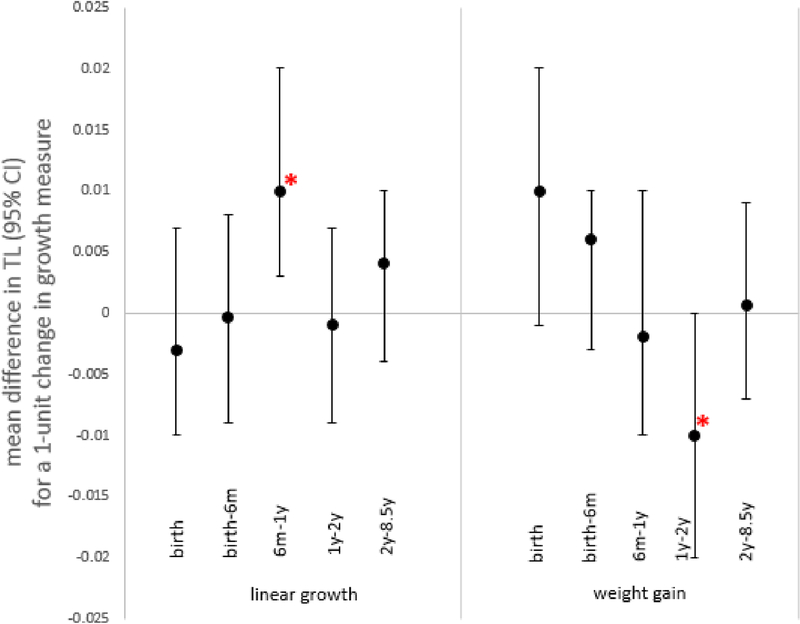
The study sample had an average gestational age (38.5 ± 2 weeks) and birth size (HAZ = -0.2 ± 1.1, WAZ = -0.7 ± 1.0), but by age 8.5 years had stunted linear growth (HAZ = -2.1 ± 0.9) and borderline low weight (WAZ = -1.9 ± 1.0) relative to World Health Organization references. Heavier birth weight was associated with longer TL in early adulthood (P = .03), but this association was attenuated when maternal age at birth was included in the model (P = .07). Accelerated linear growth between 6 and 12 months was associated with longer TL in adulthood (P = .006), whereas weight gain between 12 and 24 months was associated with shorter TL in adulthood (P = .047).
In Cebu, individuals who were born heavier have longer TL in early adulthood, but that birthweight itself may not explain the association. Findings suggest that childhood growth is associated with the cellular senescence process in adulthood, implying early life well-being may be linked to adult health.
本研究通过使用瘦组织和脂肪质量生长的条件衡量来评估生命早期生长的潜在敏感时期,研究生命早期生长模式与成年后血液端粒长度(TL)之间的关系。
本研究纳入了 1562 名参与者(53%为男性,年龄为 20-22 岁)的数据,这些参与者来自菲律宾宿务大都市的宿务纵向健康与营养调查。主要暴露因素包括出生时的身高年龄 z 评分(HAZ)和体重年龄 z 评分(WAZ),以及四个产后时期的线性生长和体重增长的条件衡量:0-6 个月、6-12 个月、12-24 个月和 24 个月至 8.5 岁。在大约 21 岁时测量 TL。我们使用线性回归来估计关联。
研究样本的平均胎龄(38.5±2 周)和出生体重(HAZ=-0.2±1.1,WAZ=-0.7±1.0),但到 8.5 岁时,相对于世界卫生组织的参考值,他们的线性生长迟缓(HAZ=-2.1±0.9)且体重处于边缘低值(WAZ=-1.9±1.0)。出生体重较重与成年早期 TL 较长相关(P=0.03),但当在模型中纳入母亲的出生年龄时,该关联减弱(P=0.07)。6-12 个月期间的线性生长加速与成年后 TL 较长相关(P=0.006),而 12-24 个月期间的体重增长与成年后 TL 较短相关(P=0.047)。
在宿务,出生体重较重的人在成年早期 TL 较长,但出生体重本身可能无法解释这种关联。研究结果表明,儿童时期的生长与成年后的细胞衰老过程有关,这意味着生命早期的健康状况可能与成年后的健康有关。