Research Center for Social Determinants of Health, Research Institute for Endocrine Sciences, Shahid Beheshti University of Medical Sciences, Tehran, Iran.
Department of Nutrition, Science and Research Branch, Islamic Azad University, Tehran, Iran.
BMC Public Health. 2019 Aug 5;19(1):1042. doi: 10.1186/s12889-019-7390-0.
Despite the strong association of smoking with cardiovascular disease (CVD) and cerebral stroke, the consequences of smoking have not been elucidated among Iranian populations. This study aimed to assess sex-specific incidence of CVDs among an urban Iranian population with different smoking habits.
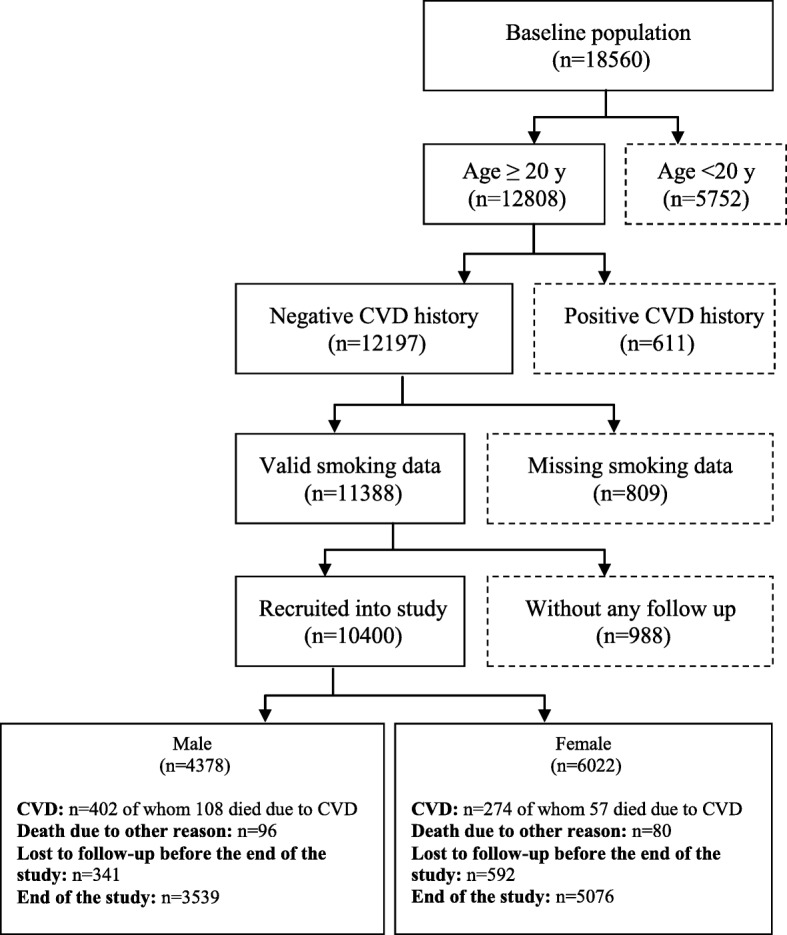
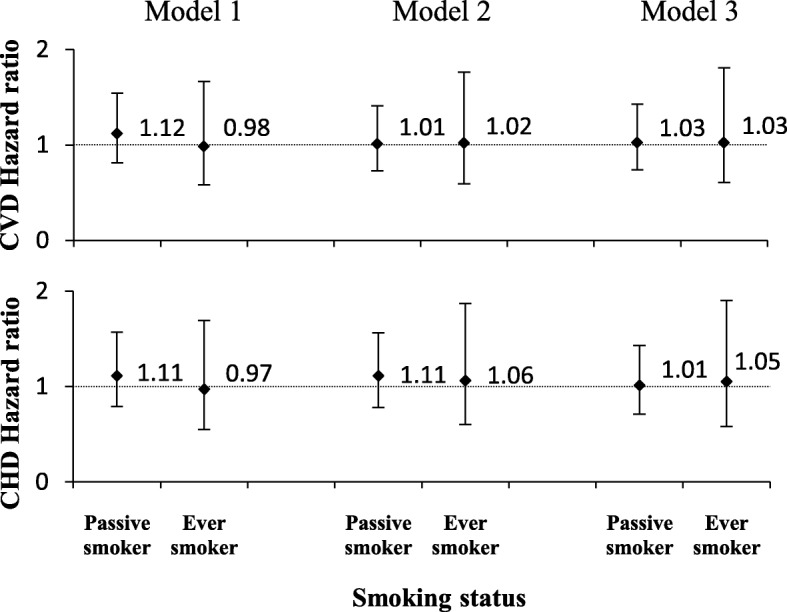
Participants were recruited from the Tehran Lipid and Glucose Study (TLGS). Data on socio-demographic features and smoking habits from a sample of 10,400 individuals (4378 men and 6022 women), aged ≥20 years without prior CVD history were analyzed. Participants were followed up for 12 years for incidence of CVD/CHD events. Men were categorized in six groups, including never-, passive, ex-, passive and ex-, occasional and daily smokers. Women were categorized in three groups, i.e. never smokers, passive smokers and ever smokers. Using cox regression model, adjusted hazard ratios (HRs) of incident CVD/CHD were calculated for each group, given never smokers as the reference.
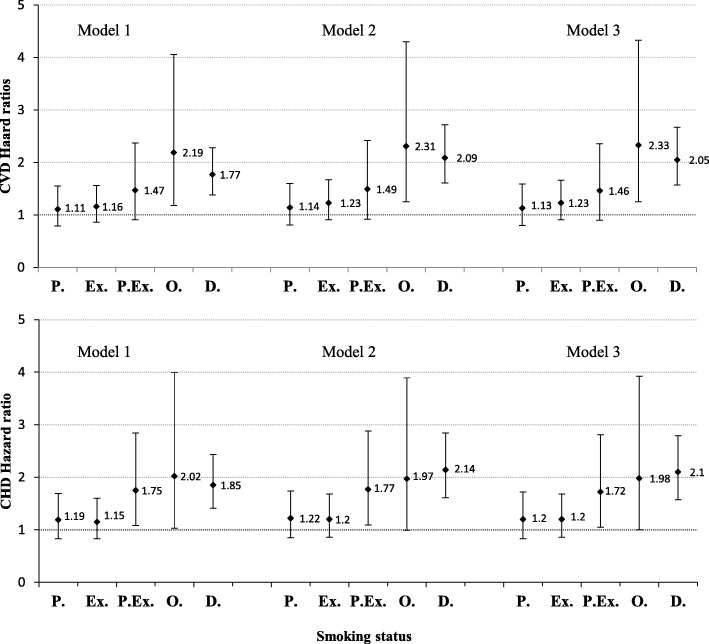
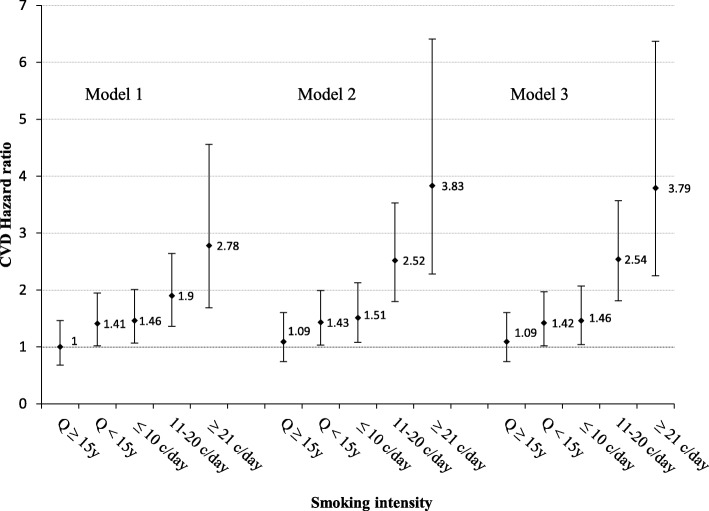
In men, HR of CVD was 1.13 (95%CI: 0.80-1.59) in passive smokers, 1.23 (95%CI: 0.91-1.66) in ex-smokers, 1.46 (95%CI: 0.90-2.36) in passive and ex-smokers, 2.33 (95%CI: 1.25-4.33) in occasional smokers and 2.05 (95%CI: 1.57-2.67) in daily smokers. In smokers of ≥21 cigarettes/day, HR of CVD was 3.79 (95%CI: 2.25-6.37), with less risk observed in those who smoked lesser numbers of cigarettes/day. Quitters of ≥15 years were almost risk free. In women, none of the HRs of CVD/CHD were significant.
An increased risk of incidence of CVD/CHD was found in current male smokers. To confirm and further elaborate these findings, more data of sex-specific studies are required from culturally diverse urban and rural areas of Iran.
尽管吸烟与心血管疾病(CVD)和脑卒中有很强的关联,但在伊朗人群中,吸烟的后果仍不清楚。本研究旨在评估不同吸烟习惯的城市伊朗人群中 CVD 的性别特异性发病率。
参与者是从德黑兰血脂和血糖研究(TLGS)中招募的。对 10400 名年龄≥20 岁且无先前 CVD 史的个体(4378 名男性和 6022 名女性)的社会人口特征和吸烟习惯数据进行了分析。对参与者进行了 12 年的 CVD/CHD 事件发病率随访。男性被分为六组,包括从不吸烟、被动吸烟、曾经吸烟、被动和曾经吸烟、偶尔吸烟和每日吸烟。女性被分为三组,即从不吸烟者、被动吸烟者和曾经吸烟者。使用 Cox 回归模型,将从不吸烟者作为参考,计算每组新发 CVD/CHD 的调整后风险比(HR)。
在男性中,被动吸烟者的 CVD 风险为 1.13(95%CI:0.80-1.59),曾经吸烟者为 1.23(95%CI:0.91-1.66),被动和曾经吸烟者为 1.46(95%CI:0.90-2.36),偶尔吸烟者为 2.33(95%CI:1.25-4.33),每日吸烟者为 2.05(95%CI:1.57-2.67)。在每天吸烟≥21 支的吸烟者中,CVD 的 HR 为 3.79(95%CI:2.25-6.37),每天吸烟较少的人风险较低。戒烟≥15 年的人几乎没有风险。在女性中,CVD/CHD 的任何 HR 均无统计学意义。
目前男性吸烟者发生 CVD/CHD 的风险增加。为了证实和进一步阐述这些发现,需要来自伊朗不同文化的城市和农村地区更多的特定性别研究数据。