Department of Statistical Genetics, Osaka University Graduate School of Medicine, 2-2 Yamadaoka, Suita, 565-0871, Japan.
Department of Neurology, Osaka University Graduate School of Medicine, Suita, 565-0871, Japan.
J Neuroinflammation. 2019 Aug 5;16(1):162. doi: 10.1186/s12974-019-1551-z.
The spectrum of classical and non-classical HLA genes related to the risk of multiple sclerosis (MS) and neuromyelitis optica spectrum disorder (NMOSD) in the Japanese population has not been studied in detail. We conducted a case-control analysis of classical and non-classical HLA genes.
We used next-generation sequencing (NGS)-based HLA genotyping methods for mapping risk for 45 MS patients, 31 NMOSD patients, and 429 healthy controls. We evaluated the association of the HLA variants with the risk of MS and NMOSD using logistic regression analysis and Fisher's exact test.
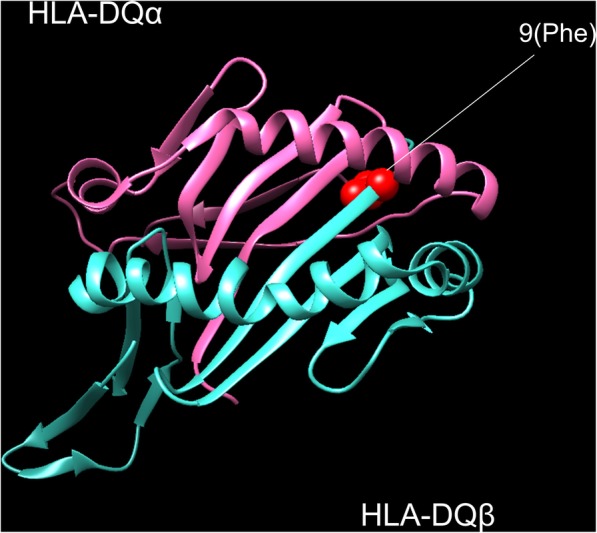
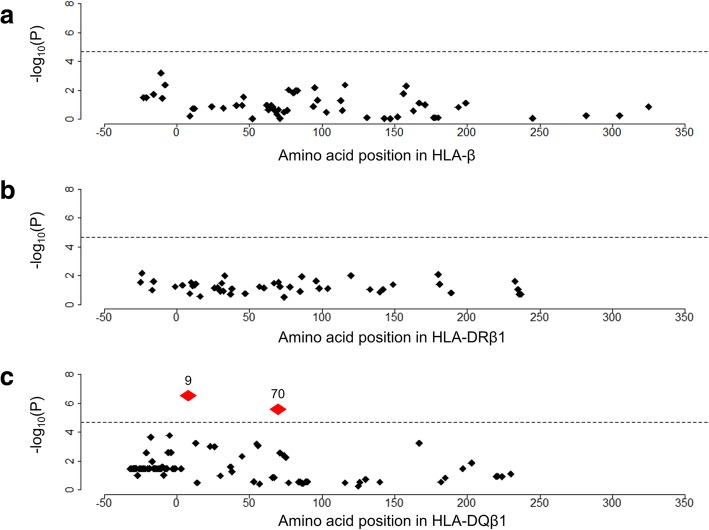
We confirmed that HLA-DRB115:01 showed the strongest association with MS (P = 2.1 × 10; odds ratio [OR] = 3.44, 95% confidence interval [95% CI] = 1.95-6.07). Stepwise conditional analysis identified HLA-DRB104:05, HLA-B39:01, and HLA-B15:01 as being associated with independent MS susceptibility (P < 8.3 × 10). With respect to amino acid polymorphisms in HLA genes, we found that phenylalanine at HLA-DQβ1 position 9 had the strongest effect on MS susceptibility (P = 3.7 × 10, OR = 3.48, 95% CI = 2.23-5.43). MS risk at HLA-DQβ1 Phe9 was independent of HLA-DRB115:01 (P = 1.5 × 10, OR = 2.91, 95% CI = 1.79-4.72), while HLA-DRB115:01 was just significant when conditioned on HLA-DQβ1 Phe9 (P = 0.037). Regarding a case-control analysis for NMOSD, HLA-DQA1*05:03 had a significant association with NMOSD (P = 1.5 × 10, OR = 6.96, 95% CI = 2.55-19.0).
We identified HLA variants associated with the risk of MS and NMOSD. Our study contributes to the understanding of the genetic architecture of MS and NMOSD in the Japanese population.
经典和非经典 HLA 基因与多发性硬化症(MS)和视神经脊髓炎谱系障碍(NMOSD)风险的相关性在日本人群中尚未得到详细研究。我们进行了经典和非经典 HLA 基因的病例对照分析。
我们使用基于下一代测序(NGS)的 HLA 基因分型方法对 45 名 MS 患者、31 名 NMOSD 患者和 429 名健康对照者进行了风险映射。我们使用逻辑回归分析和 Fisher 精确检验评估 HLA 变体与 MS 和 NMOSD 风险的关联。
我们证实 HLA-DRB115:01 与 MS 关联最强(P=2.1×10;优势比[OR] = 3.44,95%置信区间[95%CI] = 1.95-6.07)。逐步条件分析确定 HLA-DRB104:05、HLA-B39:01 和 HLA-B15:01 与独立的 MS 易感性相关(P<8.3×10)。关于 HLA 基因中的氨基酸多态性,我们发现 HLA-DQβ1 位置 9 处的苯丙氨酸对 MS 易感性的影响最强(P=3.7×10,OR=3.48,95%CI=2.23-5.43)。HLA-DQβ1 Phe9 处的 MS 风险独立于 HLA-DRB115:01(P=1.5×10,OR=2.91,95%CI=1.79-4.72),而当条件为 HLA-DQβ1 Phe9 时,HLA-DRB115:01 仅具有显著意义(P=0.037)。关于 NMOSD 的病例对照分析,HLA-DQA1*05:03 与 NMOSD 显著相关(P=1.5×10,OR=6.96,95%CI=2.55-19.0)。
我们确定了与 MS 和 NMOSD 风险相关的 HLA 变体。我们的研究有助于理解日本人群中 MS 和 NMOSD 的遗传结构。