Department of Acupuncture and Moxibustion Medicine, College of Korean Medicine, DongShin University, Naju City, 58245, Republic of Korea.
Department of Acupuncture and Moxibustion Medicine, DongShin University Gwangju Korean Medicine Hospital, 141, Wolsan-ro, Nam-gu, Gwangju City, 61619, Republic of Korea.
Trials. 2019 Aug 5;20(1):478. doi: 10.1186/s13063-019-3599-6.
Mild cognitive impairment (MCI) is defined as an intermediate stage between normal aging and Alzheimer's disease (AD), and early and easily available interventions to delay the progress of MCI to AD are necessary. Feasible complementary and alternative therapies such as electroacupuncture (EA), exercise, and cognitive training have shown some beneficial effects on MCI and AD. Here we report the protocol for a randomized controlled trial of the efficacy and safety of EA combined with computer-based cognitive rehabilitation (EA-CCR) for the treatment of MCI.
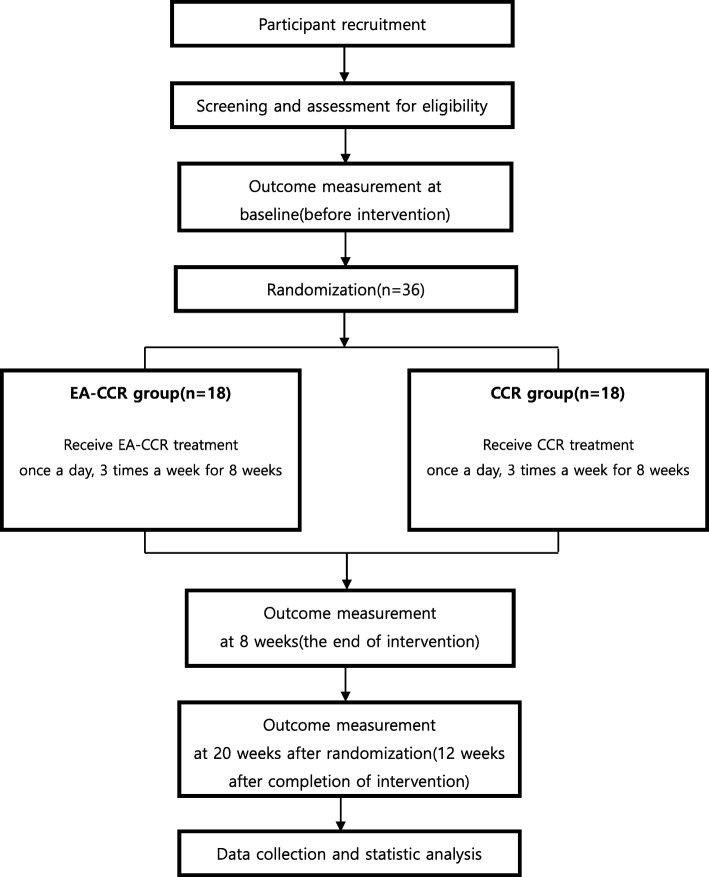
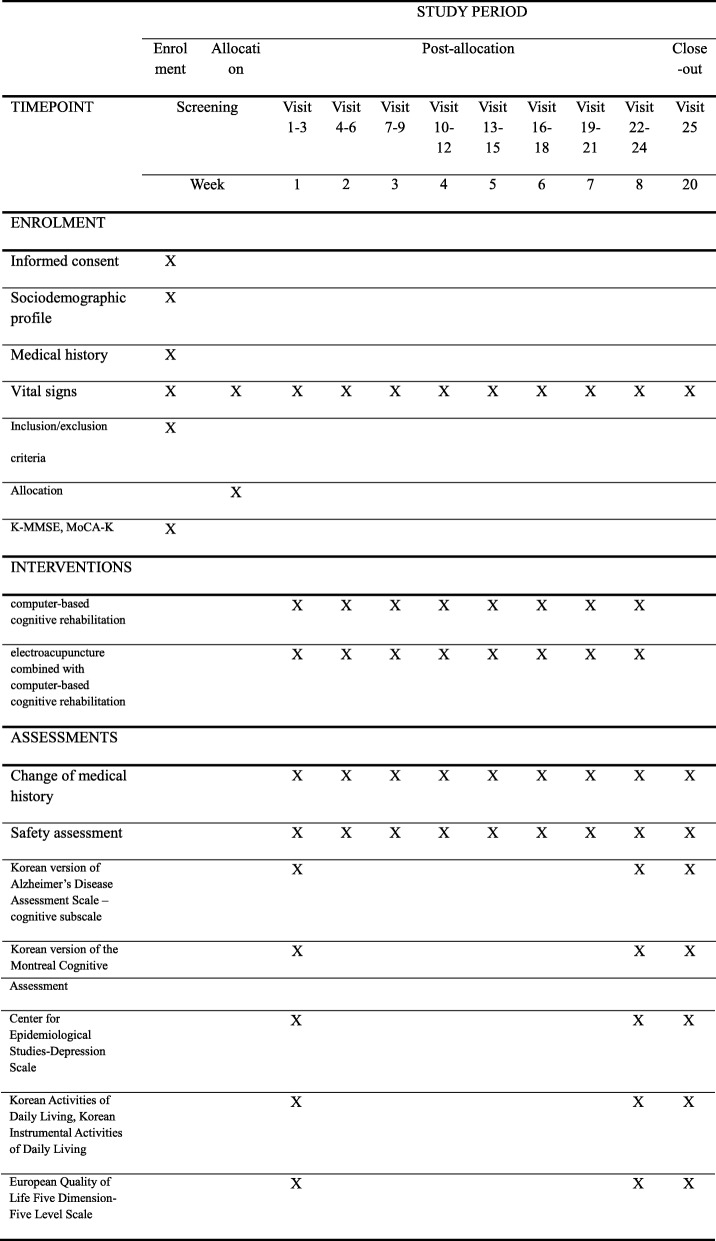
The study will be a prospective, outcome assessor-blinded, parallel-arm, single-center (DongShin University Gwangju Korean Medicine Hospital, Republic of Korea), pilot randomized controlled clinical trial with a 1:1 allocation ratio. Participants with MCI will be randomized to a computer-based cognitive rehabilitation (CCR) or an EA-CCR group (n = 18 each). The CCR group will receive RehaCom cognitive rehabilitation once (30 min) a day, 3 days per week (excluding Saturday and Sunday) for 8 weeks. The EA-CCR group will receive EA at Baihui (GV20), Sishencong (EX-HN1), Fengchi (GB20), and Shenting (GV24) in addition to RehaCom cognitive rehabilitation once (EA:30 min, CCR:30 min) a day, 3 days per week (excluding Saturday and Sunday) for 8 weeks. The primary outcome will be an improvement in cognitive function assessed using the Korean version of the Alzheimer's Disease Assessment Scale-cognitive subscale. Scores for the Korean version of the Montreal Cognitive Assessment scale, Center for Epidemiological Studies Depression Scale, Korean Activities of Daily Living scale, Korean Instrumental Activities of Daily Living scale, and European Quality of Life Five Dimension Five Level Scale will be recorded as secondary outcome measures. All scores will be recorded at baseline (before intervention), 8 weeks after the first intervention (i.e., at the end of the intervention), and 12 weeks after completion of the intervention.
The study is expected to provide preliminary evidence regarding the efficacy, safety, and usefulness of EA-CCR for the treatment of MCI.
Korea Clinical Information Service, cris.nih.go.kr, KCT0003415 . Registered on 4 January 2019. Retrospectively registered, http://cris.nih.go.kr .
轻度认知障碍(MCI)被定义为正常衰老和阿尔茨海默病(AD)之间的中间阶段,需要早期且易于实施的干预措施来延缓 MCI 向 AD 的进展。可行的补充和替代疗法,如电针(EA)、运动和认知训练,已显示出对 MCI 和 AD 的一些有益影响。在这里,我们报告了一项关于 EA 联合计算机认知康复(EA-CCR)治疗 MCI 的疗效和安全性的随机对照试验方案。
该研究将是一项前瞻性、结局评估者盲法、平行臂、单中心(韩国光州东新大学韩国医学医院)、试验性随机对照临床试验,采用 1:1 分配比例。MCI 参与者将随机分为计算机认知康复(CCR)或 EA-CCR 组(每组 18 人)。CCR 组将接受 RehaCom 认知康复治疗,每天一次(30 分钟),每周 3 天(不包括星期六和星期天),共 8 周。EA-CCR 组将在接受 RehaCom 认知康复治疗的同时接受电针治疗,穴位包括百会(GV20)、四神聪(EX-HN1)、风池(GB20)和神庭(GV24),每天一次(电针:30 分钟,认知康复:30 分钟),每周 3 天(不包括星期六和星期天),共 8 周。主要结局指标为使用阿尔茨海默病评估量表认知子量表评估的认知功能改善。次要结局指标包括蒙特利尔认知评估量表韩国版、流行病学研究中心抑郁量表、韩国日常生活活动量表、韩国工具性日常生活活动量表和欧洲生活质量五维五分量表的评分。所有评分将在基线(干预前)、第一次干预后 8 周(即干预结束时)和干预完成后 12 周记录。
该研究有望提供关于 EA-CCR 治疗 MCI 的疗效、安全性和实用性的初步证据。
韩国临床信息服务中心,cris.nih.go.kr,KCT0003415。注册于 2019 年 1 月 4 日。回顾性注册,http://cris.nih.go.kr。