INSERM, UMR_S 1148-Laboratory for Vascular Translational Science, Université de Paris, Paris, France.
Hemostase Inflammation Thrombose, INSERM, UMR_S1176, Université Paris-Sud, Université Paris-Saclay, Le Kremlin-Bicêtre, France.
Blood. 2019 Nov 7;134(19):1632-1644. doi: 10.1182/blood.2019000281.
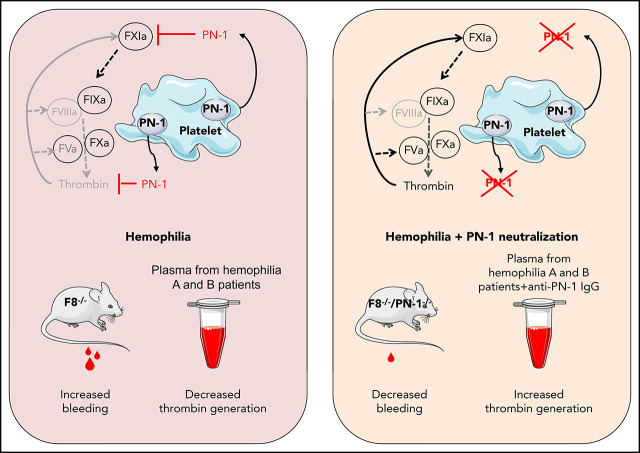
Hemophilia A and B, diseases caused by the lack of factor VIII (FVIII) and factor IX (FIX) respectively, lead to insufficient thrombin production, and therefore to bleeding. New therapeutic strategies for hemophilia treatment that do not rely on clotting factor replacement, but imply the neutralization of natural anticoagulant proteins, have recently emerged. We propose an innovative approach consisting of targeting a natural and potent thrombin inhibitor, expressed by platelets, called protease nexin-1 (PN-1). By using the calibrated automated thrombin generation assay, we showed that a PN-1-neutralizing antibody could significantly shorten the thrombin burst in response to tissue factor in platelet-rich plasma (PRP) from patients with mild or moderate hemophilia. In contrast, in PRP from patients with severe hemophilia, PN-1 neutralization did not improve thrombin generation. However, after collagen-induced platelet activation, PN-1 deficiency in F8-/-mice or PN-1 blocking in patients with severe disease led to a significantly improved thrombin production in PRP, underlining the regulatory role of PN-1 released from platelet granules. In various bleeding models, F8-/-/PN-1-/- mice displayed significantly reduced blood loss and bleeding time compared with F8-/-mice. Moreover, platelet recruitment and fibrin(ogen) accumulation were significantly higher in F8-/-/PN-1-/- mice than in F8-/-mice in the ferric chloride-induced mesenteric vessel injury model. Thromboelastometry studies showed enhanced clot stability and lengthened clot lysis time in blood from F8-/-/PN-1-/- and from patients with hemophilia A incubated with a PN-1-neutralizing antibody compared with their respective controls. Our study thus provides proof of concept that PN-1 neutralization can be a novel approach for future clinical care in hemophilia.
A 型和 B 型血友病分别由凝血因子 VIII(FVIII)和凝血因子 IX(FIX)缺乏引起,导致凝血酶生成不足,从而引起出血。最近出现了一些新的治疗血友病的策略,这些策略不依赖于凝血因子替代,而是通过中和天然抗凝蛋白来实现。我们提出了一种创新方法,靶向一种由血小板表达的天然强效凝血酶抑制剂,称为蛋白酶神经素 1(PN-1)。通过使用校准的自动凝血酶生成检测法,我们发现一种中和 PN-1 的抗体可以显著缩短富含血小板的血浆(PRP)中组织因子诱导的凝血酶爆发时间,这些 PRP 来自轻或中度血友病患者。相比之下,在严重血友病患者的 PRP 中,中和 PN-1 并不能改善凝血酶生成。然而,在 F8-/- 小鼠胶原诱导的血小板激活后,或在严重疾病患者中阻断 PN-1,会导致 PRP 中凝血酶生成显著改善,这强调了从血小板颗粒中释放的 PN-1 的调节作用。在各种出血模型中,与 F8-/- 小鼠相比,F8-/-/PN-1-/- 小鼠的失血量和出血时间明显减少。此外,在三氯化铁诱导的肠系膜血管损伤模型中,F8-/-/PN-1-/- 小鼠的血小板募集和纤维蛋白原(ogen)积累明显高于 F8-/- 小鼠。血栓弹力图研究表明,与各自的对照相比,在来自 F8-/-/PN-1-/- 小鼠和接受中和 PN-1 的抗体孵育的血友病 A 患者的血液中,血凝块稳定性增强,血凝块溶解时间延长。因此,我们的研究提供了概念验证,即中和 PN-1 可能成为未来血友病临床治疗的一种新方法。