York Teaching Hospital NHS Foundation Trust, York, UK
Royal Liverpool University Hospital, Liverpool, UK.
Br J Ophthalmol. 2020 Apr;104(4):493-499. doi: 10.1136/bjophthalmol-2019-314251. Epub 2019 Aug 5.
BACKGROUND/AIMS: Prospective data on switching anti-vascular endothelial growth factors in patients with neovascular age-related macular degeneration (nAMD) who have previously shown no/partial response are limited. This prospective study assessed the effect of switching from aflibercept to ranibizumab on anatomical and functional outcomes in patients with persistent/recurrent disease activity.
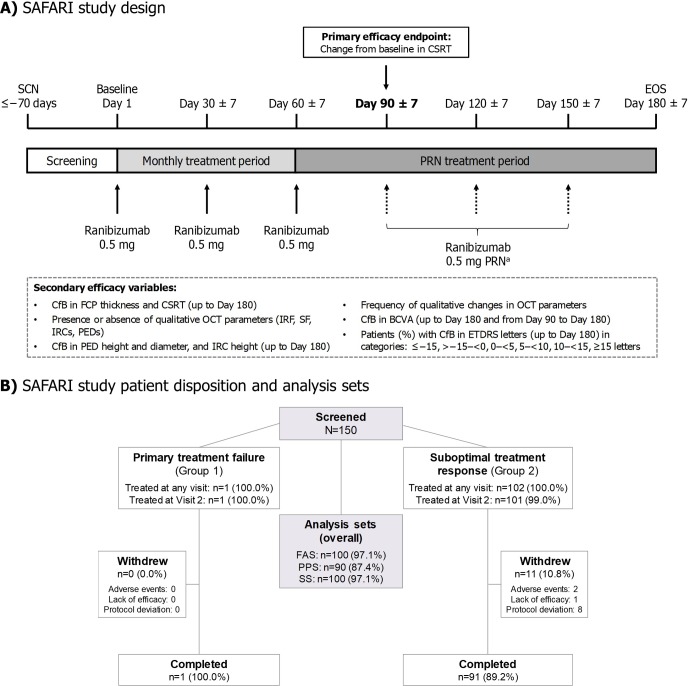
SAFARI (NCT02161575) was a 6-month, prospective, single-arm study conducted in the UK and Germany. Patients, meeting strict eligibility criteria for one of two subgroups (primary treatment failure or suboptimal treatment response), received 3 monthly intravitreal ranibizumab injections (0.5 mg). Thereafter, ranibizumab was administered pro re nata at monthly visits. The primary endpoint was change from baseline (CfB) to day 90 in central subfield retinal thickness (CSRT). Best-corrected visual acuity (BCVA) and retinal morphology parameters were assessed.
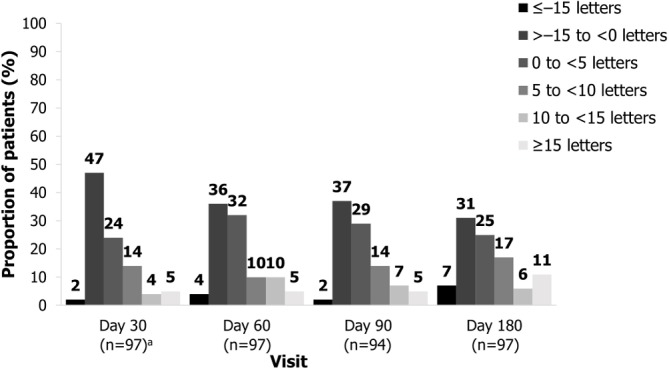
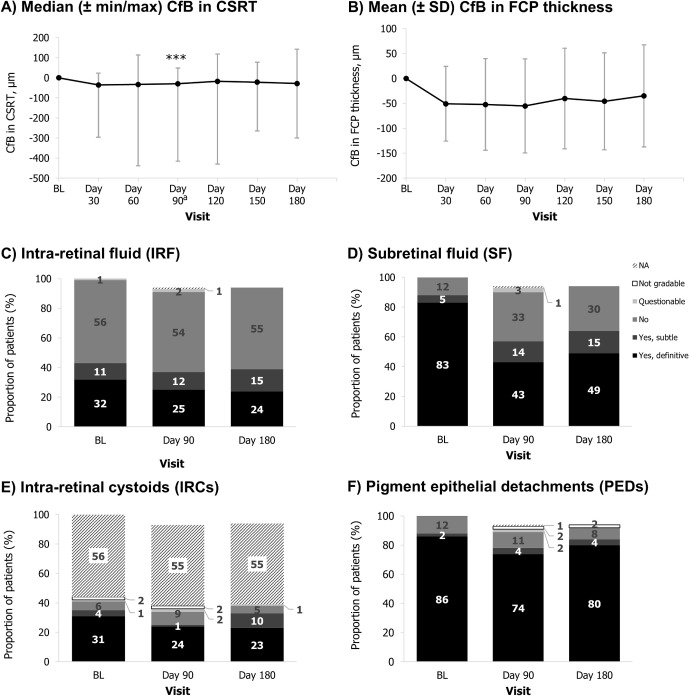
One hundred patients were enrolled (primary treatment failure, 1; suboptimal treatment response, 99). In the overall population, there was a significant CfB in median CSRT of -30.75 µm (95% CI -59.50,-20.50; p<0.0001) to day 90. Improvements were also observed in other quantitative and qualitative optical coherence tomography parameters. In Early Treatment Diabetic Retinopathy Study letters assessed by category, 55% and 59% of patients gained 0-≥15 letters versus baseline at day 90 and day 180, respectively. However, mean improvements in BCVA (CfB) to each time point were small (≤2 letters). No new safety signals were identified.
Switching from aflibercept to ranibizumab led to a significant improvement in CSRT, with ~60% experiencing stabilised/improved BCVA. Therefore, patients with nAMD who have shown a suboptimal response to aflibercept may benefit from switching to ranibizumab.
背景/目的:在先前表现为无/部分反应的新生血管性年龄相关性黄斑变性(nAMD)患者中,抗血管内皮生长因子药物转换的前瞻性数据有限。本前瞻性研究评估了从阿柏西普转换为雷珠单抗对持续性/复发性疾病活动患者的解剖和功能结局的影响。
SAFIRE(NCT02161575)是一项在英国和德国进行的 6 个月前瞻性单臂研究。患者符合两个亚组(初始治疗失败或治疗反应不佳)之一的严格入选标准,接受 3 次每月玻璃体内雷珠单抗注射(0.5mg)。此后,雷珠单抗根据每月就诊情况进行按需治疗。主要终点是从基线(CfB)到第 90 天的中心凹下视网膜厚度(CSRT)的变化。评估最佳矫正视力(BCVA)和视网膜形态参数。
共纳入 100 例患者(初始治疗失败 1 例,治疗反应不佳 99 例)。在总体人群中,第 90 天的中位数 CSRT 有显著的 CfB,为-30.75µm(95%CI-59.50,-20.50;p<0.0001)。其他定量和定性光学相干断层扫描参数也有改善。根据类别评估的早期糖尿病视网膜病变研究字母数,55%和 59%的患者在第 90 天和第 180 天时分别比基线增加了 0-≥15 个字母。然而,BCVA(CfB)在每个时间点的平均改善较小(≤2 个字母)。未发现新的安全信号。
从阿柏西普转换为雷珠单抗可显著改善 CSRT,约 60%的患者视力稳定/改善。因此,对阿柏西普反应不佳的 nAMD 患者可能从转换为雷珠单抗中获益。