Sampat Ajay, Rouleau Gerald, O'Brien Celia, Zadikoff Cindy
Department of Neurology, UC Davis School of Medicine, Sacramento, CA, USA.
College of Medicine, University of Cincinnati, Cincinnati, OH, USA.
J Med Educ Curric Dev. 2019 Jul 22;6:2382120519862782. doi: 10.1177/2382120519862782. eCollection 2019 Jan-Dec.
We sought to determine whether the following factors are associated with stronger performance on the medical school neurology clerkship: (1) structure of the outpatient rotation (working with a single general neurologist or multiple subspecialists), (2) dedicated shelf exam preparation, and (3) clerkships completed prior to neurology rotation.
A total of 439 Feinberg medical students between 2014 and 2016 were analyzed based on the 3 variables of interest listed above. Student performance was evaluated using the National Board of Medical Examiner shelf exam and Objective Structured Clinical Examination/standardized evaluation scores. Univariate and multivariate analyses were conducted.
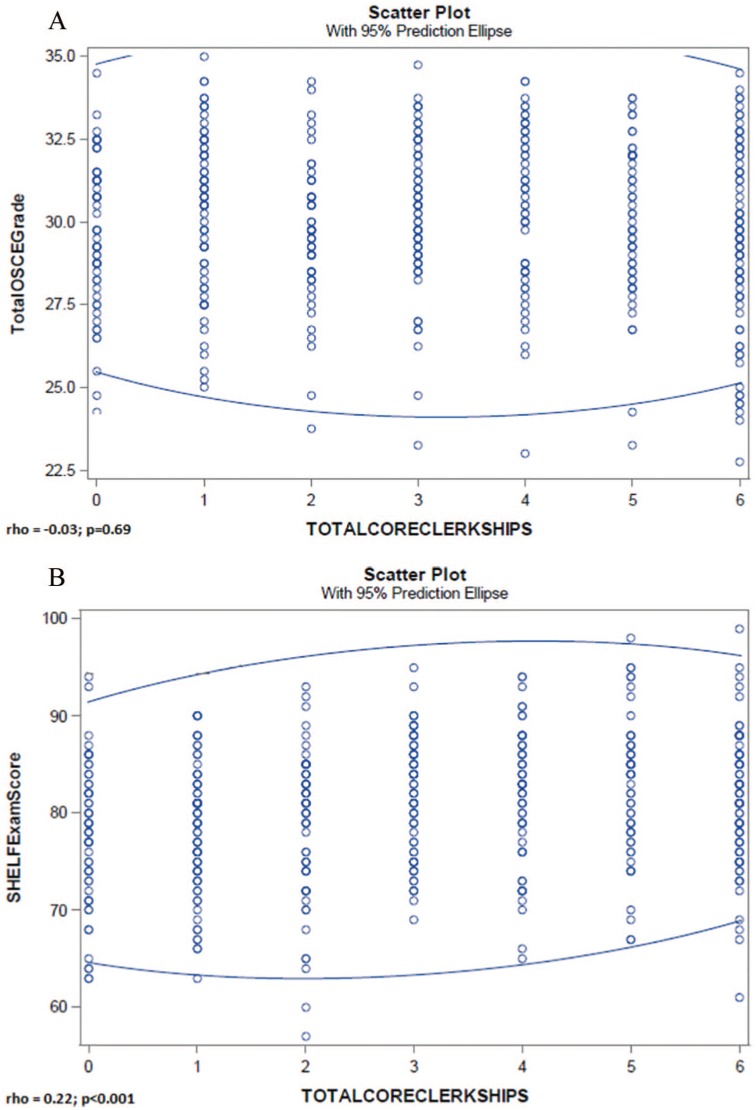
The format of the 2-week outpatient rotation did not significantly affect shelf examination ( = .59), or standardized evaluation ( = .34) scores. Taking a shelf pre-test correlated with overall higher standardized evaluation scores ( < .01), and higher shelf examination scores ( < .01). No individual clerkship correlated with better performance; however, the total number of core clerkships was associated with higher shelf examination scores ( = .007). Each additional core clerkship taken prior to neurology was associated with 0.72 points greater shelf examination score.
Greater attending continuity did not appear to be associated with stronger performance perhaps due to a difference in types of cases observed. Students who took a practice shelf exam did better on both their shelf exam and standardized evaluation, suggesting that acquisition of knowledge translates to a better clinical performance. No individual clerkship offers an advantage, but rather it is the total number of clerkships that is correlated with stronger performance.
我们试图确定以下因素是否与医学院神经科实习表现更优相关:(1)门诊轮转结构(与单一普通神经科医生合作或与多个亚专科医生合作),(2)专门的结业考试准备,以及(3)神经科轮转之前完成的实习。
基于上述列出的3个感兴趣的变量,对2014年至2016年间的439名范伯格医学院学生进行了分析。使用美国医学考试委员会结业考试和客观结构化临床考试/标准化评估分数来评估学生表现。进行了单变量和多变量分析。
为期2周的门诊轮转形式对结业考试成绩(P = 0.59)或标准化评估成绩(P = 0.34)没有显著影响。进行结业预测试与更高的总体标准化评估成绩(P < 0.01)和更高的结业考试成绩(P < 0.01)相关。没有单个实习与更好的表现相关;然而,核心实习的总数与更高的结业考试成绩相关(P = 0.007)。在神经科轮转之前每多完成一个核心实习,结业考试成绩就会高出0.72分。
更高的带教连续性似乎与更优表现无关,这可能是由于观察到的病例类型存在差异。参加过结业考试预测试的学生在结业考试和标准化评估中表现更好,这表明知识的掌握转化为了更好的临床能力。没有单个实习具有优势,而是实习的总数与更优表现相关。