Neuroscience Program, (NMZ, KMP, AP), SRI International, Menlo Park, California.
Department of Psychiatry and Behavioral Sciences, (NMZ, KMP, AP, EVS), Stanford University School of Medicine, Stanford, California.
Alcohol Clin Exp Res. 2019 Oct;43(10):2144-2152. doi: 10.1111/acer.14162. Epub 2019 Aug 23.
Among the neurological consequences of alcoholism is peripheral neuropathy. Relative to human immunodeficiency virus (HIV) or diabetes-related neuropathies, neuropathy associated with alcohol use disorders (AUD) is understudied. In both the diabetes and HIV literature, emerging evidence supports a central nervous system (CNS) component to peripheral neuropathy.
In seeking a central substrate for AUD-related neuropathy, the current study was conducted in 154 individuals with AUD (43 women, age 21 to 74 years) and 99 healthy controls (41 women, age 21 to 77 years) and explored subjective symptoms (self-report) and objective signs (perception of vibration, deep tendon ankle reflex, position sense, 2-point discrimination) of neuropathy separately. In addition to regional brain volumes, risk factors for AUD-related neuropathy, including age, sex, total lifetime ethanol consumed, nutritional indices (i.e., thiamine, folate), and measures of liver integrity (i.e., γ-glutamyltransferase), were evaluated.
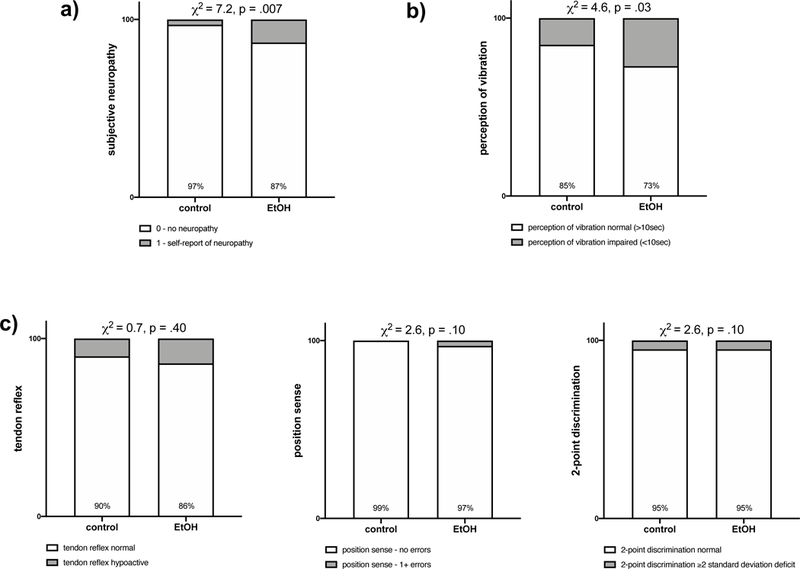
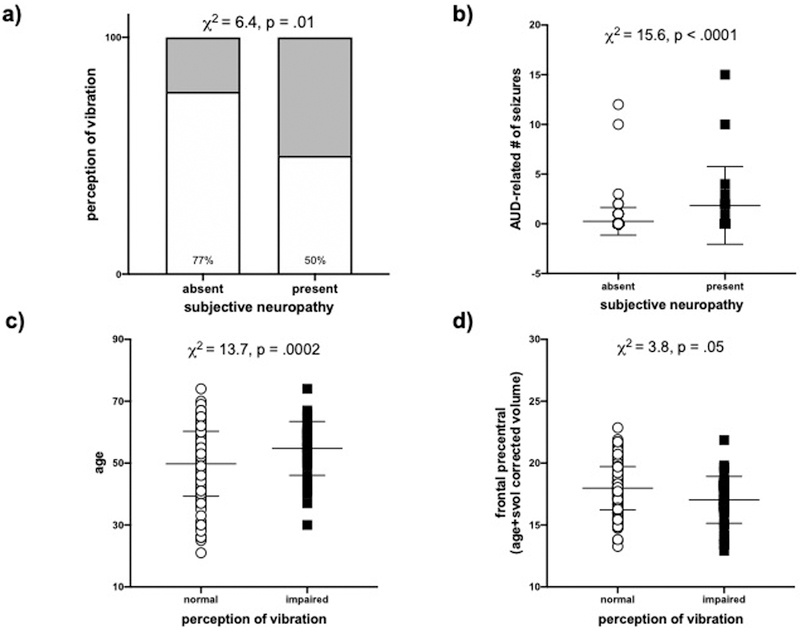
The AUD group described more subjective symptoms of neuropathy and was more frequently impaired on bilateral perception of vibration. From 5 correlates, the number of AUD-related seizures was most significantly associated with subjective symptoms of neuropathy. There were 15 correlates of impaired perception of vibration among the AUD participants: Of these, age and volume of frontal precentral cortex were the most robust predictors.
This study supports CNS involvement in objective signs of neuropathy in AUD.
酒精中毒的神经学后果之一是周围神经病变。与人类免疫缺陷病毒(HIV)或糖尿病相关的神经病变相比,与酒精使用障碍(AUD)相关的神经病变研究较少。在糖尿病和 HIV 文献中,越来越多的证据支持周围神经病变的中枢神经系统(CNS)成分。
为了寻找 AUD 相关神经病的中枢底物,本研究对 154 名 AUD 患者(43 名女性,年龄 21 至 74 岁)和 99 名健康对照者(41 名女性,年龄 21 至 77 岁)进行了研究,分别探讨了神经病的主观症状(自我报告)和客观体征(振动感知、深腱反射、位置感、两点辨别)。除了区域脑体积外,还评估了与 AUD 相关神经病的危险因素,包括年龄、性别、终生乙醇摄入量、营养指标(即硫胺素、叶酸)和肝脏完整性指标(即γ-谷氨酰转移酶)。
AUD 组描述了更多的周围神经病主观症状,双侧振动感知障碍更为频繁。在 5 个相关因素中,AUD 相关癫痫发作次数与周围神经病主观症状最显著相关。AUD 组中有 15 个与振动感知障碍相关的因素:其中,年龄和额前中央皮质体积是最有力的预测因素。
本研究支持 AUD 中 CNS 参与周围神经病的客观体征。