Department of Translational Research and New Technologies in Medicine and Surgery, University of Pisa, via Roma 55, 56126, Pisa, Italy.
I.R.C.C.S. Neuromed, via Atinense 18, 86077 Pozzilli (IS), Italy.
Int J Mol Sci. 2019 Aug 5;20(15):3824. doi: 10.3390/ijms20153824.
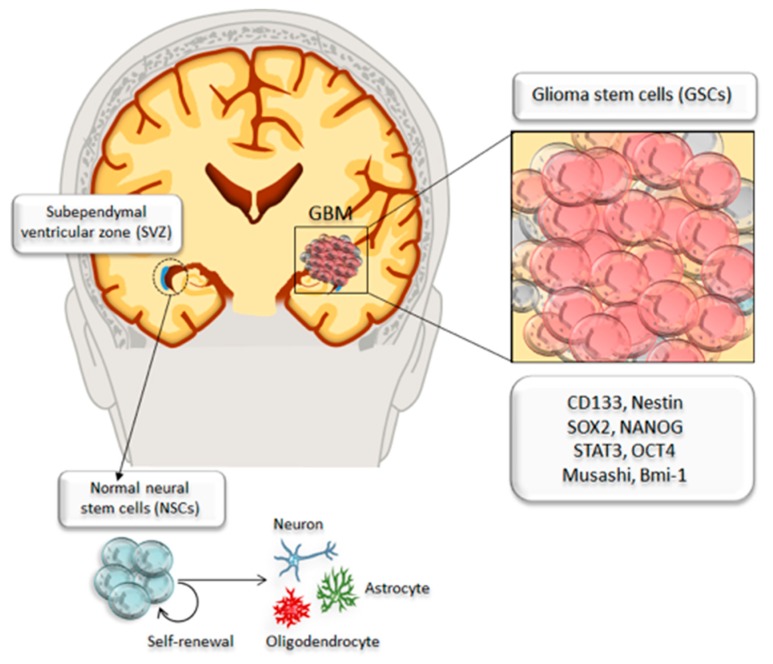
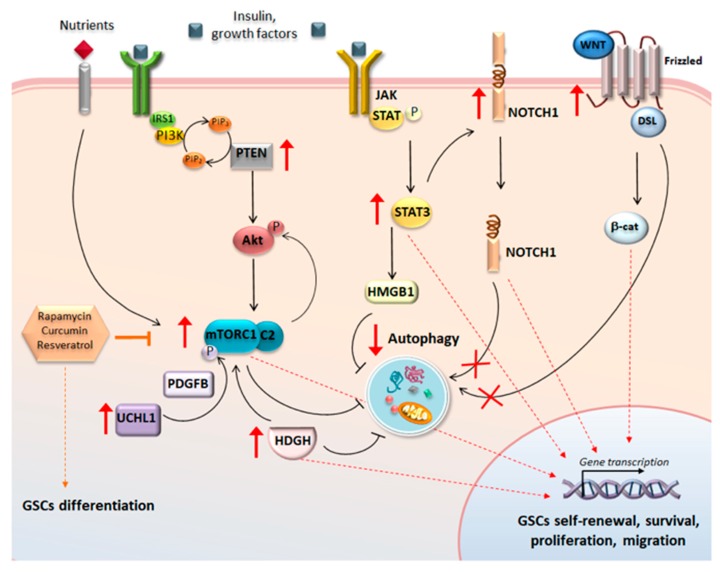
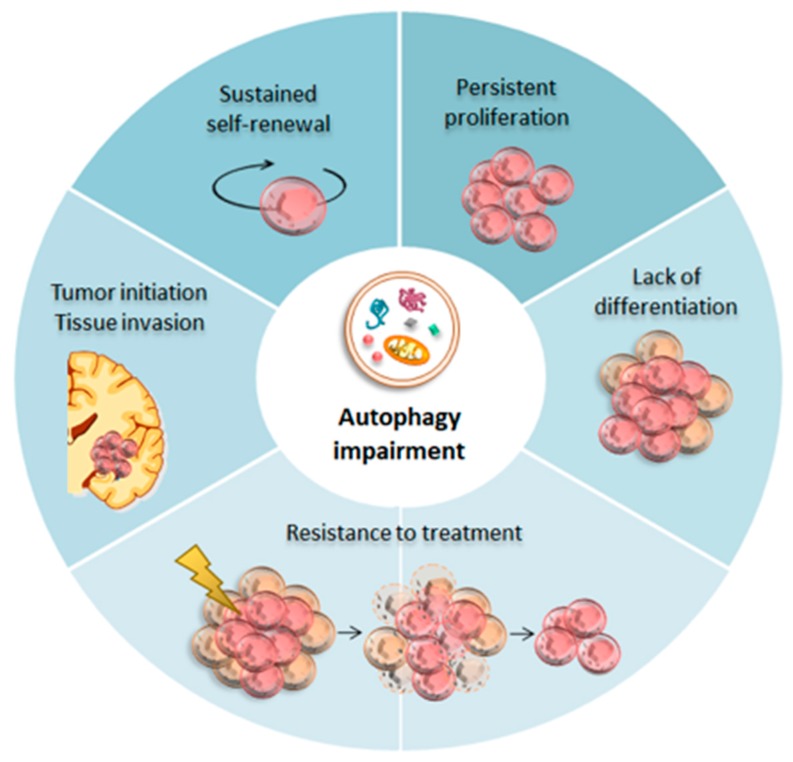
Glioblastoma multiforme (GBM) is the most common and aggressive primary brain tumor featuring rapid cell proliferation, treatment resistance, and tumor relapse. This is largely due to the coexistence of heterogeneous tumor cell populations with different grades of differentiation, and in particular, to a small subset of tumor cells displaying stem cell-like properties. This is the case of glioma stem cells (GSCs), which possess a powerful self-renewal capacity, low differentiation, along with radio- and chemo-resistance. Molecular pathways that contribute to GBM stemness of GSCs include mTOR, Notch, Hedgehog, and Wnt/β-catenin. Remarkably, among the common biochemical effects that arise from alterations in these pathways, autophagy suppression may be key in promoting GSCs self-renewal, proliferation, and pluripotency maintenance. In fact, besides being a well-known downstream event of mTOR hyper-activation, autophagy downregulation is also bound to the effects of aberrantly activated Notch, Hedgehog, and Wnt/β-catenin pathways in GBM. As a major orchestrator of protein degradation and turnover, autophagy modulates proliferation and differentiation of normal neuronal stem cells (NSCs) as well as NSCs niche maintenance, while its failure may contribute to GSCs expansion and maintenance. Thus, in the present review we discuss the role of autophagy in GSCs metabolism and phenotype in relationship with dysregulations of a variety of NSCs controlling pathways, which may provide novel insights into GBM neurobiology.
多形性胶质母细胞瘤(GBM)是最常见和侵袭性的原发性脑肿瘤,其特征是细胞增殖迅速、治疗耐药和肿瘤复发。这主要是由于存在具有不同分化程度的异质性肿瘤细胞群体,特别是一小部分具有干细胞样特性的肿瘤细胞。这就是神经胶质瘤干细胞(GSCs)的情况,它们具有强大的自我更新能力、低分化能力以及放射和化疗耐药性。导致 GSCs 肿瘤干性的分子途径包括 mTOR、Notch、Hedgehog 和 Wnt/β-catenin。值得注意的是,在这些途径改变引起的常见生化效应中,自噬抑制可能是促进 GSCs 自我更新、增殖和多能性维持的关键。事实上,除了作为 mTOR 过度激活的一个众所周知的下游事件之外,自噬下调也与 GBM 中异常激活的 Notch、Hedgehog 和 Wnt/β-catenin 途径的作用有关。作为蛋白质降解和周转的主要协调者,自噬调节正常神经干细胞(NSCs)的增殖和分化以及 NSCs 生态位的维持,而其失败可能导致 GSCs 的扩增和维持。因此,在本综述中,我们讨论了自噬在 GSCs 代谢和表型中的作用与各种 NSCs 控制途径的失调之间的关系,这可能为 GBM 神经生物学提供新的见解。