Healthy Ageing Research Consortium, Registry of Older South Australians, South Australian Health and Medical Research Institute, North Terrace, PO Box: 11060, Adelaide, SA, 5001, Australia.
Institute for Choice, University of South Australia, Adelaide, Australia.
BMC Geriatr. 2019 Aug 6;19(1):213. doi: 10.1186/s12877-019-1209-9.
Aged care support services in Australia are delivered through home care packages, permanent residential care, respite care and transition care. This study aimed to determine age and gender specific incidence rates of aged care service utilisation in Australia between 2008-09 and 2015-16.
This is a population-based epidmiological study of people accessing aged care services in Australia. The trends and characteristics of people (over the age of 65 years old) accessing aged care services in Australia were evaluated, using data (2008-09 and 2015-16) from the Australian Institute of Health and Welfare and Australian Bureau of Statistics. The yearly utilisation incidence rates (per 1000 people) per service type were calculated and changes in incidence rate ratios (IRR) of service utilisation for the study period were estimated using Poisson regression models.
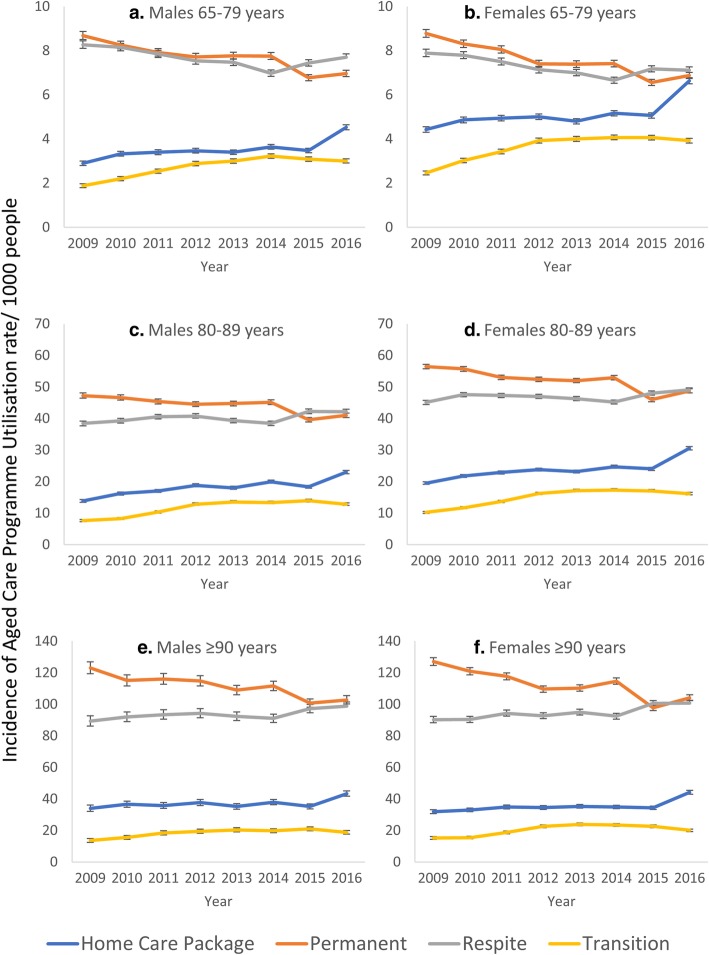
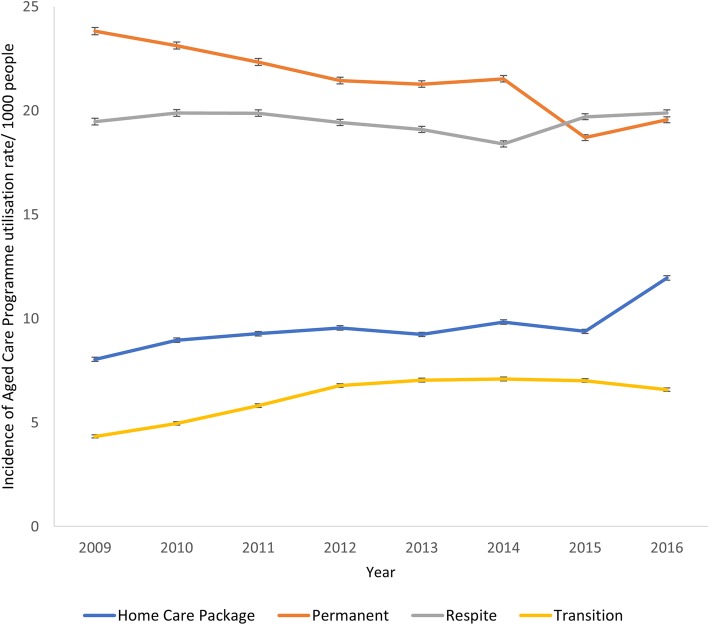
The proportion of older Australians aged ≥65 years who used aged care services remained similar between 2008-09 (5.4%, N = 208,247) and 2015-16 (5.6%, N = 248,669). However, the incidence use of specific services changed during the study period. Specifically, admissions into permanent residential care decreased (from 23.8/1000 people in 2008-09 to 19.6/1000 in 2015-16, at a IRR of 0.84/year, p < 0.001) but increased for transition care (from 4.3/1000 in 2008-09 to 6.6/1000 in 2015-16, at a IRR of 1.57/year, p < 0.001) and home care packages (from 8.04/1000 in 2008-09 to 12.0/1000 per 1000 in 2015-16, at a IRR of 1.52/year, p < 0.001). Between 2008-09 and 2015-16, the greatest changes in IRR were observed in males aged 80-89 years accessing transition care (IRR = 1.68/year, p < 0.001). A higher proportion of people aged between 80-89 years (≥45%), females (≥60%), Australia born (≥ 60%) and English speakers (≥80%) used all the service types.
Patterns of service utilisation for aged care services changed over the study period with a decrease in incidence of individuals accessing permanent residential care but increased for other service types. This finding reflects changes in attitudes regarding ageing in place and policies. These findings are helpful to inform key stakeholders on service planning to further improve quality of the aged-care services in Australia.
澳大利亚的老年护理支持服务通过家庭护理包、永久性住宿护理、临时护理和过渡护理提供。本研究旨在确定 2008-09 年至 2015-16 年期间澳大利亚老年护理服务利用的年龄和性别特定发病率。
这是一项针对澳大利亚接受老年护理服务人群的基于人群的流行病学研究。使用澳大利亚卫生与福利研究所和澳大利亚统计局的数据(2008-09 年和 2015-16 年),评估了澳大利亚老年人(65 岁以上)接受老年护理服务的趋势和特征。计算了每类服务的年利用率发病率(每 1000 人),并使用泊松回归模型估计了研究期间服务利用率发病率比(IRR)的变化。
2008-09 年(5.4%,N=208247)和 2015-16 年(5.6%,N=248669)期间,≥65 岁的澳大利亚老年人使用老年护理服务的比例保持相似。然而,在此期间,特定服务的使用发病率发生了变化。具体来说,永久性住宿护理的入院人数减少(从 2008-09 年的 23.8/1000 人降至 2015-16 年的 19.6/1000 人,IRR 为 0.84/年,p<0.001),但过渡护理的入院人数增加(从 2008-09 年的 4.3/1000 人增加到 2015-16 年的 6.6/1000 人,IRR 为 1.57/年,p<0.001)和家庭护理包(从 2008-09 年的 8.04/1000 人增加到 2015-16 年的 12.0/1000 人,IRR 为 1.52/年,p<0.001)。2008-09 年至 2015-16 年期间,80-89 岁男性接受过渡护理的 IRR 变化最大(IRR=1.68/年,p<0.001)。年龄在 80-89 岁之间(≥45%)、女性(≥60%)、澳大利亚出生(≥60%)和英语使用者(≥80%)的人使用所有服务类型的比例更高。
在研究期间,老年护理服务的利用模式发生了变化,永久性住宿护理的发病率下降,但其他服务类型的发病率上升。这一发现反映了对就地老龄化和政策的态度变化。这些发现有助于为利益相关者提供有关服务规划的信息,以进一步提高澳大利亚老年护理服务的质量。