Heister Thomas, Wolkewitz Martin, Hehn Philip, Wolff Jan, Dettenkofer Markus, Grundmann Hajo, Kaier Klaus
1Institute of Medical Biometry and Statistics, Faculty of Medicine and Medical Center, University of Freiburg, Stefan-Meier-Str. 26, 79104 Freiburg, Germany.
2Department of Psychiatry and Psychotherapy, Faculty of Medicine and Medical Center, University of Freiburg, Freiburg, Germany.
Cost Eff Resour Alloc. 2019 Aug 1;17:16. doi: 10.1186/s12962-019-0184-5. eCollection 2019.
Hospital-acquired infections have not only gained increasing attention clinically, but also methodologically, as a time-varying exposure. While methods to appropriately estimate extra length of stay (LOS) have been established and are increasingly used in the literature, proper estimation of cost figures has lagged behind.
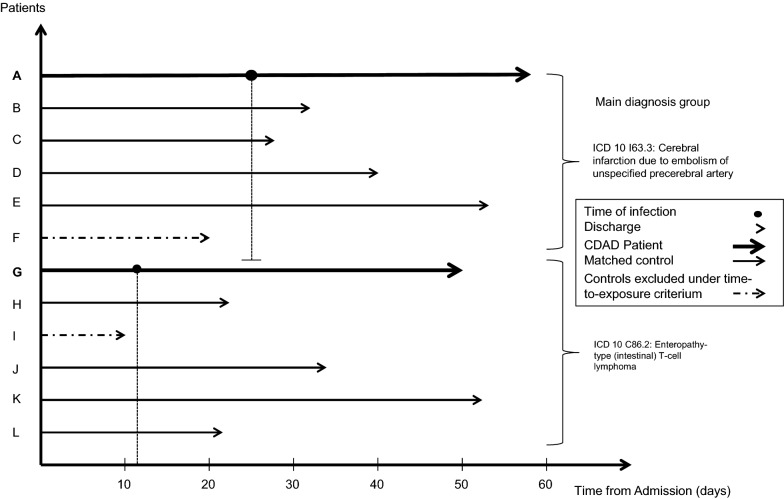
Analysing the additional costs and reimbursements of -infections (CDI), we use a within-main-diagnosis-time-to-exposure stratification approach to incorporate time-varying exposures in a regression model, while at the same time accounting for cost clustering within diagnosis groups.
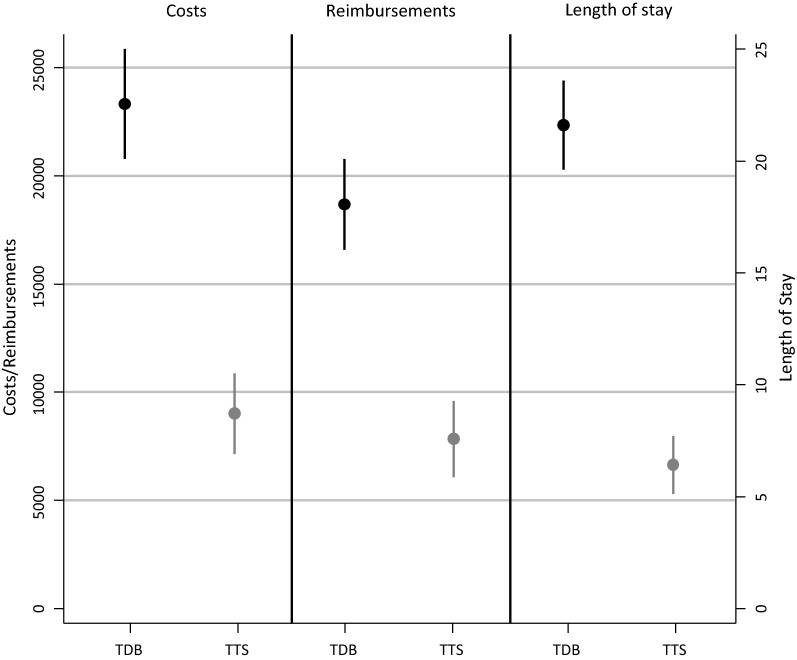
We find that CDI is associated with €9000 of extra costs, €7800 of higher reimbursements, and 6.4 days extra length of stay. Using a conventional method, which suffers from time-dependent bias, we derive estimates more than three times as high (€23,000, €8000, 21 days respectively). We discuss our method in the context of recent methodological advances in the estimation of the costs of hospital-acquired infections.
CDI is associated with sizeable in-hospital costs. Neglecting the methodological particularities of hospital-acquired infections can however substantially bias results. As the data needed for an appropriate analysis are collected routinely in most hospitals, we recommend our approach as a feasible way for estimating the economic impact of time-varying adverse events during hospital stay.
医院获得性感染不仅在临床上受到越来越多的关注,而且在方法学上,作为一种随时间变化的暴露因素,也受到了更多关注。虽然已经建立了适当估计额外住院时间(LOS)的方法,并且在文献中越来越多地被使用,但成本数据的正确估计却滞后了。
通过分析艰难梭菌感染(CDI)的额外成本和报销情况,我们采用主要诊断至暴露时间分层方法,将随时间变化的暴露因素纳入回归模型,同时考虑诊断组内的成本聚类情况。
我们发现,CDI与9000欧元的额外成本、7800欧元的更高报销额以及6.4天的额外住院时间相关。使用一种存在时间依赖性偏差的传统方法,我们得出的估计值分别高出三倍多(分别为23000欧元、8000欧元、21天)。我们在医院获得性感染成本估计的最新方法进展背景下讨论了我们的方法。
CDI与相当可观的住院成本相关。然而,忽视医院获得性感染的方法学特殊性可能会使结果产生重大偏差。由于大多数医院会常规收集进行适当分析所需的数据,我们建议将我们的方法作为估计住院期间随时间变化的不良事件经济影响的一种可行方法。