Yasuoka Yuuri, Tando Yukiko, Kubokawa Kaoru, Taira Masanori
1Department of Biological Sciences, Graduate School of Science, University of Tokyo, 7-3-1 Hongo, Bunkyo-ku, Tokyo, 113-0033 Japan.
2Marine Genomics Unit, Okinawa Institute of Science and Technology Graduate University, 1919-1 Tancha, Onna-son, Okinawa, 904-0495 Japan.
Zoological Lett. 2019 Aug 2;5:27. doi: 10.1186/s40851-019-0143-1. eCollection 2019.
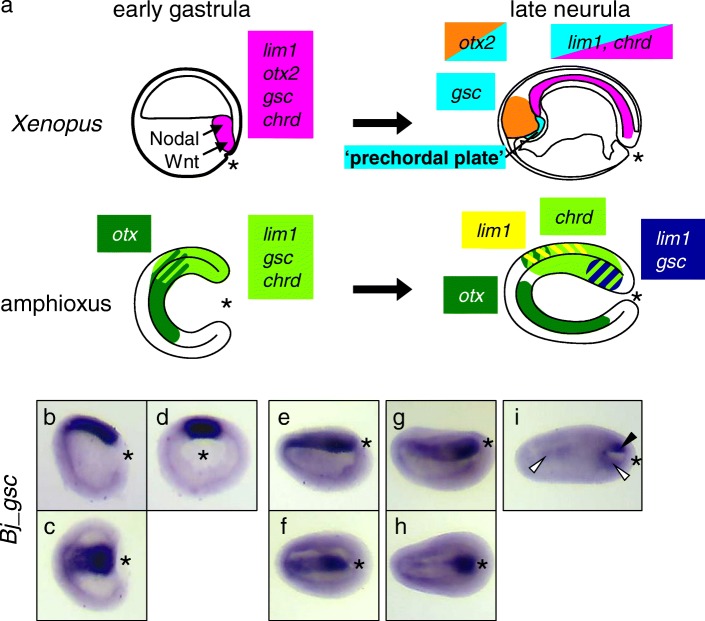
In cephalochordates (amphioxus), the notochord runs along the dorsal to the anterior tip of the body. In contrast, the vertebrate head is formed anterior to the notochord, as a result of head organizer formation in anterior mesoderm during early development. A key gene for the vertebrate head organizer, , is broadly expressed in the dorsal mesoderm of amphioxus gastrula. Amphioxus expression subsequently becomes restricted to the posterior notochord from the early neurula. This has prompted the hypothesis that a change in expression patterns of led to development of the vertebrate head during chordate evolution. However, molecular mechanisms of head organizer evolution involving have never been elucidated.
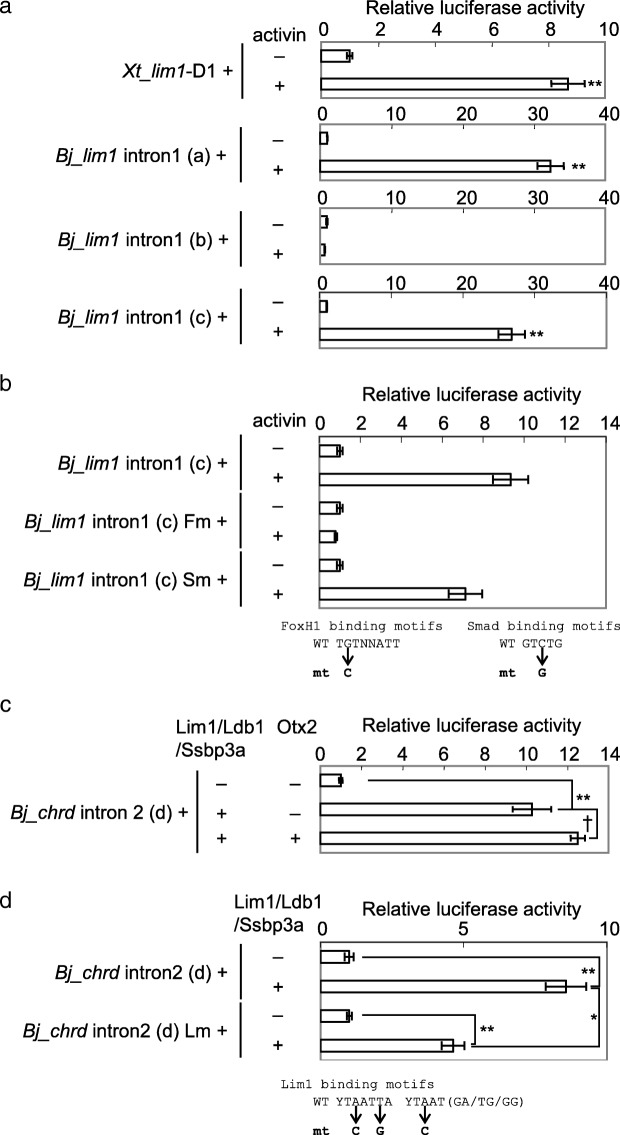
To address this question, we compared cis-regulatory modules of vertebrate organizer genes between amphioxus, , and frogs, and . Here we show conservation and diversification of gene regulatory mechanisms through cis-regulatory modules for , , and in and . Reporter analysis using embryos demonstrates that activation of by Nodal/FoxH1 signal through the 5' upstream region, that of by Nodal/FoxH1 signal through the first intron, and that of by Lim1 through the second intron, are conserved between amphioxus and . However, activation of by Lim1 and Otx through the 5' upstream region in are not conserved in amphioxus. Furthermore, the 5' region of amphioxus recapitulated the amphioxus-like posterior mesoderm expression of the reporter gene in transgenic embryos.
On the basis of this study, we propose a model, in which the gene acquired the cis-regulatory module bound with Lim1 and Otx at its 5' upstream region to be activated persistently in anterior mesoderm, in the vertebrate lineage. Because Gsc globally represses trunk (notochord) genes in the vertebrate head organizer, this cooption of in vertebrates appears to have resulted in inhibition of trunk genes and acquisition of the head organizer and its derivative prechordal plate.
在头索动物(文昌鱼)中,脊索沿着身体的背侧延伸至前端。相比之下,脊椎动物的头部是在早期发育过程中由前中胚层形成头部组织者后,在脊索前方形成的。脊椎动物头部组织者的一个关键基因,在文昌鱼原肠胚的背侧中胚层广泛表达。文昌鱼的表达随后从早期神经胚开始局限于后脊索。这引发了一种假说,即在脊索动物进化过程中,该基因表达模式的变化导致了脊椎动物头部的发育。然而,涉及该基因的头部组织者进化的分子机制从未得到阐明。
为了解决这个问题,我们比较了文昌鱼、和青蛙、中脊椎动物组织者基因的顺式调控模块。在这里,我们展示了通过文昌鱼和中、和的顺式调控模块,基因调控机制的保守性和多样性。使用胚胎的报告基因分析表明,通过5'上游区域由Nodal/FoxH1信号激活,通过第一个内含子由Nodal/FoxH1信号激活,以及通过第二个内含子由Lim1激活,在文昌鱼和之间是保守的。然而,在中由Lim1和Otx通过5'上游区域激活在文昌鱼中并不保守。此外,文昌鱼的5'区域在转基因胚胎中重现了报告基因类似文昌鱼的后中胚层表达。
基于这项研究,我们提出了一个模型,其中基因在其5'上游区域获得了与Lim1和Otx结合的顺式调控模块,从而在脊椎动物谱系的前中胚层中持续被激活。因为Gsc在脊椎动物头部组织者中全局抑制躯干(脊索)基因,所以该基因在脊椎动物中的这种借用似乎导致了躯干基因的抑制以及头部组织者及其衍生物前索板的获得。