Hajizadeh Yaghoub, Mokhtari Mehdi, Faraji Maryam, Abdolahnejad Ali, Mohammadi Amir
Environment Research Center, Research Institute for Primordial Prevention of Non-Communicable Disease, Isfahan University of Medical Sciences, Isfahan, Iran.
Environmental Science and Technology Research Center, Department of Environmental Health Engineering, Shahid Sadoughi University of Medical Sciences, Yazd, Iran.
MethodsX. 2019 Jul 20;6:1694-1700. doi: 10.1016/j.mex.2019.07.019. eCollection 2019.
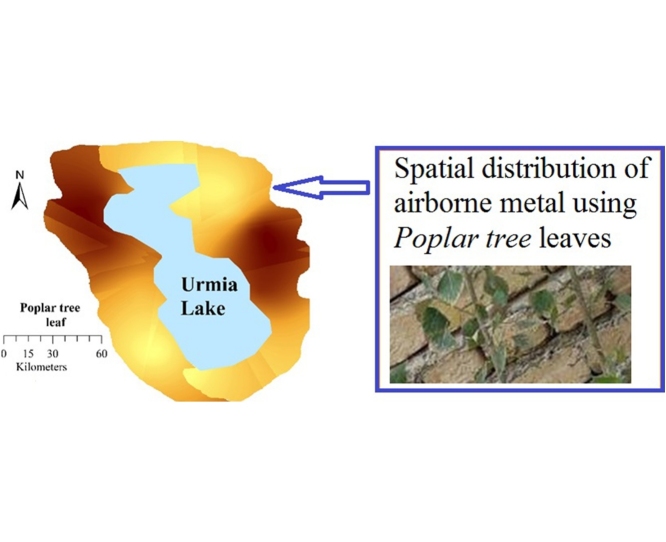
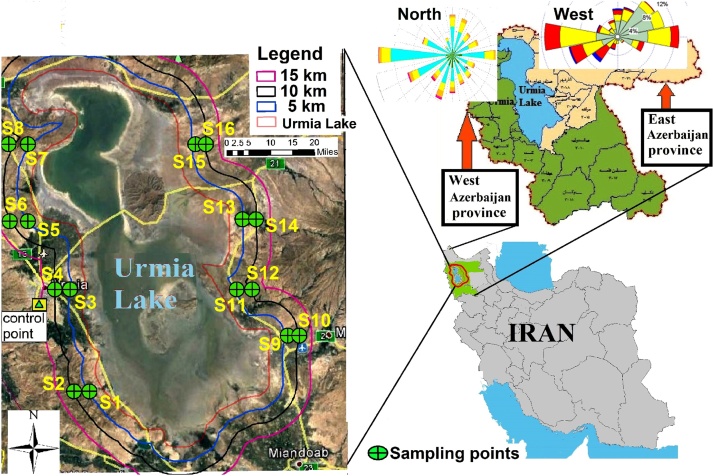
In northwest of Iran, airborne particulate matter originated from drying Urmia Lake is threaten the health of surrounding communities due to salt particles and heavy metals. This study aimed to use leave of local trees for biomonitoring of toxic metals and to evaluate tolerance of the trees against air pollution due to greenbelt development. Leaf samples were taken from four dominant tree species including and in two radial distances (5 and 10 km) around the Urmia Lake in 32 sampling sites. The concentration of Cd, Pb, Ni, As, Cu, Zn and Na in the leaves were extracted according to method 3050B defined by United States Environmental Protection Agency (USEPA) and analyzed by ICP-AES technique. According to the levels of air pollution tolerance index (APTI), was classified as more sensitive and as moderately tolerant. The accumulation/existence of metals in the leaves can be arranged as follows: Na > Zn > Cu > Ni > Pb > As > Cd. Our findings showed that can be applied as a local biomonitor and can be used as a good sink of air pollutants for greenbelt development around the drying Urmia Lake. •The results show that APTI is a suitable index for selection of tree species as biomonitor and green belt development.•Determination of metal concentration level in local tree leaves is suggested as a good tool for mapping of airborne metal.•The local trees can be suitable for development of greenbelt in order to improve air quality, and for biomonitoring of air pollution.
在伊朗西北部,源于乌尔米耶湖干涸的空气中的颗粒物因盐粒和重金属而威胁着周边社区居民的健康。本研究旨在利用当地树木的叶子对有毒金属进行生物监测,并评估由于绿化带建设树木对空气污染的耐受性。在乌尔米耶湖周围两个径向距离(5公里和10公里)的32个采样点,从包括[具体树种1]和[具体树种2]在内的四种优势树种采集叶子样本。根据美国环境保护局(USEPA)定义的方法3050B提取叶子中镉、铅、镍、砷、铜、锌和钠的浓度,并通过电感耦合等离子体发射光谱(ICP - AES)技术进行分析。根据空气污染耐受指数(APTI)水平,[树种1]被归类为更敏感,[树种2]为中等耐受性。叶子中金属的积累/存在情况如下:钠>锌>铜>镍>铅>砷>镉。我们的研究结果表明,[树种1]可作为当地生物监测器,[树种2]可作为乌尔米耶湖干涸周边绿化带建设中空气污染物的良好吸纳者。•结果表明,APTI是选择作为生物监测器的树种和绿化带建设的合适指标。•建议测定当地树叶中的金属浓度水平作为绘制空气中金属分布图的良好工具。•当地树木适合用于绿化带建设以改善空气质量,[树种1]适合用于空气污染的生物监测。