Aoki Dan, Okumura Wakaba, Akita Takuya, Matsushita Yasuyuki, Yoshida Masato, Sano Yuzou, Fukushima Kazuhiko
Graduate School of Bioagricultural Sciences Nagoya University Nagoya Japan.
Research Faculty of Agriculture Hokkaido University Sapporo Japan.
Plant Direct. 2019 Aug 2;3(8):e00155. doi: 10.1002/pld3.155. eCollection 2019 Aug.
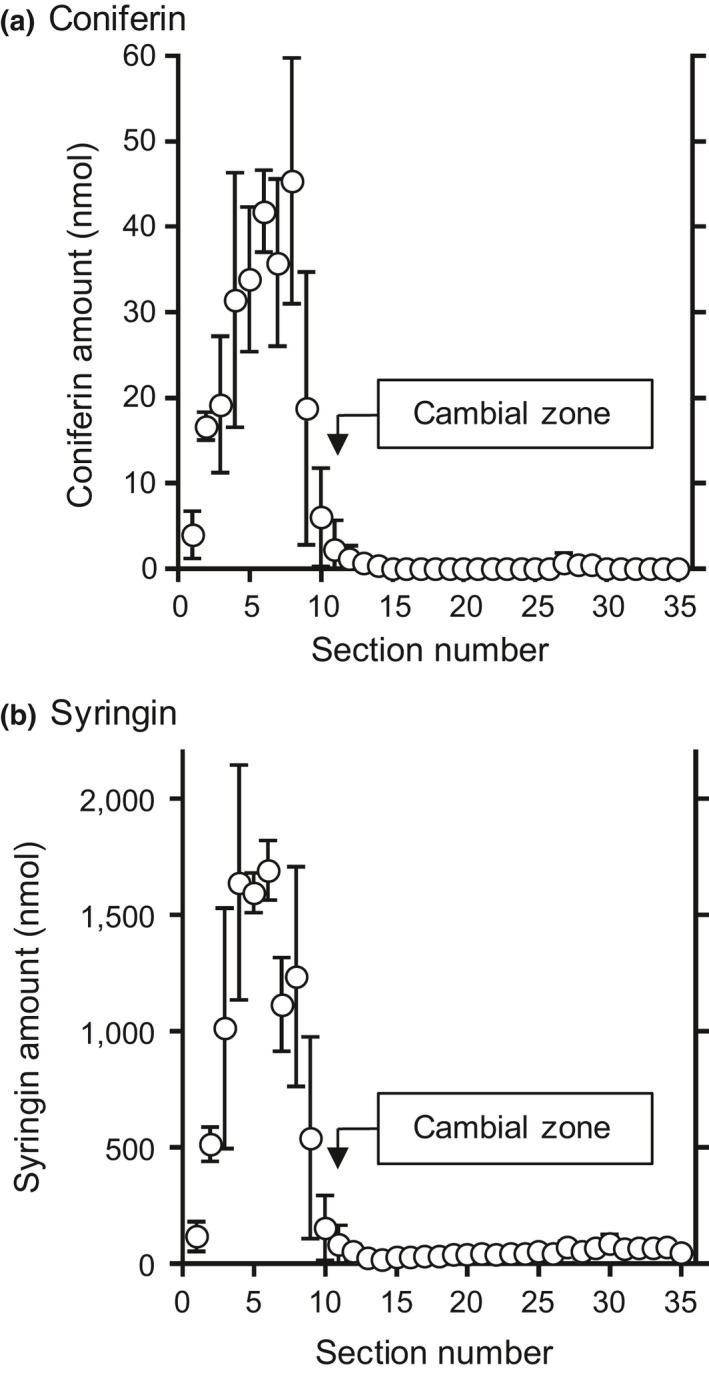
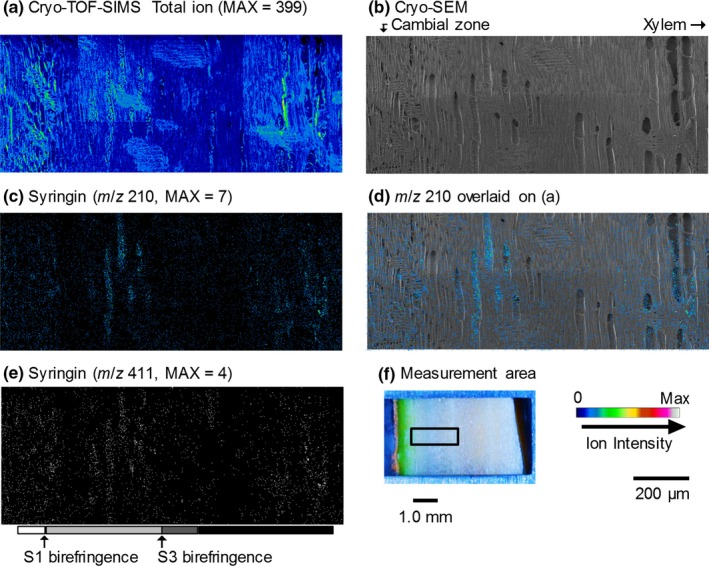
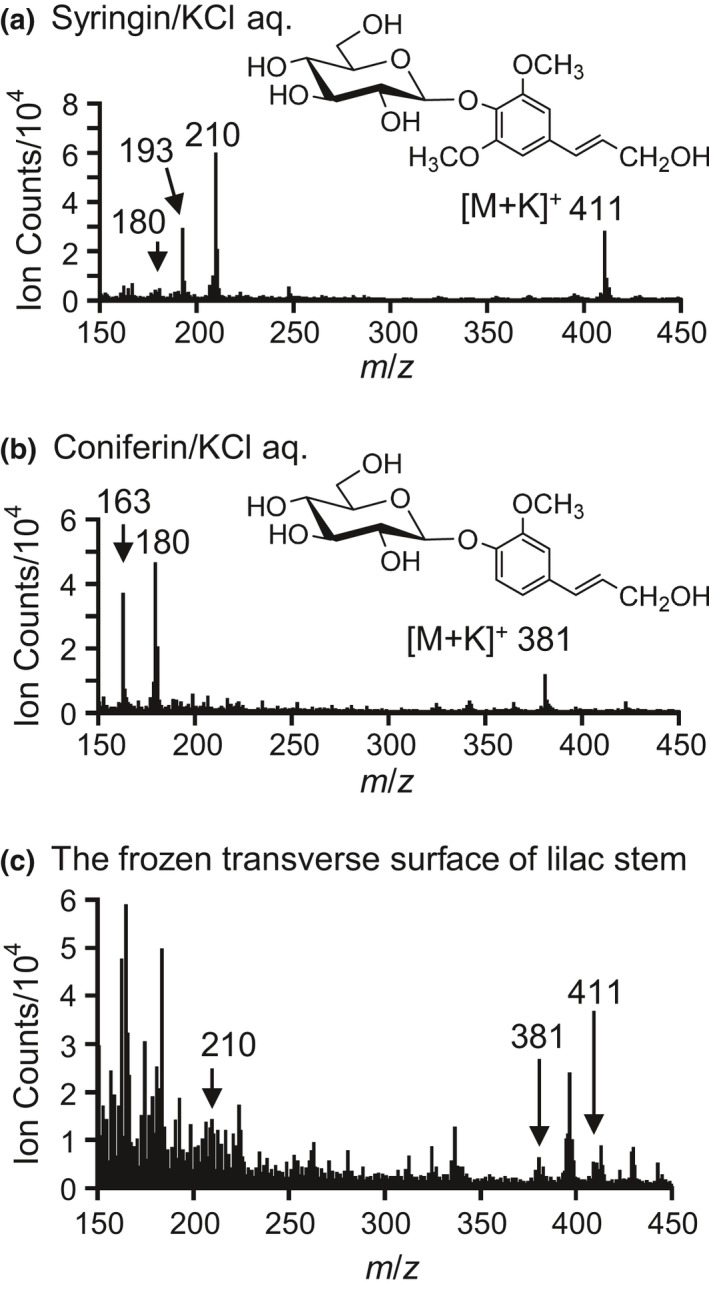
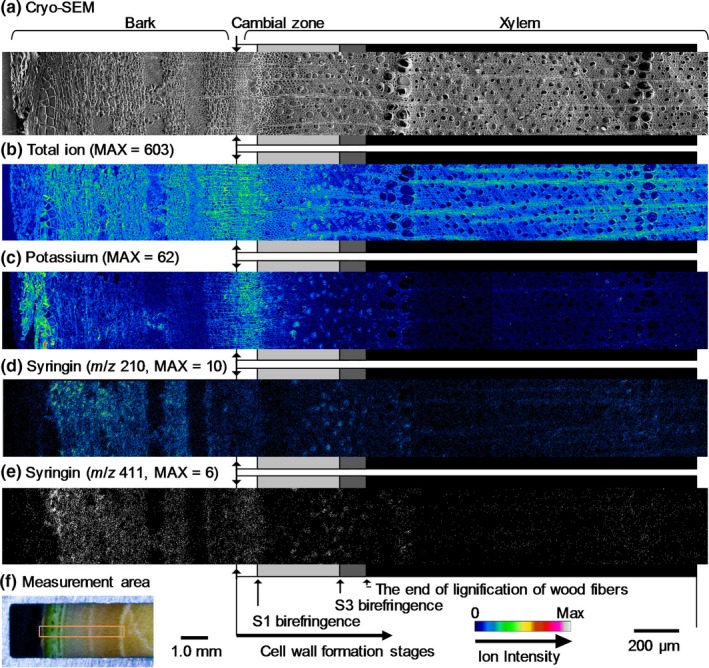
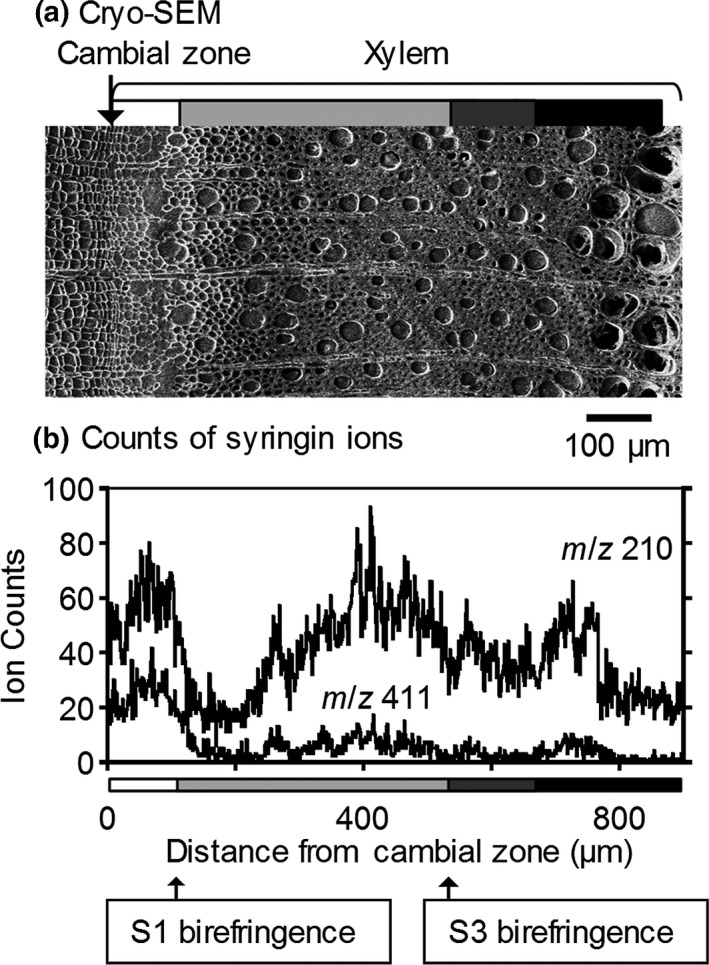
Monolignols are precursors of lignin, and their glucosides are often found in plants. Glucosylation creates water-soluble and chemically stable monolignols by protecting the phenolic hydroxyl group. To discuss the role of sinapyl alcohol glucoside, syringin, , the cellular distribution of syringin in the transverse and radial surfaces of quick-frozen stems of L. (lilac) was visualized by cryo-time-of-flight secondary ion mass spectrometry and scanning electron microscopy (cryo-TOF-SIMS/SEM) analyses. The amount and rough distribution of syringin were confirmed by high-performance liquid chromatography measurements using serial tangential sections of freeze-fixed lilac stems. The syringin distribution was also discussed with reference to the tissue classification from microscopic observations. Syringin was mainly found in the phloem region. In the xylem region, syringin was evenly distributed irrespective of the cell type from the cambial zone to the early differentiating stage region and selectively distributed in vessels in the later differentiating stage region. After the lignification of wood fibers, syringin was found in rays and some vessels in the initial part of the annual rings. Previously, artificially administered isotope-labeled syringin was shown to be assimilated into lignin in the differentiating xylem region. Based on this, our present data showing syringin storage in the differentiating xylem region and its variation depending on the lignification stage suggest that syringin works as a lignin precursor. Additionally, detection of syringin in vessels and rays indicates intercellular transportation of syringin in lilac stems.
单木质醇是木质素的前体,其糖苷常见于植物中。糖基化通过保护酚羟基形成水溶性且化学稳定的单木质醇。为了探讨芥子醇糖苷(紫丁香苷)的作用,通过低温飞行时间二次离子质谱和扫描电子显微镜(cryo-TOF-SIMS/SEM)分析,观察了紫丁香苷在紫丁香快速冷冻茎横切面和径向表面的细胞分布。使用冷冻固定的紫丁香茎的连续弦向切片,通过高效液相色谱测量确定了紫丁香苷的含量和大致分布。还参考显微镜观察的组织分类对紫丁香苷的分布进行了讨论。紫丁香苷主要存在于韧皮部区域。在木质部区域,从形成层区到早期分化阶段区域,紫丁香苷在不同细胞类型中均匀分布,而在后期分化阶段区域则选择性地分布在导管中。木纤维木质化后,在年轮初始部分的射线和一些导管中发现了紫丁香苷。此前研究表明,人工施用的同位素标记紫丁香苷会在分化的木质部区域被同化为木质素。基于此,我们目前的数据显示紫丁香苷在分化的木质部区域储存及其随木质化阶段的变化,表明紫丁香苷作为木质素前体发挥作用。此外,在导管和射线中检测到紫丁香苷,表明紫丁香苷在紫丁香茎中存在细胞间运输。