Musculoskeletal Science and Sports Medicine Research Centre, Manchester Metropolitan University, Manchester, UNITED KINGDOM.
Department of Biomedical Physiology and Kinesiology, Simon Fraser University, Burnaby, British Columbia, CANADA.
Med Sci Sports Exerc. 2020 Jan;52(1):214-224. doi: 10.1249/MSS.0000000000002096.
A key determinant of muscle coordination and maximum power output during cycling is pedaling cadence. During cycling, the neuromuscular system may select from numerous solutions that solve the task demands while producing the same result. For more challenging tasks, fewer solutions will be available. Changes in the variability of individual muscle excitations (EMG) and multimuscle coordination, quantified by entropic half-life (EnHL), can reflect the number of solutions available at each system level. We, therefore, ask whether reduced variability in muscle coordination patterns occur at critical cadences and if they coincide with reduced variability in excitations of individual muscles.
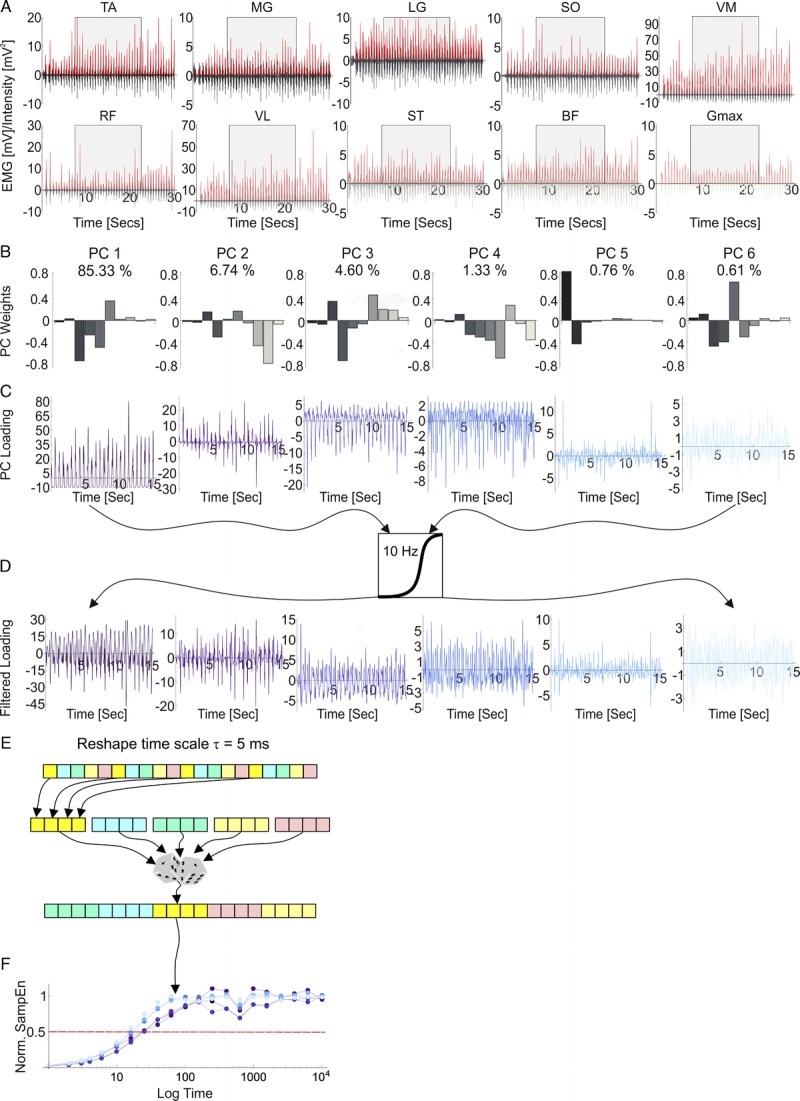
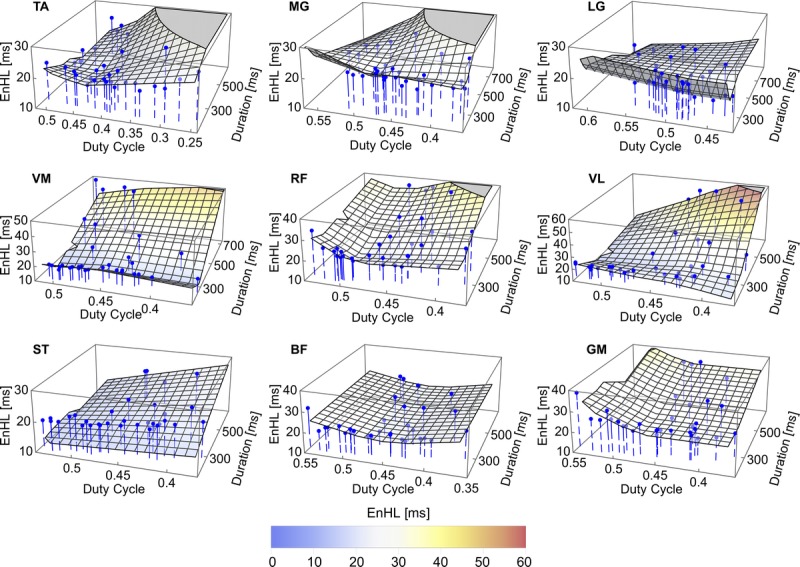
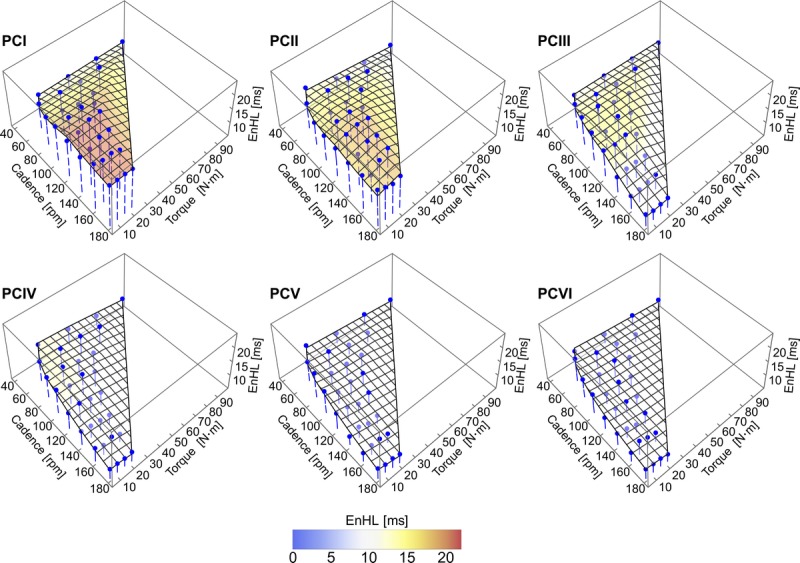
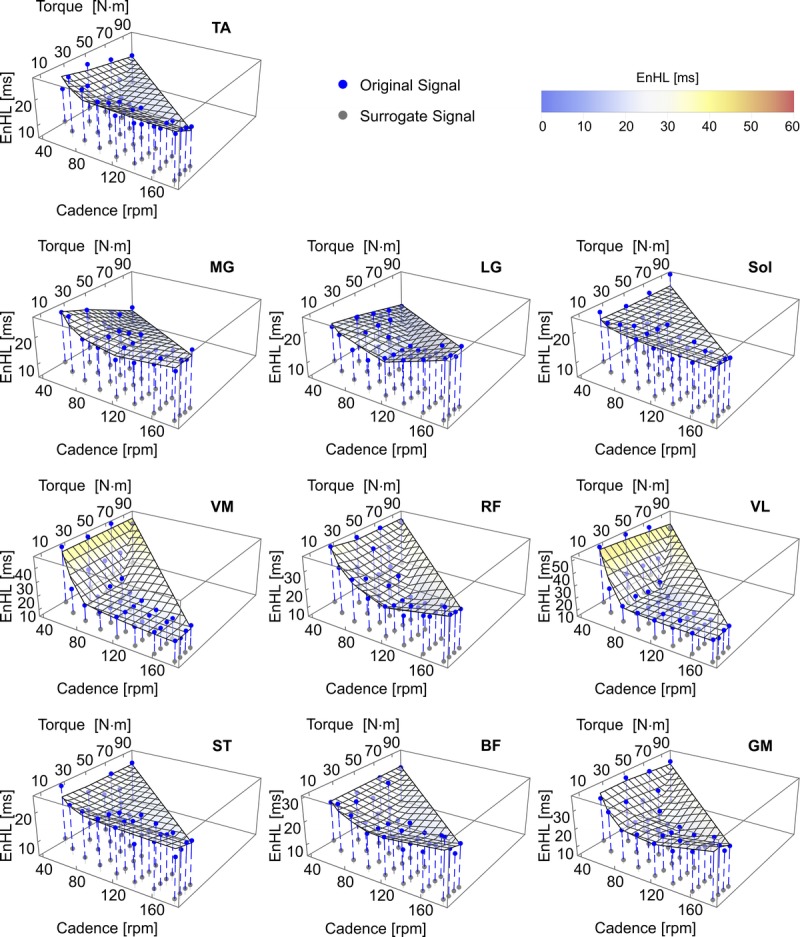
Eleven trained cyclists completed an array of cadence-power output conditions. The EnHL of EMG intensity recorded from 10 leg muscles and EnHL of principal components describing muscle coordination were calculated. Multivariate adaptive regressive splines were used to determine the relationships between each EnHL and cycling condition or excitation characteristics (duration, duty cycle).
Muscle coordination became more persistent at cadences up to 120 rpm, indicated by increasing EnHL values. Changes in EnHL at the level of the individual muscles differed from the changes in muscle coordination EnHL, with longer EnHL occurring at the slowest (<80 rpm) and fastest (>120 rpm) cadences. The EnHL of the main power producing muscles, however, reached a minimum by 80 rpm and did not change across the faster cadences studied.
Muscle coordination patterns, rather than the contribution of individual muscles, are key to power production at faster cadences in trained cyclists. Reductions in maximum power output at cadences above 120 rpm could be a function of the time available to coordinate orientation and transfer of forces to the pedals.
在骑行过程中,踩踏频率是决定肌肉协调性和最大功率输出的关键因素。在骑行过程中,神经系统可能会从众多解决方案中选择,这些解决方案可以解决任务需求,同时产生相同的结果。对于更具挑战性的任务,可用的解决方案会更少。通过熵半衰期(EnHL)量化的个体肌肉兴奋(EMG)和多肌肉协调的可变性变化,可以反映每个系统水平可用的解决方案数量。因此,我们想知道在关键频率下是否会出现肌肉协调模式的可变性降低,以及它们是否与个体肌肉兴奋的可变性降低同时发生。
11 名训练有素的自行车手完成了一系列踏频-功率输出条件。从 10 条腿部肌肉记录的 EMG 强度的 EnHL 和描述肌肉协调的主成分的 EnHL 进行了计算。多变量自适应回归样条用于确定每个 EnHL 与骑行条件或兴奋特征(持续时间、占空比)之间的关系。
肌肉协调性在高达 120rpm 的踏频下变得更加持久,表现为 EnHL 值增加。个体肌肉的 EnHL 变化与肌肉协调的 EnHL 变化不同,最长的 EnHL 发生在最慢(<80rpm)和最快(>120rpm)的踏频。然而,主要动力产生肌肉的 EnHL 在 80rpm 时达到最小值,并且在研究的更快踏频下没有变化。
在训练有素的自行车手,肌肉协调模式而不是个体肌肉的贡献是更快踏频下产生功率的关键。在 120rpm 以上的踏频下,最大功率输出的降低可能是协调力的方向和将力传递到踏板上的时间可用的函数。