Leo Laura Anna, Paiocchi Vera Lucia, Schlossbauer Susanne Anna, Ho Siew Yen, Faletra Francesco F
Cardiac Imaging Department, Fondazione Cardiocentro Ticino, Lugano, Switzerland.
Department of Cardiac Morphology, Royal Brompton Hospital and Imperial College London, London, UK.
J Cardiovasc Echogr. 2019 Apr-Jun;29(2):45-51. doi: 10.4103/jcecho.jcecho_22_19.
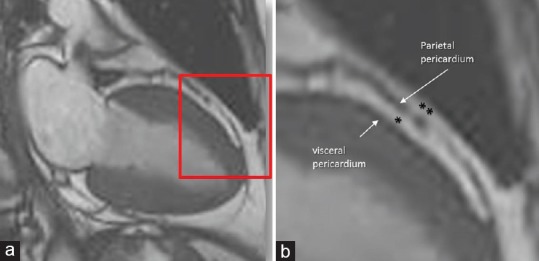
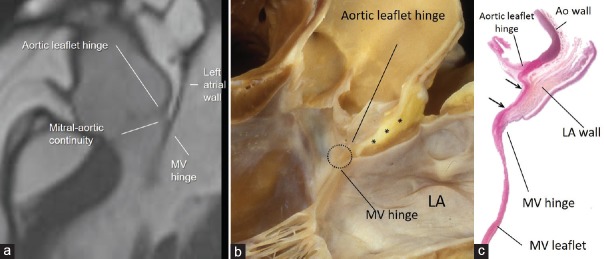
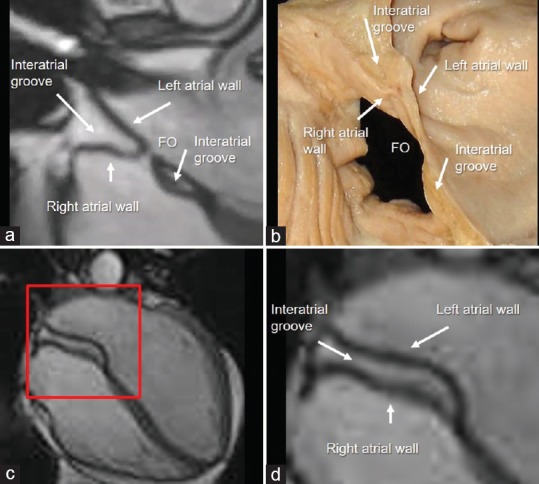
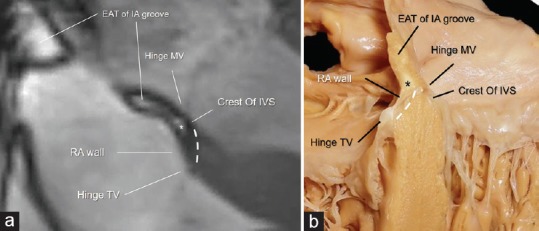
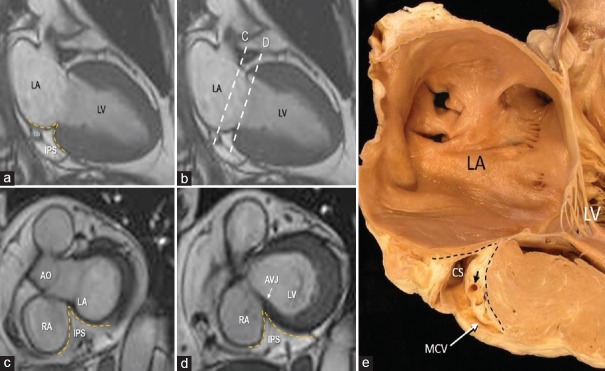
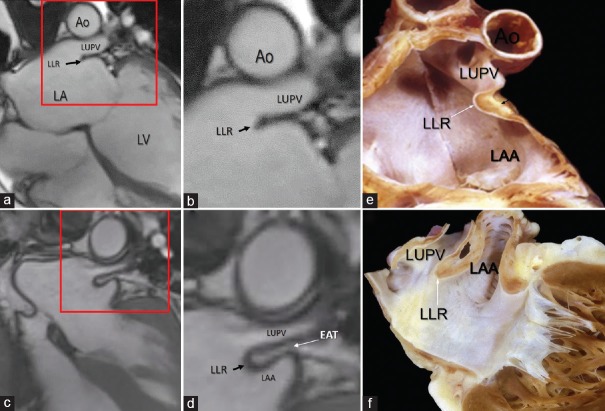
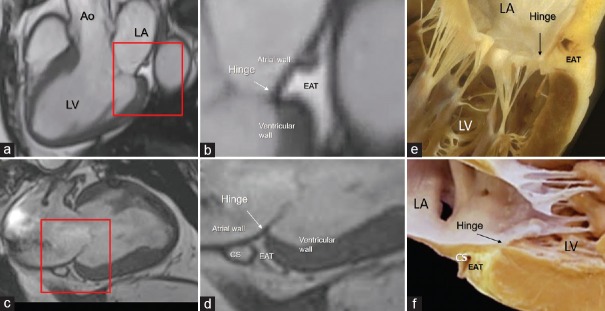
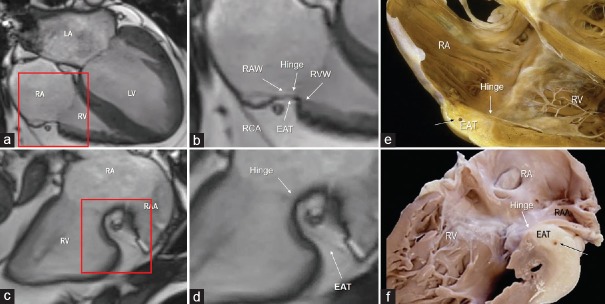
The epicardial adipose tissue (EAT) refers to the deposition of adipose tissue fully enclosed by the pericardial sac. EAT has a complex mixture of adipocytes, nervous tissue, as well as inflammatory, stromal and immune cells secreting bioactive molecules. This heterogeneous composition reveals that it is not a simply fat storage depot, but rather a biologically active organ that appears playing a "dichotomous" role, either protective or proinflammatory and proatherogenic. The cardiac magnetic resonance (CMR) allows a clear visualization of EAT using a specific pulse sequence called steady-state free precession. When abundant, the EAT assumes a pervasive presence not only covering the entire epicardial surface but also invading spaces that usually are almost virtual and separating walls that usually are so close each other to resemble a single wall. To the best of our knowledge, this aspect of cardiac anatomy has never been described before. In this pictorial review, we therefore focus our attention on certain cardiac areas in which EAT, when abundant, is particularly intrusive. In particular, we describe the presence of EAT into: (a) the interatrial groove, the atrioventricular septum, and the inferior pyramidal space, (b) the left lateral ridge, (c) the atrioventricular grooves, and (d) the transverse pericardial sinus. To confirm the reliability in depicting the EAT distribution, we present CMR images side-by-side with corresponding anatomic specimens.
心外膜脂肪组织(EAT)是指被心包囊完全包裹的脂肪组织沉积。EAT由脂肪细胞、神经组织以及分泌生物活性分子的炎症细胞、基质细胞和免疫细胞混合而成。这种异质性组成表明它并非简单的脂肪储存库,而是一个具有生物活性的器官,似乎发挥着“双重”作用,既有保护作用,也有促炎和促动脉粥样硬化作用。心脏磁共振成像(CMR)使用一种称为稳态自由进动的特定脉冲序列能够清晰显示EAT。当EAT大量存在时,它不仅会遍布整个心外膜表面,还会侵入通常几乎是虚拟的空间,并分隔通常彼此靠近而看似单一壁的壁。据我们所知,心脏解剖学的这一方面以前从未被描述过。因此,在这篇图片综述中,我们将注意力集中在某些心脏区域,当EAT大量存在时,这些区域的EAT特别具有侵入性。具体来说,我们描述了EAT在以下部位的存在情况:(a)房间沟、房室间隔和下锥体间隙,(b)左侧嵴,(c)房室沟,以及(d)心包横窦。为了证实描绘EAT分布的可靠性,我们将CMR图像与相应的解剖标本并排展示。