Department of Mathematics, University of British Columbia, Vancouver, British Columbia, Canada.
PLoS Comput Biol. 2019 Aug 8;15(8):e1006948. doi: 10.1371/journal.pcbi.1006948. eCollection 2019 Aug.
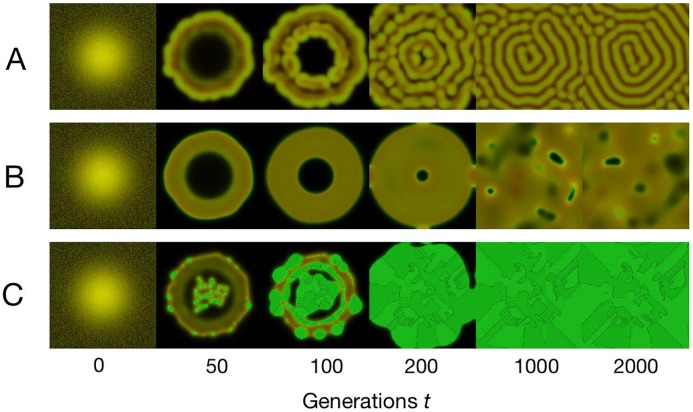
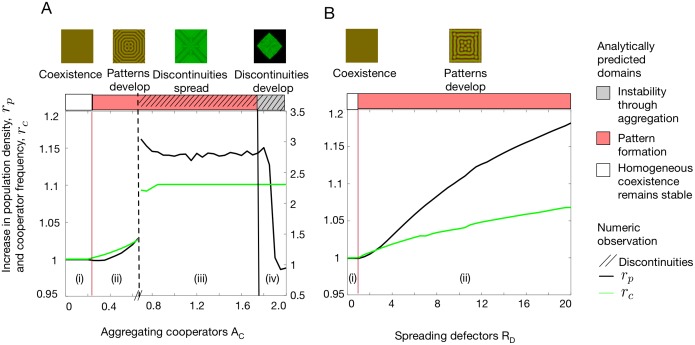
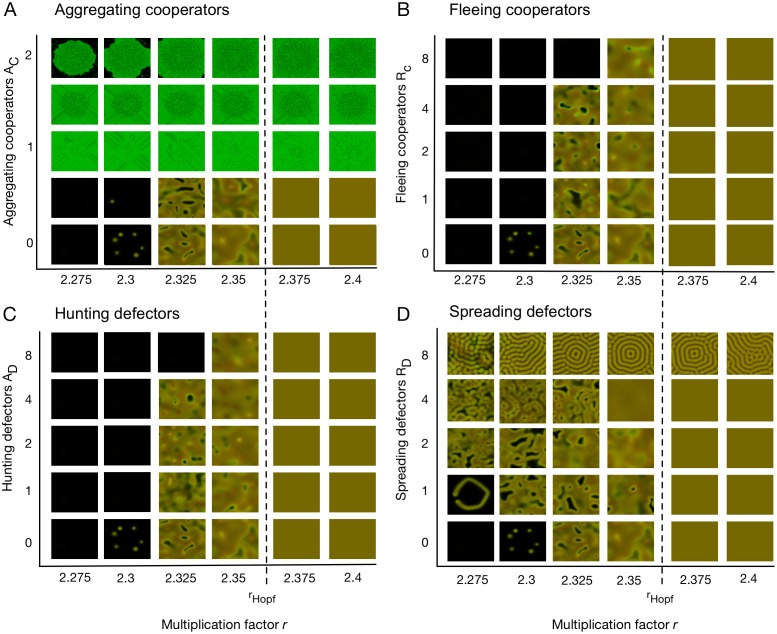
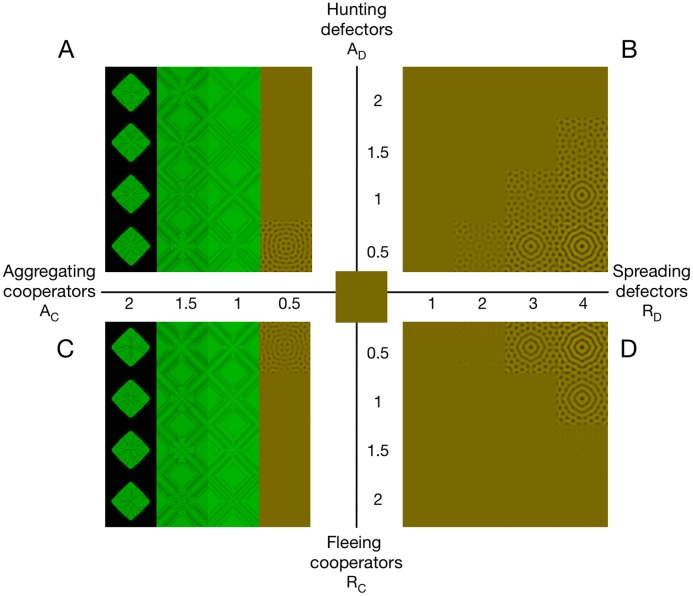
From the microscopic to the macroscopic level, biological life exhibits directed migration in response to environmental conditions. Chemotaxis enables microbes to sense and move towards nutrient-rich regions or to avoid toxic ones. Socio-economic factors drive human populations from rural to urban areas. The effect of collective movement is especially significant when triggered in response to the generation of public goods. Microbial communities can, for instance, alter their environment through the secretion of extracellular substances. Some substances provide antibiotic-resistance, others provide access to nutrients or promote motility. However, in all cases the maintenance of public goods requires costly cooperation and is consequently susceptible to exploitation. The threat of exploitation becomes even more acute with motile individuals because defectors can avoid the consequences of their cheating. Here, we propose a model to investigate the effects of targeted migration and analyze the interplay between social conflicts and migration in ecological public goods. In particular, individuals can locate attractive regions by moving towards higher cooperator densities or avoid unattractive regions by moving away from defectors. Both migration patterns not only shape an individual's immediate environment but also affects the entire population. For example, defectors hunting cooperators have a homogenizing effect on population densities. This limits the production of the public good and hence inhibits the growth of the population. In contrast, aggregating cooperators promote the spontaneous formation of patterns through heterogeneous density distributions. The positive feedback between cooperator aggregation and public goods production, however, poses analytical and numerical challenges due to its tendency to develop discontinuous distributions. Thus, different modes of directed migration bear the potential to enhance or inhibit the emergence of complex and sometimes dynamic spatial arrangements. Interestingly, whenever patterns emerge, cooperation is promoted, on average, population densities rise, and the risk of extinction is reduced.
从微观到宏观层面,生物生命都表现出对环境条件的定向迁移。趋化作用使微生物能够感知并向营养丰富的区域移动,或避免有毒区域。社会经济因素促使人口从农村向城市地区迁移。当集体迁移是为了应对公共物品的产生而引发时,其效果尤其显著。例如,微生物群落可以通过分泌细胞外物质来改变环境。一些物质提供抗生素抗性,另一些物质提供营养物质或促进运动性。然而,在所有情况下,公共物品的维持都需要昂贵的合作,因此容易受到剥削。由于逃兵可以逃避欺骗的后果,因此具有流动性的个体的威胁变得更加严重。在这里,我们提出了一个模型来研究有针对性的迁移的影响,并分析社会冲突和生态公共物品中的迁移之间的相互作用。具体来说,个体可以通过向更高的合作者密度移动来定位有吸引力的区域,或者通过远离叛逃者来避免无吸引力的区域。这两种迁移模式不仅塑造了个体的直接环境,而且还影响了整个种群。例如,追捕合作者的逃兵对种群密度具有均匀化的影响。这限制了公共物品的产生,从而抑制了种群的增长。相比之下,聚集的合作者通过异质密度分布促进了模式的自发形成。然而,合作者聚集和公共物品产生之间的正反馈由于其发展不连续分布的趋势,在分析和数值方面都构成了挑战。因此,不同的定向迁移模式有可能增强或抑制复杂且有时是动态的空间排列的出现。有趣的是,只要出现模式,合作就会得到促进,平均而言,种群密度会上升,灭绝的风险会降低。