Zouhal Hassane, Abderrahman Abderraouf B, Dupont Gregory, Truptin Pablo, Le Bris Régis, Le Postec Erwan, Sghaeir Zouita, Brughelli Matt, Granacher Urs, Bideau Benoit
Univ Rennes, M2S (Laboratoire Mouvement, Sport, Santé) - EA 1274, Rennes, France.
ISSEP Ksar Said, University of Manouba, Tunis, Tunisia.
Front Physiol. 2019 Jul 23;10:947. doi: 10.3389/fphys.2019.00947. eCollection 2019.
Agility in general and change-of-direction speed (CoD) in particular represent important performance determinants in elite soccer.
The objectives of this study were to determine the effects of a 6-week neuromuscular training program on agility performance, and to determine differences in movement times between the slower and faster turning directions in elite soccer players.
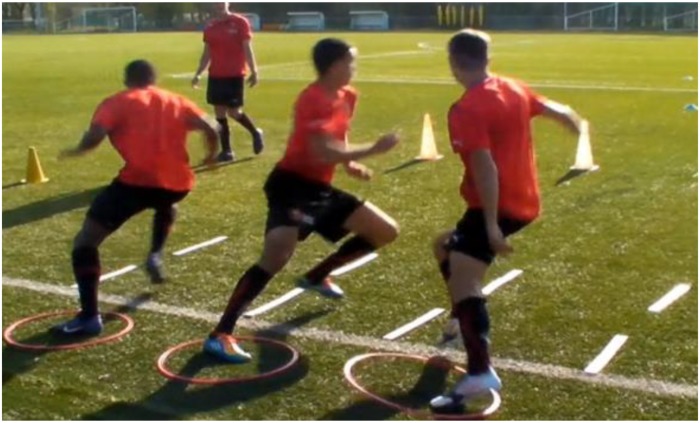
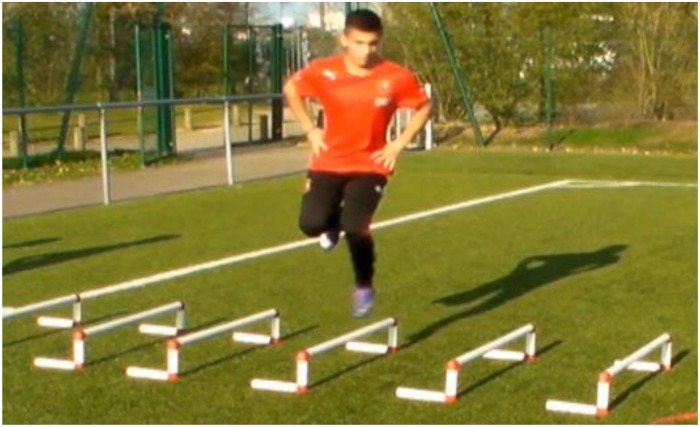
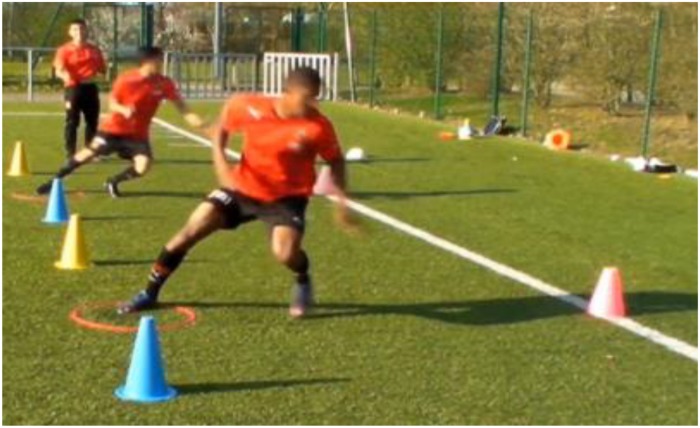
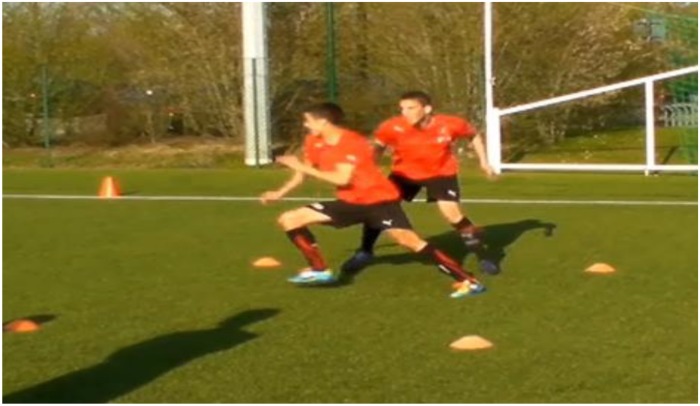
Twenty male elite soccer players from the Stade Rennais Football Club (Ligue 1, France) participated in this study. The players were randomly assigned to a neuromuscular training group (NTG, = 10) or an active control (CG, = 10) according to their playing position. NTG participated in a 6-week, twice per week neuromuscular training program that included CoD, plyometric and dynamic stability exercises. Neuromuscular training replaced the regular warm-up program. Each training session lasted 30 min. CG continued their regular training program. Training volume was similar between groups. Before and after the intervention, the two groups performed a reactive agility test that included 180° left and right body rotations followed by a 5-m linear sprint. The weak side was defined as the left/right turning direction that produced slower overall movement times (MT). Reaction time (RT) was assessed and defined as the time from the first appearance of a visual stimulus until the athlete's first movement. MT corresponded to the time from the first movement until the athlete reached the arrival gate (5 m distance).
No significant between-group baseline differences were observed for RT or MT. Significant group x time interactions were found for MT ( = 0.012, effect size = 0.332, small) for the slower and faster directions ( = 0.011, effect size = 0.627, moderate). Significant pre-to post improvements in MT were observed for NTG but not CG ( = 0.011, effect size = 0.877, moderate). For NTG, analyses revealed significant MT improvements for the slower ( = 0.012, effect size = 0.897, moderate) and faster directions ( = 0.017, effect size = 0.968, moderate).
Our results illustrate that 6 weeks of neuromuscular training with two sessions per week included in the warm-up program, significantly enhanced agility performance in elite soccer players. Moreover, improvements were found on both sides during body rotations. Thus, practitioners are advised to focus their training programs on both turning directions.
一般而言,敏捷性,尤其是变向速度,是精英足球运动中重要的表现决定因素。
本研究旨在确定为期6周的神经肌肉训练计划对敏捷性表现的影响,并确定精英足球运动员较慢和较快转向方向之间的运动时间差异。
来自法国甲级联赛雷恩足球俱乐部的20名男性精英足球运动员参与了本研究。根据球员的比赛位置,将他们随机分为神经肌肉训练组(NTG,n = 10)或积极对照组(CG,n = 10)。NTG参加了为期6周、每周两次的神经肌肉训练计划,包括变向速度、增强式和动态稳定性练习。神经肌肉训练取代了常规的热身计划。每次训练持续30分钟。CG继续他们的常规训练计划。两组之间的训练量相似。在干预前后,两组都进行了反应敏捷性测试,包括180°左右身体旋转,然后进行5米直线冲刺。较弱的一侧定义为产生较慢整体运动时间(MT)的左/右转方向。评估反应时间(RT)并将其定义为从视觉刺激首次出现到运动员首次移动的时间。MT对应于从首次移动到运动员到达终点门(5米距离)的时间。
在RT或MT方面,未观察到显著的组间基线差异。在较慢和较快方向上,MT存在显著的组×时间交互作用(F = 0.012,效应大小 = 0.332,小)(F = 0.011,效应大小 = 0.627,中等)。观察到NTG的MT从干预前到干预后有显著改善,而CG没有(F = 0.011,效应大小 = 0.877,中等)。对于NTG,分析显示较慢方向(F = 0.012,效应大小 = 0.897,中等)和较快方向(F = 0.017,效应大小 = 0.968,中等)的MT均有显著改善。
我们的结果表明,在热身计划中每周进行两次、为期6周的神经肌肉训练,显著提高了精英足球运动员的敏捷性表现。此外,在身体旋转过程中两侧都有改善。因此,建议从业者在训练计划中关注两个转向方向。