Barcaccia Barbara, Pallini Susanna, Pozza Andrea, Milioni Michela, Baiocco Roberto, Mancini Francesco, Vecchio Giovanni Maria
Department of Education, Roma Tre University, Rome, Italy.
Associazione di Psicologia Cognitiva (APC) and Scuola di Psicoterapia Cognitiva srl (SPC), Rome, Italy.
Front Psychol. 2019 Jul 24;10:1725. doi: 10.3389/fpsyg.2019.01725. eCollection 2019.
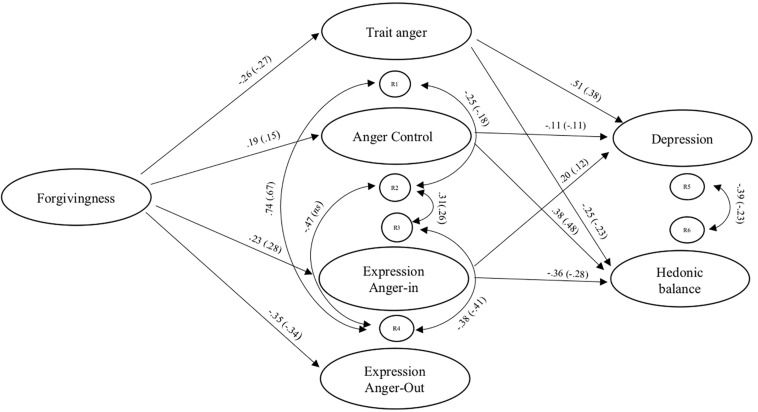
Forgiveness has been proven to be an effective way of regulating negative affect and decreasing depression. This study aimed at examining the relationship among constructs particularly relevant to adolescents' well-being, including forgivingness (dispositional forgiveness) anger, depression and Hedonic Balance (HB). Specifically, using a structural equation modelling approach, the fully mediational role of the different facets of anger in the relationship between forgiveness and depression was tested in 773 adolescents, of which 69% girls. Results showed that forgivingness was positively and negatively related to, respectively, HB and depression, through a general effect of anger, suggesting that more forgiving adolescents had higher HB and lower depression as they reported a lower general tendency to experience anger. Forgivingness was also positively related both to HB and to depression through the mediation of all the facets of Anger. Moreover, only for HB, a specific effect of Anger-control was found, suggesting that more forgiving adolescents had higher HB as they reported higher strategies to control anger in a functional manner. The model invariance was supported across gender. Our results suggest that forgiveness is a significant protective factor against depression for adolescents, helping them to effectively control and manage anger, thus fostering emotional health. An important clinical implication of our study regards the potential of forgiveness as a resource for well-being in therapy: among the various possible protective factors in adolescence, forgiveness has the added advantage that it can be fostered in clinical settings, and working on forgiveness in psychotherapy or in counselling could decrease adolescent depression and improve well-being.
宽恕已被证明是调节负面影响和减轻抑郁的有效方式。本研究旨在探讨与青少年幸福感特别相关的构念之间的关系,包括宽恕(特质宽恕)、愤怒、抑郁和享乐平衡(HB)。具体而言,采用结构方程建模方法,在773名青少年(其中69%为女孩)中测试了愤怒的不同方面在宽恕与抑郁关系中的完全中介作用。结果表明,通过愤怒的总体效应,宽恕分别与享乐平衡呈正相关,与抑郁呈负相关,这表明更具宽恕心的青少年享乐平衡得分更高,抑郁程度更低,因为他们报告的总体愤怒体验倾向较低。宽恕通过愤怒的所有方面的中介作用,也与享乐平衡和抑郁呈正相关。此外,仅在享乐平衡方面,发现了愤怒控制的特定效应,这表明更具宽恕心的青少年享乐平衡得分更高,因为他们报告了以功能性方式控制愤怒的更高策略。该模型在不同性别间具有不变性。我们的结果表明,宽恕是青少年预防抑郁的重要保护因素,有助于他们有效控制和管理愤怒,从而促进情绪健康。我们研究的一个重要临床意义在于宽恕作为治疗中幸福资源的潜力:在青少年各种可能的保护因素中,宽恕具有额外的优势,即它可以在临床环境中得到培养,在心理治疗或咨询中致力于宽恕可以减少青少年的抑郁并改善幸福感。