Department of Medical Biochemistry, Wroclaw Medical University, Wroclaw 50-368, Poland.
PORT Polski Ośrodek Rozwoju Technologii sp, ZOO, Wroclaw 54-066, Poland.
Oxid Med Cell Longev. 2019 Jul 14;2019:5965721. doi: 10.1155/2019/5965721. eCollection 2019.
The status of metabolites of the nitric oxide (NO) pathway in patients with chronic wounds in the course of cardiometabolic diseases is largely unknown. Yet arginine supplementation and citrulline supplementation as novel therapeutic modalities aimed at increasing NO are tested.
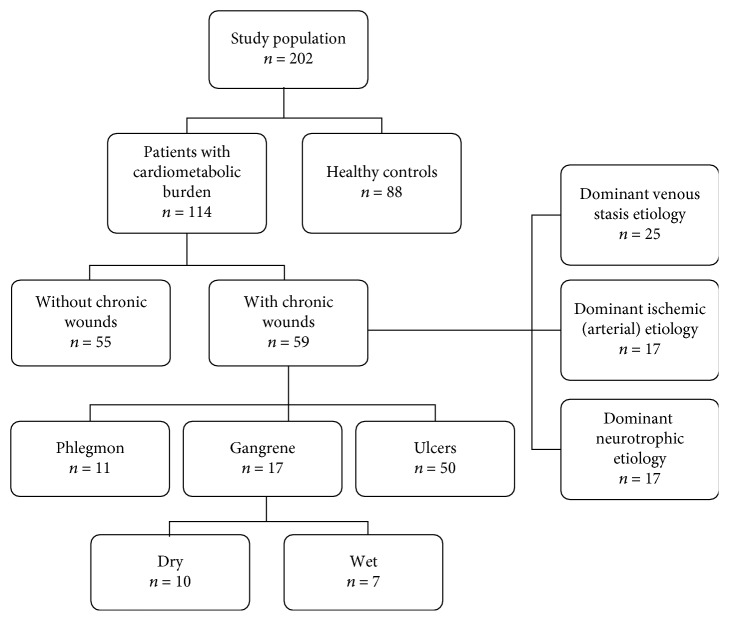
Targeted metabolomics approach (LC-MS/MS) was applied to determine the concentrations of L-arginine, L-citrulline, asymmetric and symmetric dimethylarginines (ADMA and SDMA), and arginine/ADMA and arginine/SDMA ratios as surrogate markers of NO and arginine availability in ulnar and femoral veins, representing systemic and local levels of metabolites, in patients with chronic wounds in the course of cardiometabolic diseases ( = 59) as compared to patients without chronic wounds but with similar cardiometabolic burden ( = 55) and healthy individuals ( = 88).
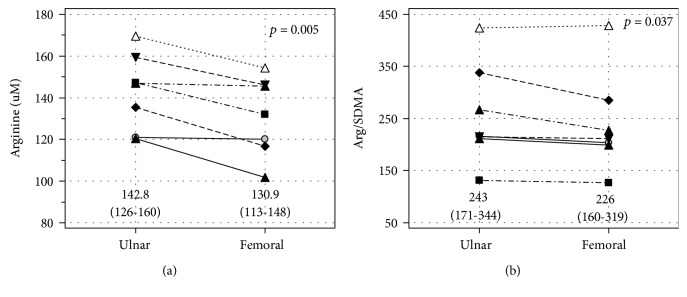
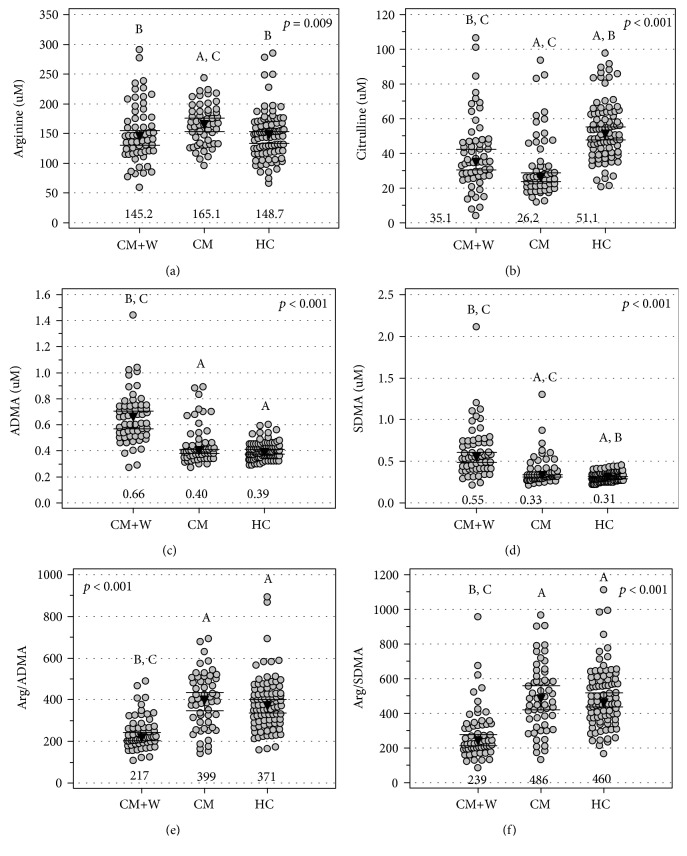
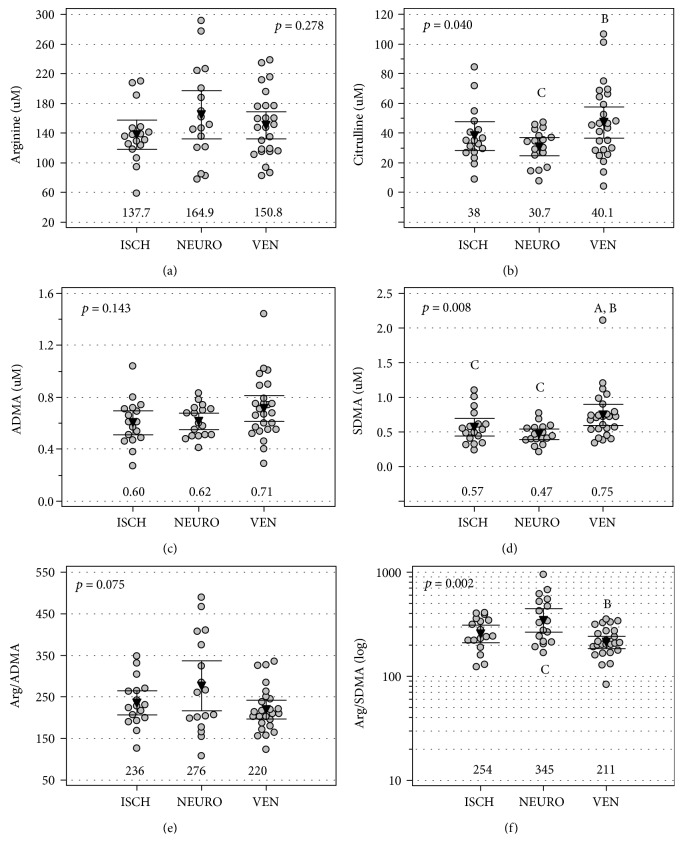
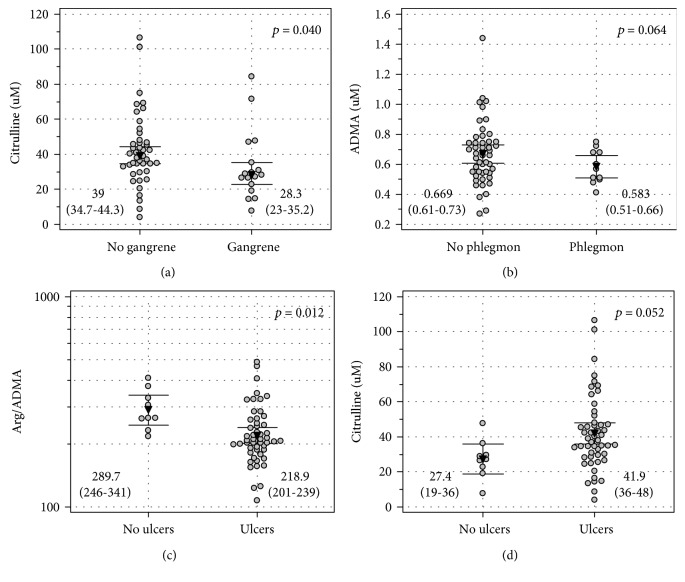
Patients with chronic wounds had significantly lower systemic L-citrulline and higher ADMA and SDMA concentrations and lower L-arginine/ADMA and L-arginine/SDMA as compared to healthy controls. The presence of chronic wounds in patients with cardiometabolic diseases was associated with decreased L-arginine but with increased L-citrulline, ADMA, and SDMA concentrations and decreased L-arginine/ADMA and L-arginine/SDMA. Serum obtained from the ulnar and femoral veins of patients with chronic wounds differed by L-arginine concentrations and L-arginine/SDMA ratio, both lower in the femoral vein. Wound etiology affected L-citrulline and SDMA concentrations, lower and higher, respectively, in patients with venous stasis, and the L-arginine/SDMA ratio-lower in venous stasis. The wound type affected L-arginine/ADMA and citrulline-lower in patients with ulcerations or gangrene. IL-6 was an independent predictor of L-arginine/ADMA, VEGF-A of ADMA, G-CSF of L-arginine/SDMA, and GM-CSF of L-citrulline and SDMA.
Chronic wounds in the course of cardiometabolic diseases are associated with reduced NO and arginine availability due to ADMA and SDMA accumulation rather than arginine deficiency, not supporting its supplementation. Wound character seems to affect NO bioavailability and wound etiology-arginine bioavailability. Arginine concentration and its availability are more markedly reduced at the local level than the systemic level.
在合并心血管代谢疾病的慢性伤口患者中,一氧化氮(NO)途径代谢物的状态在很大程度上尚不清楚。然而,作为旨在增加 NO 的新型治疗方法,精氨酸补充和瓜氨酸补充正在被测试。
应用靶向代谢组学方法(LC-MS/MS)来确定尺骨和股静脉中 L-精氨酸、L-瓜氨酸、非对称和对称二甲基精氨酸(ADMA 和 SDMA)的浓度,以及精氨酸/ADMA 和精氨酸/SDMA 比作为 NO 和精氨酸可用性的替代标志物,代表代谢物的系统和局部水平,在合并心血管代谢疾病的慢性伤口患者(n=59)中与无慢性伤口但具有相似心血管代谢负担的患者(n=55)和健康个体(n=88)进行比较。
与健康对照组相比,患有慢性伤口的患者系统 L-瓜氨酸浓度明显较低,ADMA 和 SDMA 浓度较高,L-精氨酸/ADMA 和 L-精氨酸/SDMA 较低。患有心血管代谢疾病的患者中存在慢性伤口与 L-精氨酸减少但 L-瓜氨酸、ADMA 和 SDMA 浓度增加以及 L-精氨酸/ADMA 和 L-精氨酸/SDMA 减少相关。来自患有慢性伤口的患者的尺骨和股静脉的血清在 L-精氨酸浓度和 L-精氨酸/SDMA 比值方面存在差异,股静脉中的浓度均较低。伤口病因影响 L-瓜氨酸和 SDMA 浓度,静脉淤滞患者的浓度分别较低和较高,L-精氨酸/SDMA 比值较低。伤口类型影响 L-精氨酸/ADMA 和瓜氨酸,溃疡或坏疽患者的浓度较低。IL-6 是 L-精氨酸/ADMA 的独立预测因子,VEGF-A 是 ADMA 的独立预测因子,G-CSF 是 L-精氨酸/SDMA 的独立预测因子,GM-CSF 是 L-瓜氨酸和 SDMA 的独立预测因子。
合并心血管代谢疾病的慢性伤口与由于 ADMA 和 SDMA 积累而不是精氨酸缺乏导致的 NO 和精氨酸可用性降低有关,不支持其补充。伤口特征似乎影响 NO 生物利用度和伤口病因-精氨酸生物利用度。与系统水平相比,精氨酸浓度及其可用性在局部水平上降低更为明显。