Elangovan Stacey M, Sebro Ronnie
Department of Radiology, University of Pennsylvania, Philadelphia, PA 19104, United States.
World J Radiol. 2019 Jun 28;11(6):81-93. doi: 10.4329/wjr.v11.i6.81.
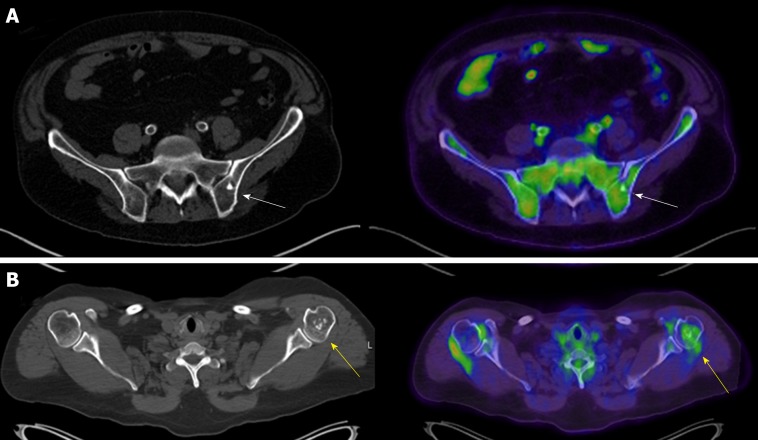
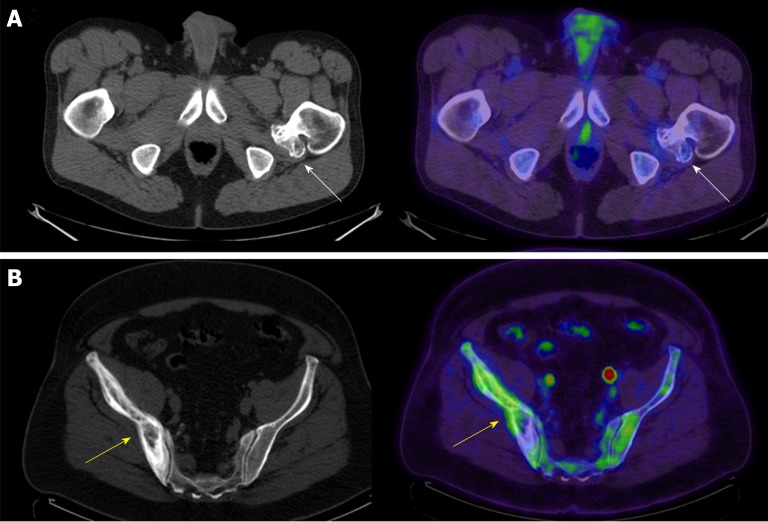
Classic "do not touch" and benign osseous lesions are sometimes detected on -F-fluorodeoxyglucose (F-FDG) positron emission tomography/computed tomography (PET/CT) studies. These lesions are often referred for biopsy because the physician interpreting the PET/CT may not be familiar with the spectrum of F-FDG uptake patterns that these lesions display.
To show that "do not touch" and benign osseous lesions can have increased F-FDG uptake above blood-pool on PET/CT; therefore, the CT appearance of these lesions should dictate management rather than the standardized uptake values (SUV).
This retrospective study evaluated 287 independent patients with 287 classic "do not touch" (benign cystic lesions, insufficiency fractures, bone islands, bone infarcts) or benign osseous lesions (hemangiomas, enchondromas, osteochondromas, fibrous dysplasia, Paget's disease, osteomyelitis) who underwent F-FDG positron emission tomography/computed tomography (PET/CT) at a tertiary academic healthcare institution between 01/01/2006 and 12/1/2018. The maximum and mean SUV, and the ratio of the maximum SUV to mean blood pool were calculated. Pearson's correlations between lesion size and maximum SUV were calculated.
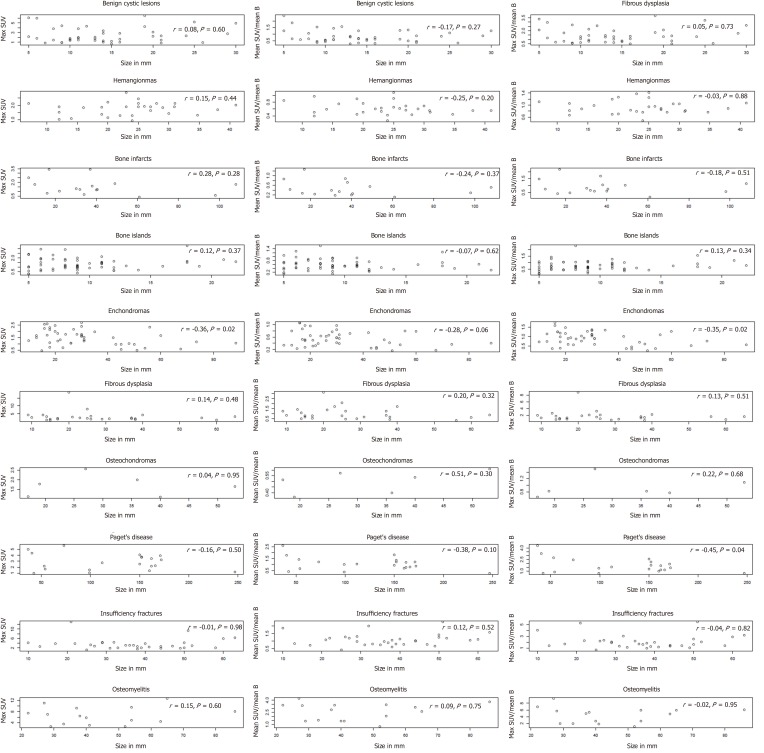
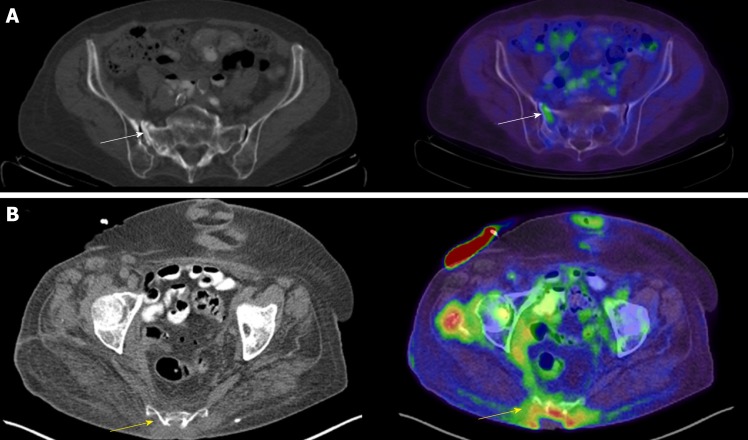
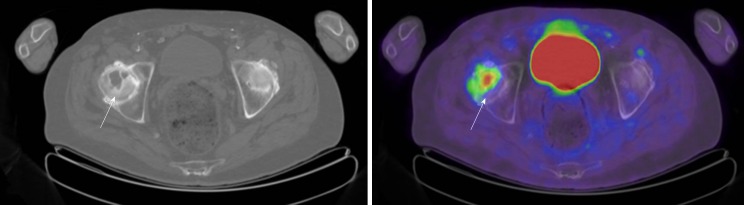
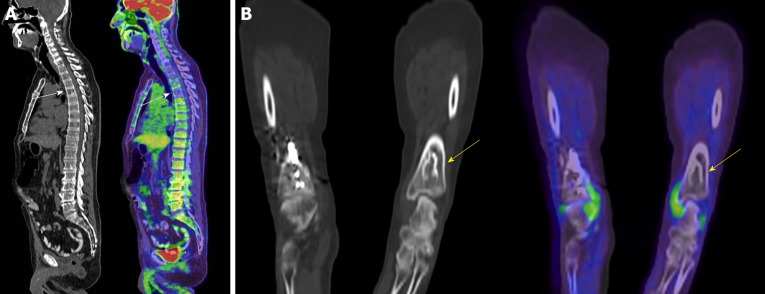
The ranges of the maximum SUV were as follows: For hemangiomas (0.95-2.99), bone infarcts (0.37-3.44), bone islands (0.26-3.29), enchondromas (0.46-2.69), fibrous dysplasia (0.78-18.63), osteochondromas (1.11-2.56), Paget's disease of bone (0.93-5.65), insufficiency fractures (1.06-12.97) and for osteomyelitis (2.57-12.64). The range of the maximum SUV was lowest for osteochondromas (maximum SUV 2.56) and was highest for fibrous dysplasia (maximum SUV of 18.63). There was at least one lesion that demonstrated greater F-FDG avidity than the blood pool amongst each lesion type, with the highest maximum SUV ranging from 9.34 times blood pool mean (osteomyelitis) to 1.42 times blood pool mean (hemangiomas). There was no correlation between the maximum SUV and the lesion size except for enchondromas. Larger enchondromas had higher maximum SUV ( = 0.36, = 0.02).
The classic "do not touch" lesions and classic benign lesions can be F-FDG avid. The CT appearance of these lesions should dictate clinical management rather than the maximum SUV.
在氟代脱氧葡萄糖(F-FDG)正电子发射断层扫描/计算机断层扫描(PET/CT)检查中,有时会发现典型的“无需处理”的良性骨病变。这些病变常被转诊进行活检,因为解读PET/CT的医生可能不熟悉这些病变所显示的F-FDG摄取模式范围。
表明“无需处理”的良性骨病变在PET/CT上的F-FDG摄取可高于血池;因此,这些病变的CT表现应决定治疗方案,而非标准化摄取值(SUV)。
这项回顾性研究评估了287例独立患者,这些患者患有287个典型的“无需处理”的病变(良性囊性病变、应力性骨折、骨岛、骨梗死)或良性骨病变(血管瘤、内生软骨瘤、骨软骨瘤、骨纤维异常增殖症、佩吉特病、骨髓炎),于2006年1月1日至2018年12月1日在一家三级学术医疗机构接受了F-FDG正电子发射断层扫描/计算机断层扫描(PET/CT)检查。计算了最大SUV和平均SUV,以及最大SUV与平均血池的比值。计算了病变大小与最大SUV之间的Pearson相关性。
最大SUV的范围如下:血管瘤(0.95 - 2.99)、骨梗死(0.37 - 3.44)、骨岛(0.26 - 3.29)、内生软骨瘤(0.46 - 2.69)、骨纤维异常增殖症(0.78 - 18.63)、骨软骨瘤(1.11 - 2.56)、骨佩吉特病(0.93 - 5.65)、应力性骨折(1.06 - 12.97)以及骨髓炎(2.57 - 12.64)。骨软骨瘤的最大SUV范围最低(最大SUV为2.56),骨纤维异常增殖症的最大SUV范围最高(最大SUV为18.63)。每种病变类型中至少有一个病变显示出比血池更高的F-FDG摄取,最高最大SUV范围从血池平均的9.34倍(骨髓炎)到血池平均的1.42倍(血管瘤)。除内生软骨瘤外,最大SUV与病变大小之间无相关性。较大的内生软骨瘤具有更高的最大SUV(r = 0.36,P = 0.02)。
典型的“无需处理”病变和典型的良性病变可表现为F-FDG摄取。这些病变的CT表现应决定临床治疗方案,而非最大SUV。