Department of Neurology, Subdepartment of Neuropsychology, University of Groningen, University Medical Center Groningen, Groningen, the Netherlands.
Department of Neurosurgery, University of Groningen, University Medical Center Groningen, Groningen, the Netherlands.
PLoS One. 2019 Aug 9;14(8):e0220972. doi: 10.1371/journal.pone.0220972. eCollection 2019.
Cognitive deficits are frequently found after subarachnoid hemorrhage (SAH), but their influence on return to work is largely unknown. To improve identification of those patients at-risk for long-term return to work problems, we aimed to examine the value of cognitive deficits in the prediction of long-term return to work after subarachnoid hemorrhage.
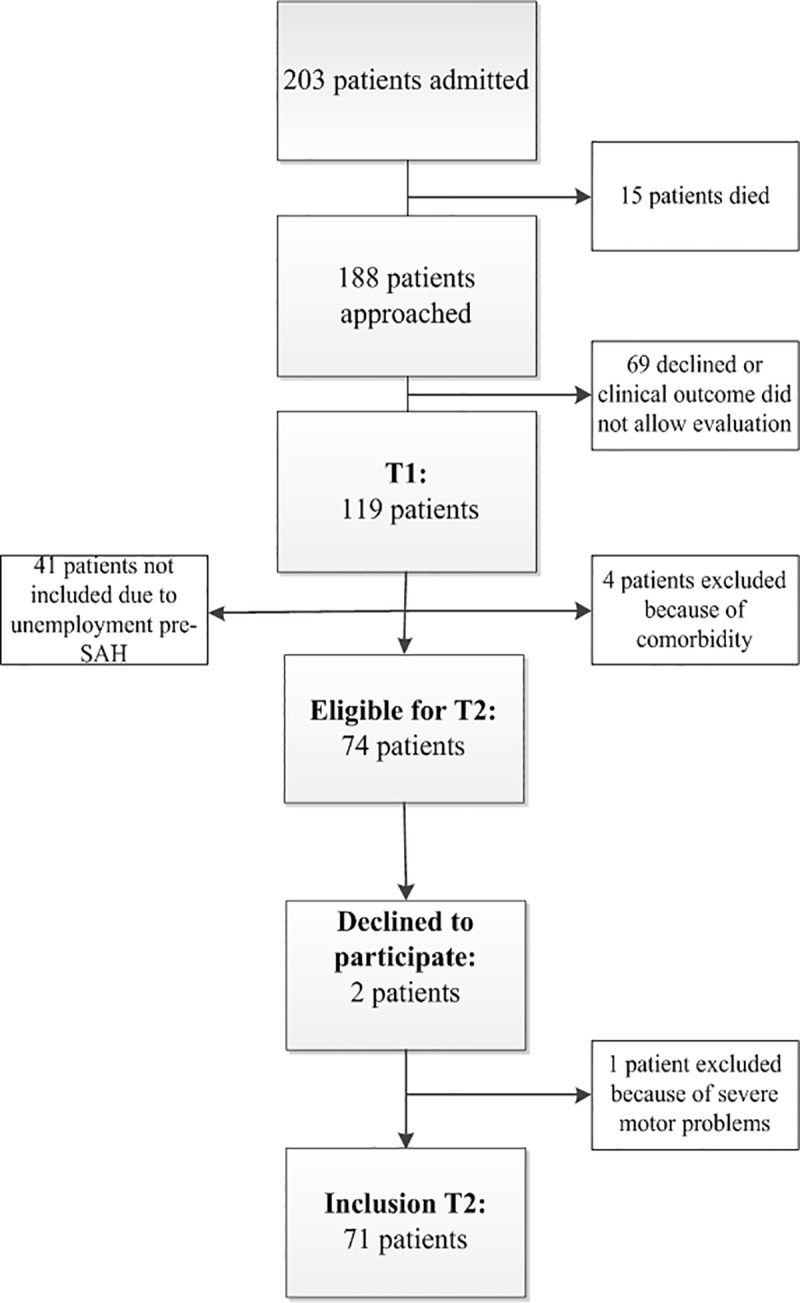
SAH patients (N = 71) who were employed before SAH and were able to undergo neuropsychological assessment, were included. Demographic characteristics and acute SAH-related variables (SAH-type and external cerebrospinal fluid drainage) were taken into account. Neuropsychological tests for memory, speed, attention, executive function, and emotion recognition and a questionnaire for executive functions were used. Return to work was assessed using the Role Resumption List.
Results showed that patients with incomplete return to work had significantly lower scores on neuropsychological measures for complex attention and executive functions (p < 0.05) compared to patients with complete return to work. Return to work could not be significantly predicted using only demographic characteristics and acute SAH-related variables, but adding measures of complex attention and executive functions resulted in a prognostic model that could reliably distinguish between complete and incomplete return to work. Statistically significant predictors in the final model were cerebrospinal fluid drainage and scores on a questionnaire for executive functions: patients with cerebrospinal fluid drainage and higher scores on the a questionnaire for executive functions were less likely to return to work.
Together, these findings show that neuropsychological measures, especially for complex attention and executive functions, have added value to acute SAH-related and demographic variables in the prediction of long-term return to work after SAH.
蛛网膜下腔出血(SAH)后常出现认知障碍,但它们对重返工作岗位的影响尚不清楚。为了更好地识别那些有长期重返工作岗位问题风险的患者,我们旨在研究认知障碍对 SAH 后长期重返工作岗位的预测价值。
纳入了 71 名在 SAH 前有工作且能够接受神经心理学评估的 SAH 患者。考虑了人口统计学特征和急性 SAH 相关变量(SAH 类型和外引流脑脊液)。使用了记忆、速度、注意力、执行功能和情绪识别的神经心理学测试以及执行功能问卷。使用角色恢复清单评估重返工作岗位情况。
结果显示,与完全重返工作岗位的患者相比,不完全重返工作岗位的患者在复杂注意力和执行功能的神经心理学测量中得分明显较低(p<0.05)。仅使用人口统计学特征和急性 SAH 相关变量无法可靠预测重返工作岗位情况,但添加复杂注意力和执行功能的测量结果可得出一个预后模型,该模型可可靠地区分完全和不完全重返工作岗位。最终模型中的统计学显著预测因子是脑脊液引流和执行功能问卷的得分:接受脑脊液引流和执行功能问卷得分较高的患者不太可能重返工作岗位。
这些发现表明,神经心理学测量,特别是复杂注意力和执行功能的测量,在预测 SAH 后长期重返工作岗位方面,对急性 SAH 相关和人口统计学变量具有附加价值。