Motoneuron Disease: Pathophysiology and Therapy, The Neuroscience Institute of Montpellier, University of Montpellier, Montpellier, Laboratoire de Biochimie et Biologie Moléculaire, Nimes University Hospital, 30029 Nîmes, France.
Laboratoire de Biochimie et Biologie Moléculaire, Nimes University Hospital, University of Montpellier, 30029 Nîmes, France.
Int J Mol Sci. 2019 Aug 8;20(16):3858. doi: 10.3390/ijms20163858.
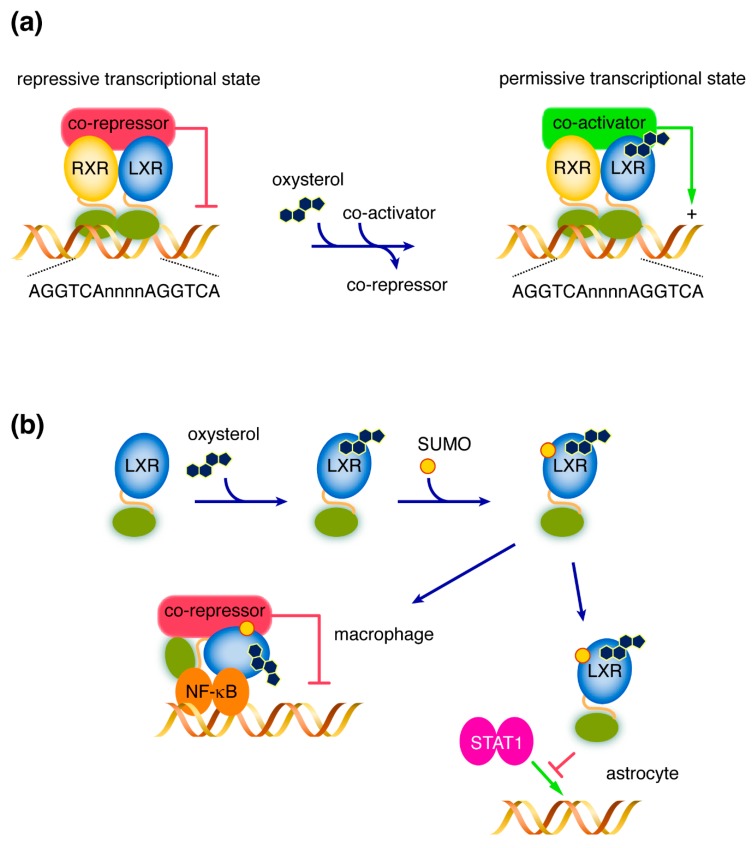
Liver X Receptors (LXR) alpha and beta are two members of nuclear receptor superfamily documented as endogenous cholesterol sensors. Following conversion of cholesterol in oxysterol, both LXR isoforms detect intracellular concentrations and act as transcription factors to promote expression of target genes. Among their numerous physiological roles, they act as central cholesterol-lowering factors. In the central nervous system (CNS), cholesterol has been shown to be an essential determinant of brain function, particularly as a major constituent of myelin and membranes. In the brain, LXRs act as cholesterol central regulators, and, beyond this metabolic function, LXRs have additional roles such as providing neuroprotective effects and lowering neuroinflammation. In many neurodegenerative disorders, including amyotrophic lateral sclerosis (ALS), Alzheimer's disease (AD), and multiple sclerosis (MS), dysregulations of cholesterol and oxysterol have been reported. In this paper, we propose to focus on recent advances in the knowledge of the LXRs roles on brain cholesterol and oxysterol homeostasis, neuroinflammation, neuroprotection, and their putative involvement in neurodegenerative disorders. We will discuss their potential use as candidates for both molecular diagnosis and as promising pharmacological targets in the treatment of ALS, AD, or MS patients.
肝 X 受体 (LXR)α 和β是核受体超家族的两个成员,被证明是内源性胆固醇传感器。在胆固醇转化为氧化固醇后,两种 LXR 同工型都能检测到细胞内浓度,并作为转录因子促进靶基因的表达。在它们众多的生理作用中,它们是降低胆固醇的重要因素。在中枢神经系统 (CNS) 中,胆固醇被证明是大脑功能的重要决定因素,特别是作为髓鞘和膜的主要成分。在大脑中,LXR 作为胆固醇的中央调节剂发挥作用,除了这种代谢功能外,LXR 还有其他作用,如提供神经保护作用和降低神经炎症。在许多神经退行性疾病中,包括肌萎缩侧索硬化症 (ALS)、阿尔茨海默病 (AD) 和多发性硬化症 (MS),已经报道了胆固醇和氧化固醇的失调。在本文中,我们拟重点关注 LXR 在大脑胆固醇和氧化固醇稳态、神经炎症、神经保护方面的最新研究进展,及其在神经退行性疾病中的潜在作用。我们将讨论它们作为分子诊断候选物的潜在用途,以及作为治疗 ALS、AD 或 MS 患者的有前途的药物靶点。