Graduate School of Environmental Studies, Tohoku University, 468-1 Aoba, Aramaki, Aoba-ku, Sendai, Miyagi, 9800845, Japan.
Division of Establishment for Graduate School of Health Innovation, Kanagawa University of Human Services, 2F Bldg.2-A, 3-25-10, Tonomachi, Kawasaki-ku, Kawasaki, Kanagawa, 2100821, Japan.
BMC Public Health. 2019 Aug 9;19(1):1085. doi: 10.1186/s12889-019-7443-4.
The reductions achieved in infant mortality in Japan are globally regarded as remarkable. However, no studies in Japan have classified infant mortality trends into neonatal and postneonatal or considered regional issues. This study aimed to explore trends in neonatal and postneonatal deaths, both overall for Japan and in a region affected by a natural disaster.
Drawing on national infant death data, we used a multi-attribute compositional study design to examine all infant deaths occurring in a region affected by a disaster (Tohoku, which consists of Iwate, Miyagi, and Fukushima) between 2002 and 2012. We used conjoint analysis to clarify the associations between infant and maternal characteristics and age of infant death.
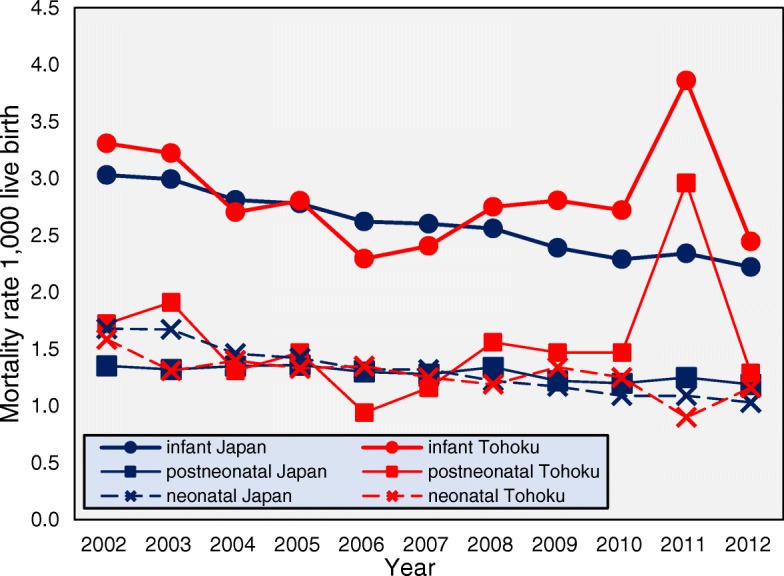
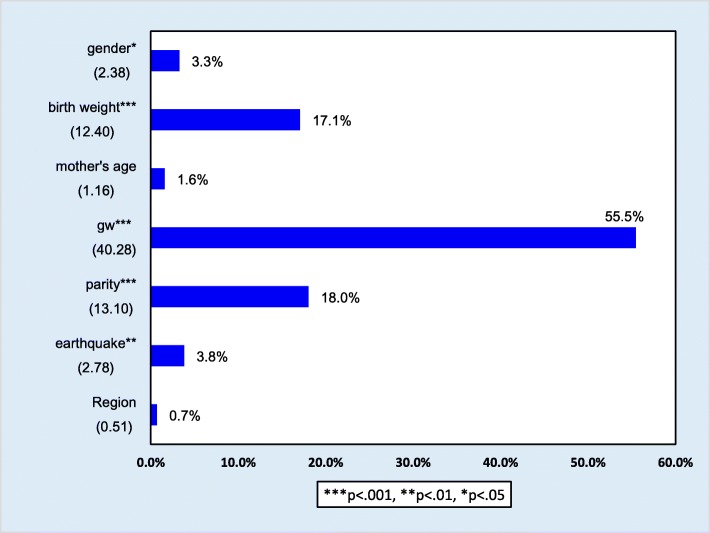
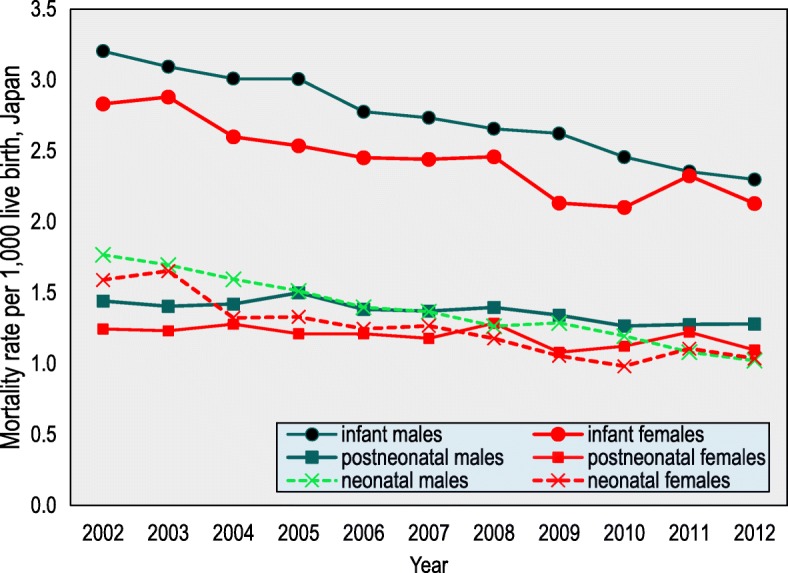
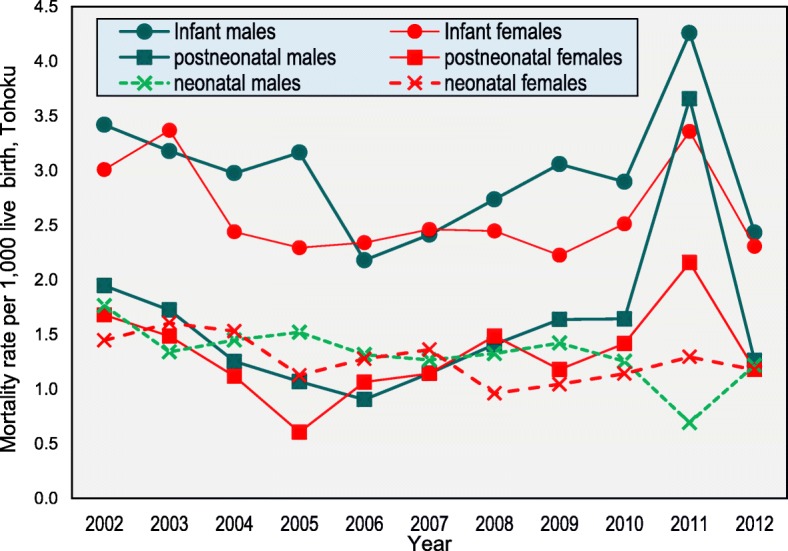
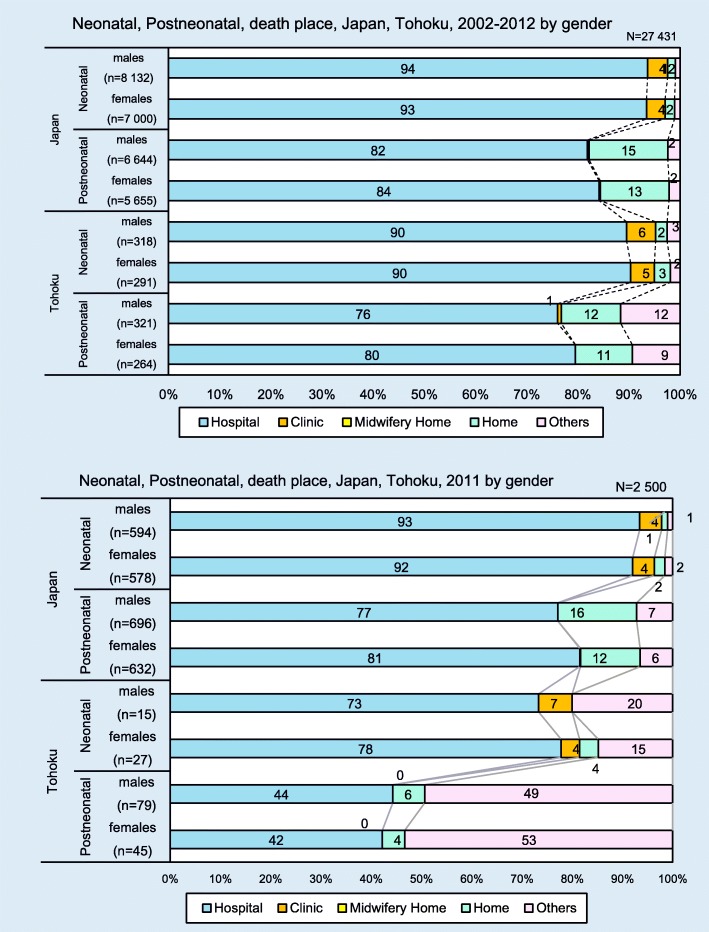
We obtained data of a total of 31,012 infant deaths between 2002 and 2012, which included 1450 from Tohoku. Infant mortality rates in Japan overall declined over the period but increased in 2011. There were more postneonatal (29-364 days post-birth) than neonatal (0-28 days post-birth) deaths. Infant deaths in Tohoku declined slightly overall, with a fluctuation in 2011. In Tohoku, the trends in postneonatal death rates were similar; the overall rates for males increased, but those for females decreased in 2011. We found that the cause and place of infant death differed by gender for neonatal and postneonatal deaths in both Japan in general and Tohoku. The conjoint analysis showed that most variables affected the age of postneonatal death. The factor with the largest influence on the variation in infant death age was gestational week (55.5%). A maternal gestational week ≤36 was linked to an average age at death of 43.4 days, and > 37 was linked to an average of 83.7 days.
In Japan, infant death rates have declined steadily over the past 10 years. The recent trends indicated that postneonatal death rates were higher than neonatal rates, especially in Tohoku. However, not much attention has been focused on postneonatal deaths in Japan. Our findings may help health planners to prioritise work on the factors that are linked to infant deaths in the neonatal and postneonatal periods.
Not applicable.
日本在婴儿死亡率方面的降幅在全球范围内备受瞩目。然而,日本国内尚无研究对婴儿死亡率趋势进行分类,也未考虑到新生儿和超过新生儿期的情况以及区域性问题。本研究旨在探索日本全国和受自然灾害影响地区(由岩手、宫城和福岛三县组成的东北地区)的新生儿和超过新生儿期的婴儿死亡趋势。
我们利用全国婴儿死亡数据,采用多属性成分研究设计,分析了 2002 年至 2012 年期间受灾地区(东北地区)所有婴儿死亡情况(共 31012 例,其中包括 1450 例来自东北地区的死亡)。我们采用联合分析明确了婴儿和产妇特征以及婴儿死亡年龄之间的关联。
我们获得了 2002 年至 2012 年期间共 31012 例婴儿死亡数据,其中包括 1450 例来自东北地区的死亡。在此期间,日本全国婴儿死亡率整体呈下降趋势,但 2011 年有所上升。超过新生儿期(出生后 29-364 天)的死亡人数多于新生儿期(出生后 0-28 天)。东北地区的婴儿死亡率整体略有下降,2011 年有所波动。东北地区的新生儿和超过新生儿期的死亡率趋势相似,男性的总体死亡率上升,而女性的死亡率下降。我们发现,日本全国和东北地区的新生儿和超过新生儿期的婴儿死亡原因和地点因性别而异。联合分析表明,大多数变量均影响了超过新生儿期死亡的年龄。对婴儿死亡年龄变化影响最大的因素是孕周(55.5%)。小于等于 36 周的产妇的平均死亡年龄为 43.4 天,大于 37 周的产妇的平均死亡年龄为 83.7 天。
在过去 10 年中,日本的婴儿死亡率稳步下降。最近的趋势表明,超过新生儿期的死亡率高于新生儿期,尤其是在东北地区。然而,日本对超过新生儿期的婴儿死亡并未给予太多关注。我们的研究结果可能有助于卫生规划者优先考虑与新生儿和超过新生儿期婴儿死亡相关的因素。
不适用。