Department of Biotechnology, University of Natural Resources and Life Science, Vienna, Austria.
PL BioScience GmbH, Technology Centre Aachen, Aachen, Germany.
Stem Cell Res Ther. 2019 Aug 9;10(1):248. doi: 10.1186/s13287-019-1346-2.
Mesenchymal stem/stromal cells (MSCs) are considered an important candidate in cell therapy and tissue engineering approaches. The culture of stem cells in a 3D environment is known to better resemble the in vivo situation and to promote therapeutically relevant effects in isolated cells. Therefore, the aim of this study was to develop an approach for the direct isolation of MSCs from adipose tissue into a 3D environment, avoiding contact to a 2D plastic surface. Furthermore, the use of a cryoprotective medium for the cryopreservation of whole adipose tissue was evaluated.
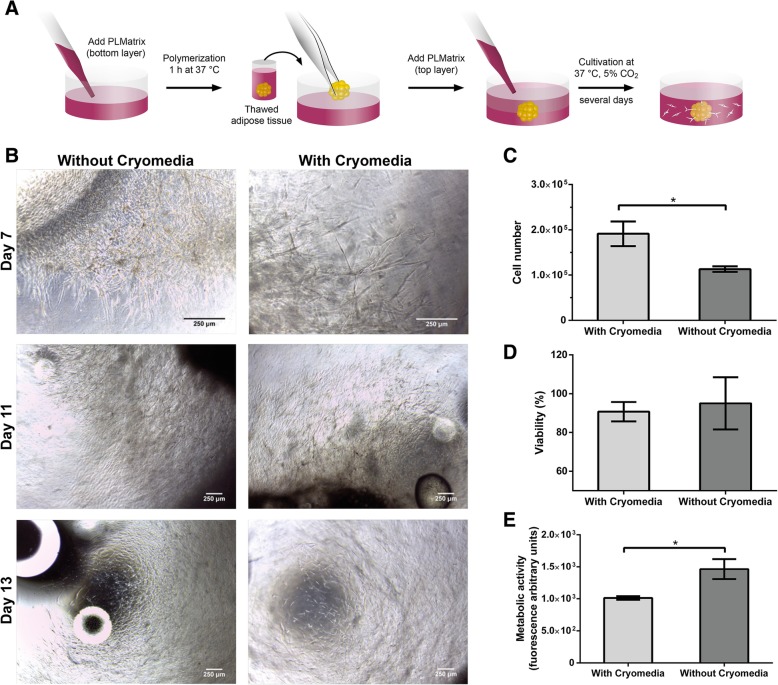
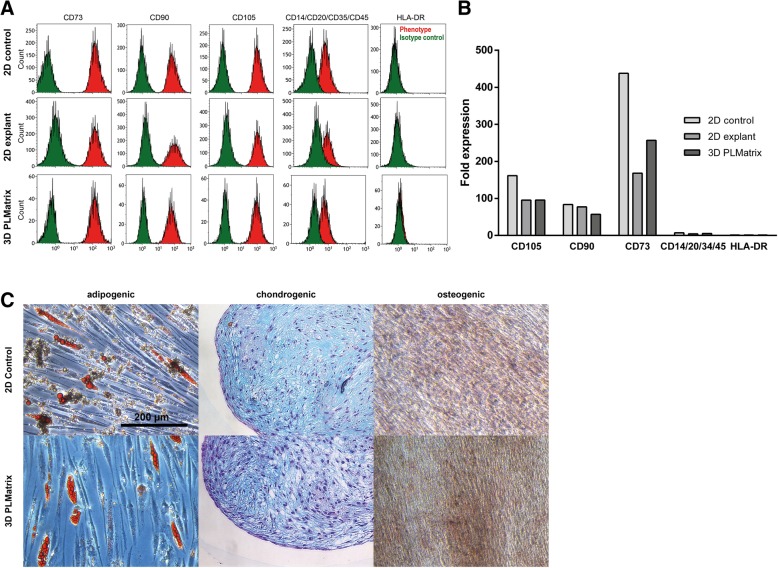
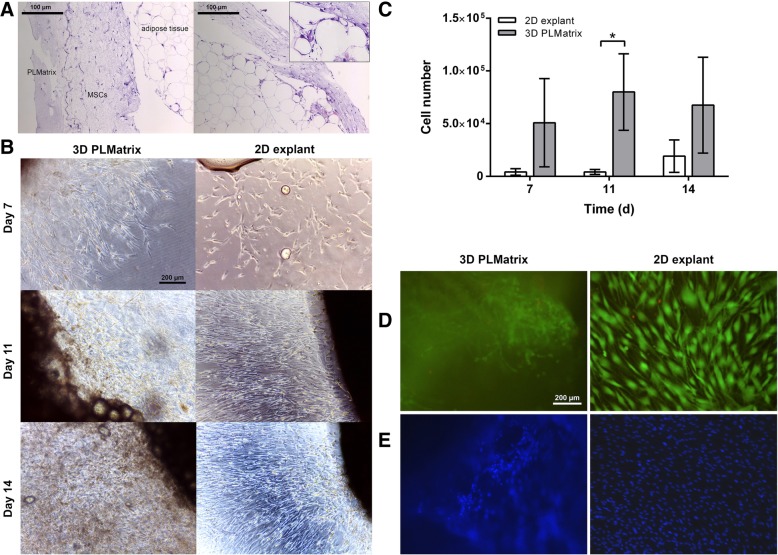
Cryopreservation of fresh adipose tissue with and without a cryoprotective medium was compared with regard to the viability and metabolic activity of cells. After thawing, the tissue was embedded in a novel human platelet lysate-based hydrogel for the isolation of MSCs. The migration, yield, viability, and metabolic activity of cells from the 3D matrix were compared to cells from 2D explant culture. Also, the surface marker profile and differentiation capacity of MSCs from the 3D matrix were evaluated and compared to MSCs from isolation by enzymatic treatment or 2D explant culture.
The cryopreservation of whole adipose tissue was found to be feasible, and therefore, adipose tissue can be stored and is available for MSC isolation on demand. Also, we demonstrate the isolation of MSCs from adipose tissue into the 3D matrix. The cells derived from this isolation procedure display a similar phenotype and differentiation capacity like MSCs derived by traditional procedures.
The presented approach allows to cryopreserve adipose tissue. Furthermore, for the first time, MSCs were directly isolated from the tissue into a soft 3D hydrogel environment, avoiding any contact to a 2D plastic culture surface.
间充质干细胞(MSCs)被认为是细胞治疗和组织工程方法中的重要候选物。将干细胞在 3D 环境中培养已知更能模拟体内情况,并促进分离细胞的治疗相关效应。因此,本研究的目的是开发一种从脂肪组织中直接分离 MSC 进入 3D 环境的方法,避免与 2D 塑料表面接触。此外,还评估了使用冷冻保护剂对整个脂肪组织进行冷冻保存的方法。
比较了新鲜脂肪组织在有和没有冷冻保护剂的情况下的冷冻保存,以评估细胞的活力和代谢活性。解冻后,将组织嵌入一种新型的基于人血小板裂解物的水凝胶中,用于分离 MSC。比较了从 3D 基质中迁移、产量、活力和代谢活性的细胞与从 2D 外植体培养的细胞。还评估了从 3D 基质中分离的 MSC 的表面标志物谱和分化能力,并与通过酶处理或 2D 外植体培养分离的 MSC 进行了比较。
发现整个脂肪组织的冷冻保存是可行的,因此可以储存脂肪组织,并可根据需要从 3D 基质中分离 MSC。我们还证明了从脂肪组织中分离 MSC 进入 3D 基质。从该分离过程中获得的细胞显示出与通过传统方法获得的 MSC 相似的表型和分化能力。
所提出的方法允许冷冻保存脂肪组织。此外,这是首次直接从组织中分离 MSC 进入软 3D 水凝胶环境,避免与 2D 塑料培养表面接触。