Li Jie, Liu Wenjing, Hao Hongling, Wang Qiuyi, Xue Liying
Department of Hematology, Hebei General Hospital, Shijiazhuang, Hebei 050000, P.R. China.
Department of Pathology, Hebei Medical University, Shijiazhuang, Hebei 050000, P.R. China.
Oncol Lett. 2019 Sep;18(3):2694-2703. doi: 10.3892/ol.2019.10589. Epub 2019 Jul 9.
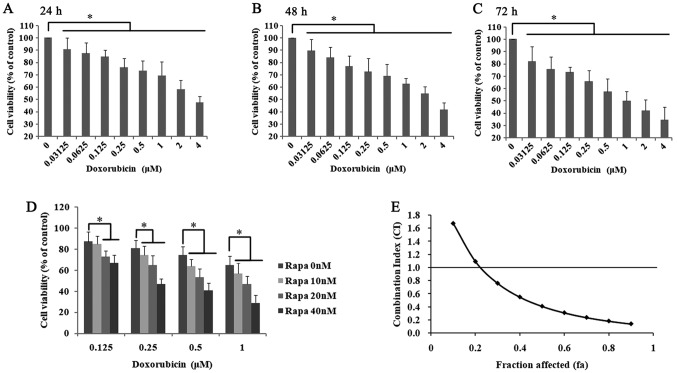
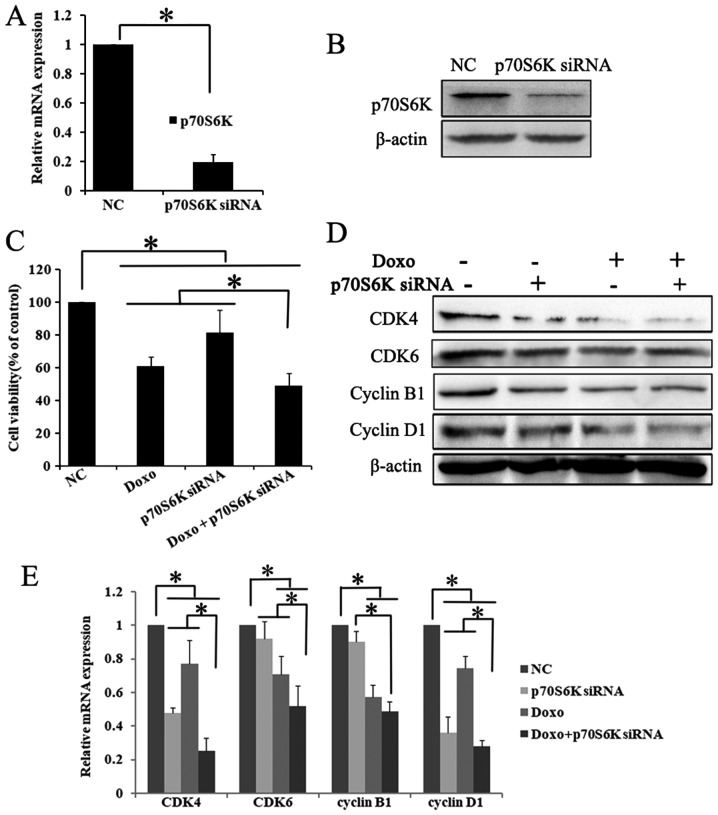
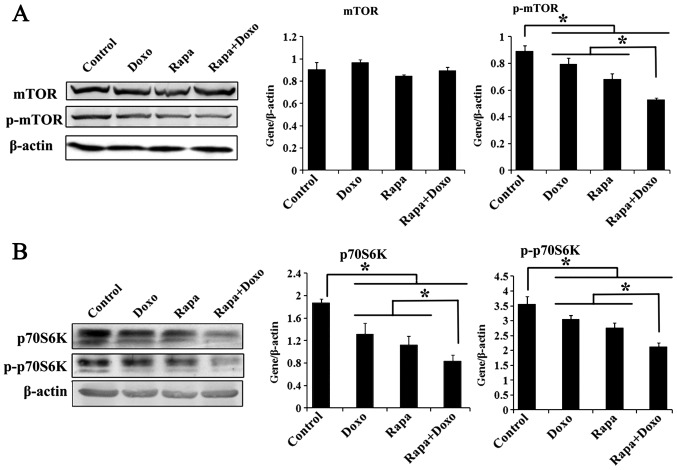
Chronic myelogenous leukemia (CML) is a common hematological malignancy. Some patients progressing to the blast phase develop chemotherapeutic drug resistance. In the authors' previous study, it was found that the mammalian target of rapamycin (mTOR) pathway was activated in CML and that rapamycin inhibited the proliferation of K562 cells. Targeting the mTOR pathway may be used in combination with chemotherapeutic drugs to enhance their efficacy and overcome multidrug resistance. The aim of the present study was to investigate the effects of rapamycin and doxorubicin on K562 cell proliferation following the combination treatment, and further focus on confirming whether rapamycin enhanced the antitumor effects of doxorubicin by downregulating the mTOR/ribosomal protein S6 kinase (p70S6K) pathway. It was found that rapamycin and doxorubicin significantly decreased the viability of K562 cells. The apoptotic cells were more frequently detected in rapamycin and doxorubicin treatment groups (25.50±1.25%). Both drugs decreased Bcl-2 and increased Bax expression in K562 cells. Rapamycin and doxorubicin also reduced the phosphorylation levels of mTOR and p70S6K. Meanwhile, p70S6K-targeting small interfering (si)RNA and doxorubicin inhibited cell proliferation and regulated key factors of the cell cycle. In addition, the exposure of cells to p70S6K siRNA and doxorubicin significantly increased cell apoptosis, as compared with single treatment. These results suggested that rapamycin could enhance the antitumor effects of doxorubicin on K562 cells by downregulating mTOR/p70S6K signaling. Targeting the mTOR/p70S6K pathway may be a new therapeutic approach for leukemia.
慢性粒细胞白血病(CML)是一种常见的血液系统恶性肿瘤。一些进展至急变期的患者会产生化疗耐药性。在作者之前的研究中,发现雷帕霉素的哺乳动物靶点(mTOR)通路在CML中被激活,并且雷帕霉素可抑制K562细胞的增殖。靶向mTOR通路可与化疗药物联合使用,以增强其疗效并克服多药耐药性。本研究的目的是探讨雷帕霉素和阿霉素联合治疗后对K562细胞增殖的影响,并进一步着重确认雷帕霉素是否通过下调mTOR/核糖体蛋白S6激酶(p70S6K)通路来增强阿霉素的抗肿瘤作用。结果发现,雷帕霉素和阿霉素显著降低了K562细胞的活力。在雷帕霉素和阿霉素治疗组中更频繁地检测到凋亡细胞(25.50±1.25%)。两种药物均降低了K562细胞中Bcl-2的表达并增加了Bax的表达。雷帕霉素和阿霉素还降低了mTOR和p70S6K的磷酸化水平。同时,靶向p70S6K的小干扰(si)RNA和阿霉素抑制细胞增殖并调节细胞周期的关键因子。此外,与单一治疗相比,细胞暴露于p70S6K siRNA和阿霉素会显著增加细胞凋亡。这些结果表明,雷帕霉素可通过下调mTOR/p70S6K信号增强阿霉素对K562细胞的抗肿瘤作用。靶向mTOR/p70S6K通路可能是白血病的一种新的治疗方法。