Ntalampiras Stavros A, Ludovico Luca Andrea, Presti Giorgio, Prato Previde Emanuela Prato, Battini Monica, Cannas Simona, Palestrini Clara, Mattiello Silvana
Department of Computer Science, University of Milan, 20133 Milan, Italy.
Department of Pathophysiology and Transplantation, University of Milan, 20133 Milan, Italy.
Animals (Basel). 2019 Aug 9;9(8):543. doi: 10.3390/ani9080543.
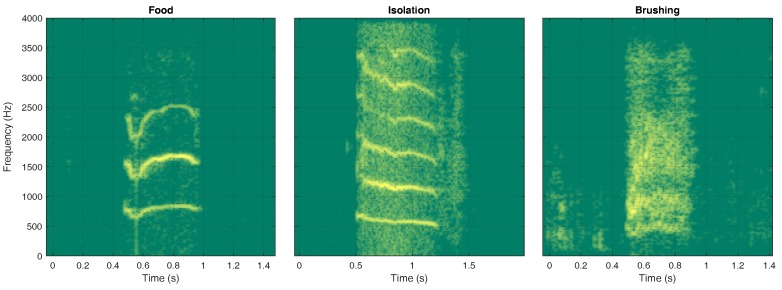
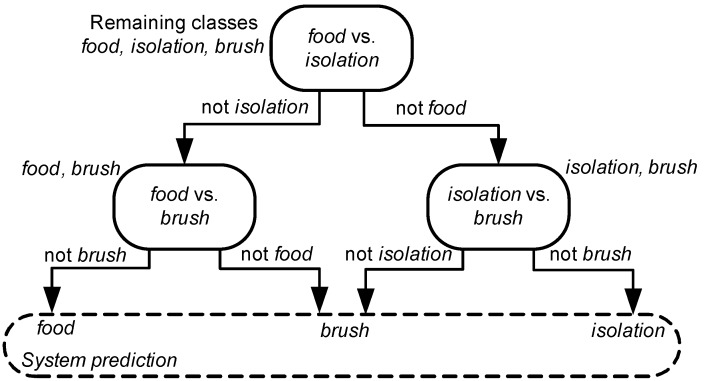
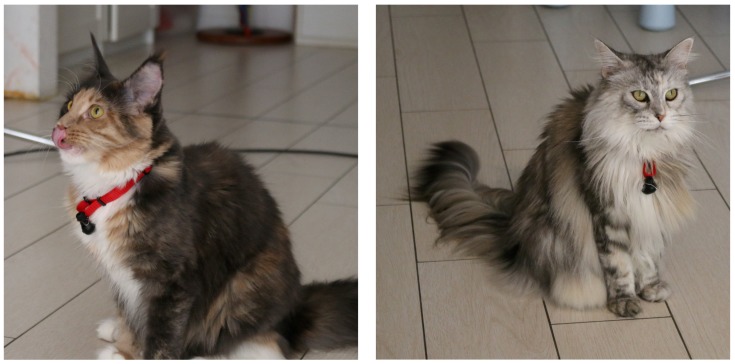
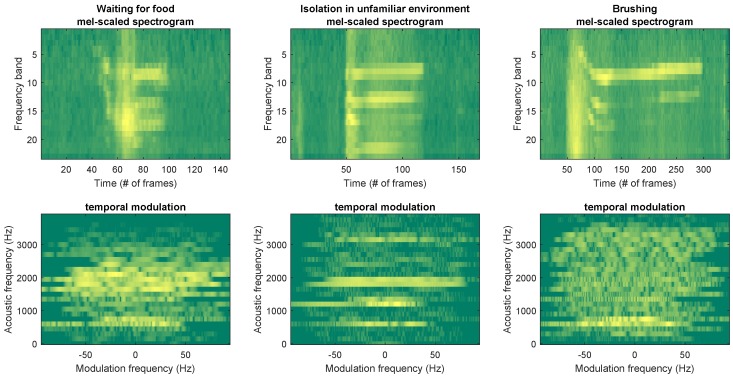
Cats employ vocalizations for communicating information, thus their sounds can carry a widerange of meanings. Concerning vocalization, an aspect of increasing relevance directly connected withthe welfare of such animals is its emotional interpretation and the recognition of the production context.To this end, this work presents a proof of concept facilitating the automatic analysis of cat vocalizationsbased on signal processing and pattern recognition techniques, aimed at demonstrating if the emissioncontext can be identified by meowing vocalizations, even if recorded in sub-optimal conditions. Werely on a dataset including vocalizations of and . Towards capturing theemission context, we extract two sets of acoustic parameters, i.e., mel-frequency cepstral coefficients andtemporal modulation features. Subsequently, these are modeled using a classification scheme based ona directed acyclic graph dividing the problem space. The experiments we conducted demonstrate thesuperiority of such a scheme over a series of generative and discriminative classification solutions. Theseresults open up new perspectives for deepening our knowledge of acoustic communication betweenhumans and cats and, in general, between humans and animals.
猫通过发声来传达信息,因此它们的声音可以有广泛的含义。关于发声,与这类动物的福利直接相关的一个越来越重要的方面是其情感解读以及对发声情境的识别。为此,这项工作提出了一个概念验证,基于信号处理和模式识别技术促进对猫叫声的自动分析,旨在证明即使在次优条件下录制,是否可以通过喵喵叫声识别出发声情境。我们依赖于一个包含[具体猫的名称1]和[具体猫的名称2]叫声的数据集。为了捕捉发声情境,我们提取了两组声学参数,即梅尔频率倒谱系数和时间调制特征。随后,使用基于有向无环图划分问题空间的分类方案对这些参数进行建模。我们进行的实验证明了该方案相对于一系列生成式和判别式分类解决方案的优越性。这些结果为深化我们对人类与猫之间以及一般人类与动物之间声学通信的认识开辟了新的视角。