Pramono Renard Xaviero Adhi, Bowyer Stuart, Rodriguez-Villegas Esther
Department of Electrical and Electronic Engineering, Imperial College London, London, United Kingdom.
PLoS One. 2017 May 26;12(5):e0177926. doi: 10.1371/journal.pone.0177926. eCollection 2017.
Automatic detection or classification of adventitious sounds is useful to assist physicians in diagnosing or monitoring diseases such as asthma, Chronic Obstructive Pulmonary Disease (COPD), and pneumonia. While computerised respiratory sound analysis, specifically for the detection or classification of adventitious sounds, has recently been the focus of an increasing number of studies, a standardised approach and comparison has not been well established.
To provide a review of existing algorithms for the detection or classification of adventitious respiratory sounds. This systematic review provides a complete summary of methods used in the literature to give a baseline for future works.
A systematic review of English articles published between 1938 and 2016, searched using the Scopus (1938-2016) and IEEExplore (1984-2016) databases. Additional articles were further obtained by references listed in the articles found. Search terms included adventitious sound detection, adventitious sound classification, abnormal respiratory sound detection, abnormal respiratory sound classification, wheeze detection, wheeze classification, crackle detection, crackle classification, rhonchi detection, rhonchi classification, stridor detection, stridor classification, pleural rub detection, pleural rub classification, squawk detection, and squawk classification.
Only articles were included that focused on adventitious sound detection or classification, based on respiratory sounds, with performance reported and sufficient information provided to be approximately repeated.
Investigators extracted data about the adventitious sound type analysed, approach and level of analysis, instrumentation or data source, location of sensor, amount of data obtained, data management, features, methods, and performance achieved.
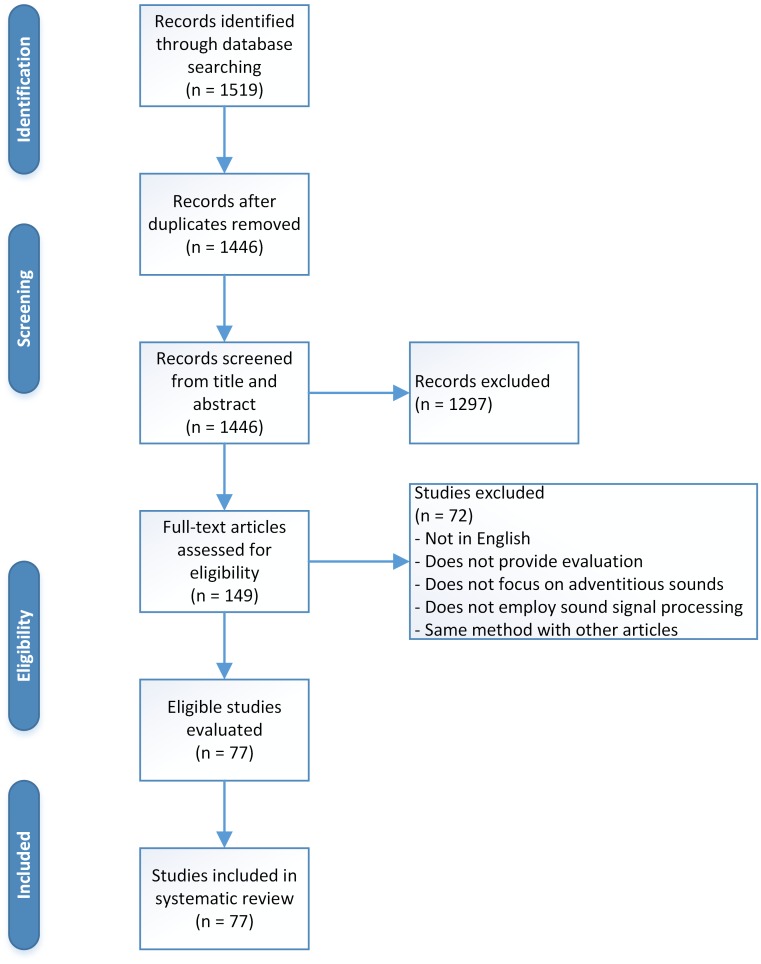
A total of 77 reports from the literature were included in this review. 55 (71.43%) of the studies focused on wheeze, 40 (51.95%) on crackle, 9 (11.69%) on stridor, 9 (11.69%) on rhonchi, and 18 (23.38%) on other sounds such as pleural rub, squawk, as well as the pathology. Instrumentation used to collect data included microphones, stethoscopes, and accelerometers. Several references obtained data from online repositories or book audio CD companions. Detection or classification methods used varied from empirically determined thresholds to more complex machine learning techniques. Performance reported in the surveyed works were converted to accuracy measures for data synthesis.
Direct comparison of the performance of surveyed works cannot be performed as the input data used by each was different. A standard validation method has not been established, resulting in different works using different methods and performance measure definitions.
A review of the literature was performed to summarise different analysis approaches, features, and methods used for the analysis. The performance of recent studies showed a high agreement with conventional non-automatic identification. This suggests that automated adventitious sound detection or classification is a promising solution to overcome the limitations of conventional auscultation and to assist in the monitoring of relevant diseases.
附加音的自动检测或分类有助于医生诊断或监测哮喘、慢性阻塞性肺疾病(COPD)和肺炎等疾病。虽然计算机化呼吸音分析,特别是针对附加音的检测或分类,最近已成为越来越多研究的焦点,但尚未建立标准化的方法和比较。
对现有的附加呼吸音检测或分类算法进行综述。本系统综述全面总结了文献中使用的方法,为未来的研究提供了基线。
对1938年至2016年间发表的英文文章进行系统综述,使用Scopus(1938 - 2016)和IEEExplore(1984 - 2016)数据库进行检索。通过所发现文章中列出的参考文献进一步获取其他文章。检索词包括附加音检测、附加音分类、异常呼吸音检测、异常呼吸音分类、哮鸣音检测、哮鸣音分类、湿啰音检测、湿啰音分类、鼾音检测、鼾音分类、喘鸣音检测、喘鸣音分类、胸膜摩擦音检测、胸膜摩擦音分类、嘎吱声检测和嘎吱声分类。
仅纳入基于呼吸音专注于附加音检测或分类的文章,报告了性能并提供了足够信息以便大致重复。
研究人员提取了有关分析的附加音类型、分析方法和水平、仪器或数据源、传感器位置、获得的数据量、数据管理、特征、方法以及所取得性能的数据。
本综述共纳入了文献中的77篇报告。55项(71.43%)研究聚焦于哮鸣音,40项(51.95%)聚焦于湿啰音,9项(11.69%)聚焦于喘鸣音,9项(11.69%)聚焦于鼾音,18项(23.38%)聚焦于其他声音,如胸膜摩擦音、嘎吱声以及病理学。用于收集数据的仪器包括麦克风、听诊器和加速度计。若干参考文献从在线存储库或书籍音频CD配套资料中获取数据。所使用的检测或分类方法从经验确定的阈值到更复杂的机器学习技术各不相同。在所调查的研究中报告的性能被转换为用于数据综合的准确性度量。
由于每项研究使用的输入数据不同,无法对所调查研究的性能进行直接比较。尚未建立标准的验证方法,导致不同研究使用不同方法和性能度量定义。
对文献进行了综述,以总结用于分析的不同分析方法、特征和方法。近期研究的性能与传统的非自动识别高度一致。这表明附加音的自动检测或分类是克服传统听诊局限性并协助监测相关疾病的有前景的解决方案。
