Department of Manufacturing and Materials Engineering, Faculty of Engineering, International Islamic University of Malaysia, Kuala Lumpur, Gombak 53100, Malaysia.
Advanced Polymeric Materials Research Lab., Department of Physics, College of Science, University of Sulaimani, Qlyasan Street, Sulaimani 46001, Iraq.
Int J Mol Sci. 2019 Aug 11;20(16):3910. doi: 10.3390/ijms20163910.
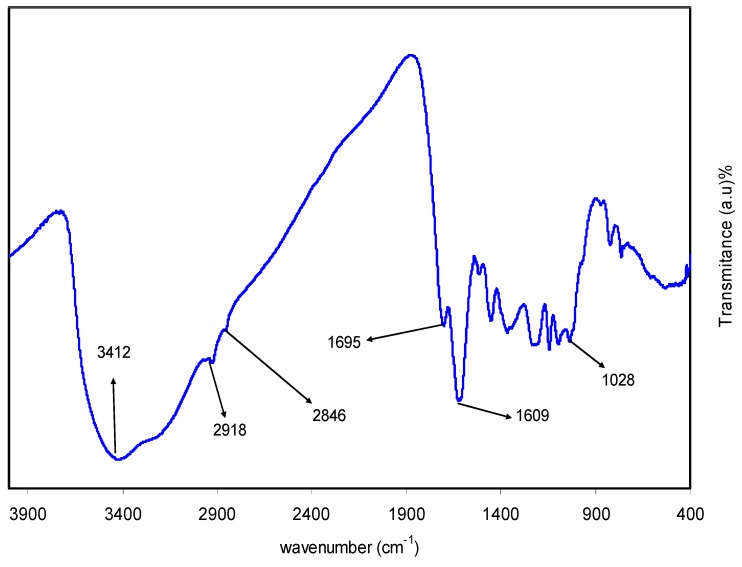
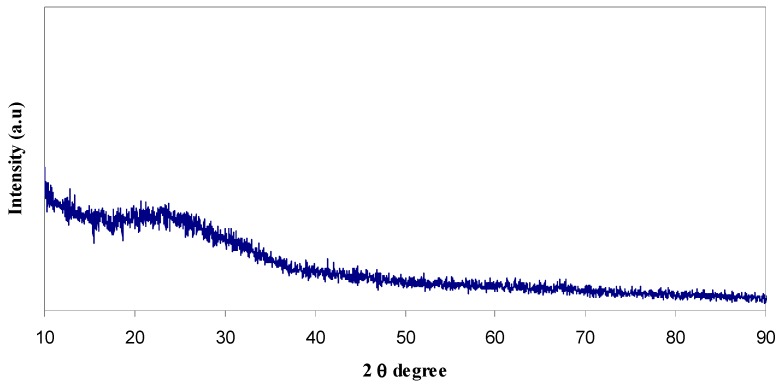
The present work proposed a novel approach for transferring high-risk heavy metals tometal complexes via green chemistry remediation. The method of remediation of heavy metals developed in the present work is a great challenge for global environmental sciences and engineering because it is a totally environmentally friendly procedure in which black tea extract solution is used. The FTIR study indicates that black tea contains enough functional groups (OH and NH), polyphenols and conjugated double bonds. The synthesis of copper complex was confirmed by the UV-vis, XRD and FTIR spectroscopic studies. The XRD and FTIR analysis reveals the formation of complexation between Cu metal complexes and Poly (Vinyl Alcohol) (PVA) host matrix. The study of optical parameters indicates that PVA-based hybrids exhibit a small optical band gap, which is close to inorganic-based materials. It was noted that the absorption edge shifted to lower photon energy. When Cu metal complexes were added to PVA polymer, the refractive index was significantly tuned. The band gap shifts from 6.2 eV to 1.4 eV for PVA incorporated with 45 mL of Cu metal complexes. The nature of the electronic transition in hybrid materials was examined based on the Taucs model, while a close inspection of the optical dielectric loss was also performed in order to estimate the optical band gap. The obtained band gaps of the present work reveal that polymer hybrids with sufficient film-forming capability could be useful to overcome the drawbacks associated with conjugated polymers. Based on the XRD results and band gap values, the structure-property relationships were discussed in detail.
本工作提出了一种通过绿色化学修复将高风险重金属转化为金属配合物的新方法。本工作中开发的重金属修复方法对全球环境科学与工程来说是一个巨大的挑战,因为它是一个完全环保的过程,其中使用了红茶提取物溶液。FTIR 研究表明,红茶含有足够的官能团(OH 和 NH)、多酚和共轭双键。通过 UV-vis、XRD 和 FTIR 光谱研究证实了铜配合物的合成。XRD 和 FTIR 分析表明,Cu 金属配合物与聚(乙烯醇)(PVA)主基质之间形成了配合物。光学参数的研究表明,基于 PVA 的杂化材料表现出较小的光学带隙,接近无机材料。值得注意的是,吸收边缘向低光子能量移动。当 Cu 金属配合物添加到 PVA 聚合物中时,折射率得到了显著调整。当 PVA 与 45 毫升 Cu 金属配合物结合时,带隙从 6.2 eV 转移到 1.4 eV。基于 Taucs 模型研究了杂化材料中电子跃迁的性质,同时还对光学介电损耗进行了仔细检查,以估算光学带隙。本工作得到的带隙表明,具有足够成膜能力的聚合物杂化材料可能有助于克服与共轭聚合物相关的缺点。基于 XRD 结果和带隙值,详细讨论了结构-性能关系。