Wang Xin, Teng Feifei, Lu Jie, Mu Dianbin, Zhang Jianbo, Yu Jinming
Department of Oncology, Renmin Hospital of Wuhan University, Wuhan, Hubei 430060, People's Republic of China.
Department of Radiation Oncology, Shandong Cancer Hospital Affiliated to Shandong University, Shandong Academy of Medical Sciences, Jinan, Shandong 250117, People's Republic of China.
Cancer Manag Res. 2019 Jul 15;11:6593-6602. doi: 10.2147/CMAR.S204924. eCollection 2019.
The inhibitors of nuclear factor kappa-B kinase subunit epsilon () and TANK-binding kinase 1 () are important members of the nonclassical IKK family that share the kinase domain. They are important oncogenes for activation of several signaling pathways in several tumors. This study aims to explore the expression of IKBKE and TBK1 and their prognostic role in stage I non-small cell lung cancer (NSCLC).
A total of 142 surgically resected stage I NSCLC patients were enrolled and immunohistochemistry of IKBKE and TBK1 was performed.
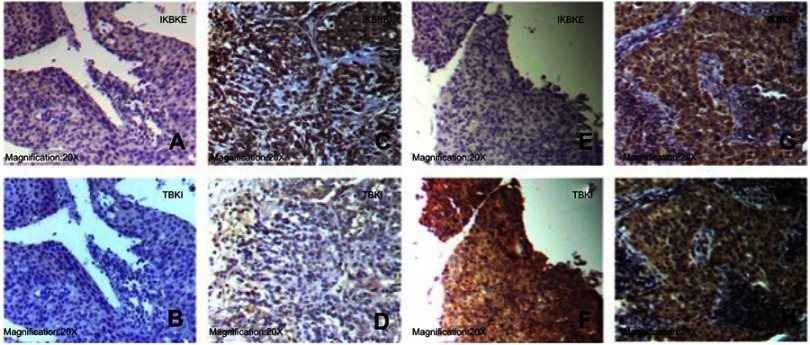
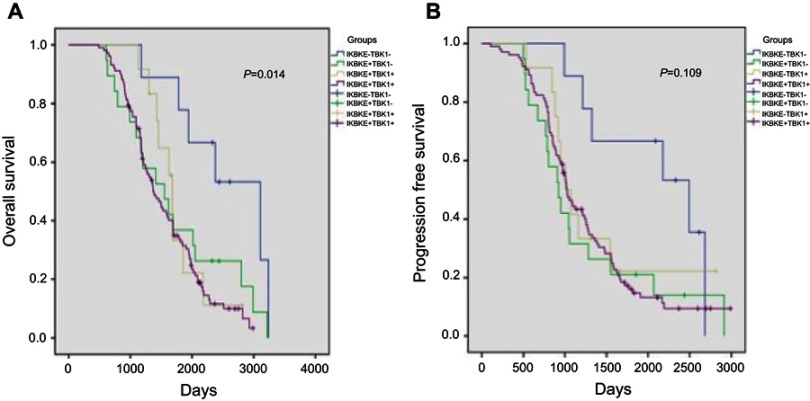
IKBKE and TBK1 were expressed in 121 (85.2%) and 114 (80.3%) of stage I NSCLC patients respectively. IKBKE expression was significantly associated with TBK1 expression (=0.004). Furthermore, multivariate regression analyses showed there was a significant relationship between patients with risk factors, the recurrence pattern of metastasis and IKBKE+/TBK1+ co-expression (=0.032 and =0.022, respectively). In Kaplan-Meier survival curve analyses, the IKBKE+/TBK1+ co-expression subgroup was significantly associated with poor overall survival (=0.014).
This is the first study to investigate the relationship between IKBKE and TBK1 expression and clinicopathologic characteristics in stage I NSCLC patients. IKBKE+/TBK1+ co-expression was significantly obvious in patients with risk factors and with recurrence pattern of distant metastasis. Furthermore, IKBKE+/TBK1+ is also an effective prognostic predictor for poor overall survival.
核因子κB激酶亚基ε(IKBKE)和TANK结合激酶1(TBK1)抑制剂是非经典IKK家族的重要成员,它们共享激酶结构域。它们是多种肿瘤中激活多种信号通路的重要癌基因。本研究旨在探讨IKBKE和TBK1在Ⅰ期非小细胞肺癌(NSCLC)中的表达及其预后作用。
共纳入142例接受手术切除的Ⅰ期NSCLC患者,并对IKBKE和TBK1进行免疫组织化学检测。
Ⅰ期NSCLC患者中IKBKE和TBK1的表达率分别为121例(85.2%)和114例(80.3%)。IKBKE表达与TBK1表达显著相关(P = 0.004)。此外,多因素回归分析显示,有危险因素的患者、转移复发模式与IKBKE+/TBK1+共表达之间存在显著关系(分别为P = 0.032和P = 0.022)。在Kaplan-Meier生存曲线分析中,IKBKE+/TBK1+共表达亚组与总生存期较差显著相关(P = 0.014)。
本研究首次探讨了IKBKE和TBK1表达与Ⅰ期NSCLC患者临床病理特征之间的关系。IKBKE+/TBK1+共表达在有危险因素和远处转移复发模式的患者中明显更显著。此外,IKBKE+/TBK1+也是总生存期较差的有效预后预测指标。