Rodríguez-Antolín Carlos, Felguera-Selas Laura, Pernía Olga, Vera Olga, Esteban Isabel, Losantos García Itsaso, de Castro Javier, Rosas-Alonso Rocío, Ibanez de Caceres Inmaculada
1Cancer Epigenetics Laboratory, INGEMM, La Paz University Hospital, Madrid, Spain.
2Biomarkers and Experimental Therapeutics in Cancer, IdiPAZ, Madrid, Spain.
Cell Biosci. 2019 Aug 7;9:63. doi: 10.1186/s13578-019-0326-7. eCollection 2019.
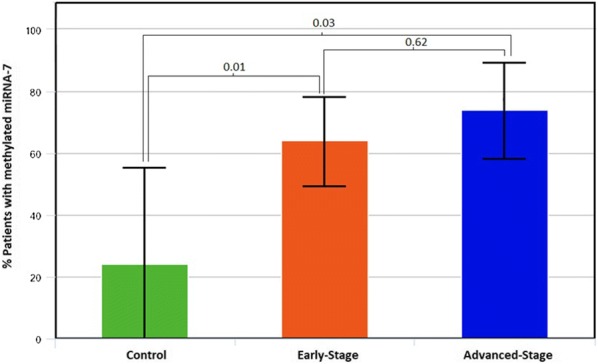
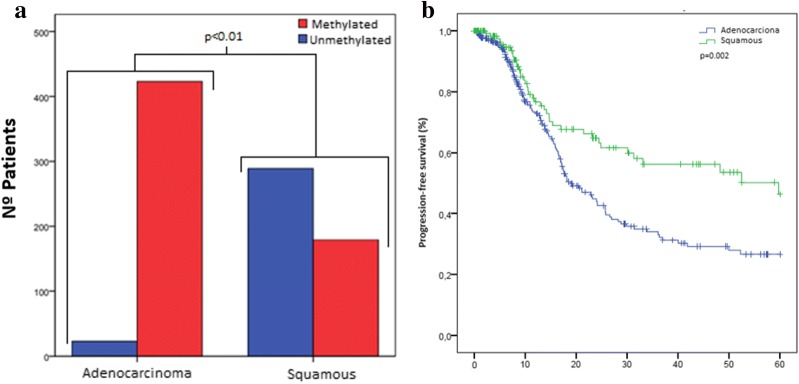
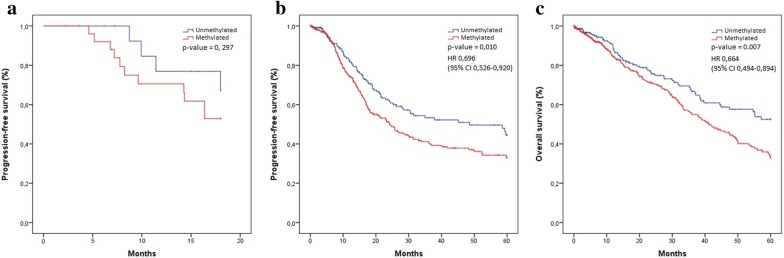
Non-small-cell lung cancer (NSCLC) is the most common malignancy worldwide. Platinum-based chemotherapy is the standard of care for these patients. Recent research showed that miR-7 methylation status is a biomarker of cisplatin resistance in lung and ovarian cancer cells, which is one of the major limitations associated with their clinical management. The aim of the present study is to provide clinical insights associated with this novel potential biomarker in NSCLC patients by comparing the miR-7 methylation status with the cisplatin treatment response. Our results analyzed in 81 samples show that miR-7 methylation is a common event in tumor tissue and it is more frequent as the stage of the disease advances, remaining in 75% of metastatic patients. Tumor miR-7 unmethylation trend to a better PFS in early stages, and when our data was validated in an extended in silico" cohort of 969 patients we obtained a significant increment in PFS and OS in those patients harboring miR-7 unmethylated (p = 0.010 and p = 0.007 respectively). When we select those early-stages patients harbouring miR-7 methylation, we observed that adenocarcinoma patients present a dramatic decrease in PFS compared with squamous cell carcinoma patients (median 18.9 versus 59.7 months, p = 0.002). In conclusion, our results show that presence of miR-7 methylation in early-stage NSCLC is suggestive of aggressive behavior, especially for adenocarcinoma patients. One major challenge in early diagnosis in NSCLC is identify the subgroup of patients that could benefit for adjuvant therapy, our data establish the basis for epigenetic classification on early-stage NSCLC that could influence treatment decisions in the future.
非小细胞肺癌(NSCLC)是全球最常见的恶性肿瘤。铂类化疗是这些患者的标准治疗方法。最近的研究表明,miR-7甲基化状态是肺癌和卵巢癌细胞中顺铂耐药的生物标志物,这是其临床管理的主要限制之一。本研究的目的是通过比较miR-7甲基化状态与顺铂治疗反应,为NSCLC患者中这种新的潜在生物标志物提供临床见解。我们对81个样本的分析结果表明,miR-7甲基化在肿瘤组织中是常见事件,并且随着疾病分期的进展更为频繁,在75%的转移性患者中存在。肿瘤miR-7未甲基化在早期阶段倾向于有更好的无进展生存期(PFS),当我们在969名患者的扩展“电子”队列中验证数据时,我们发现miR-7未甲基化的患者在PFS和总生存期(OS)方面有显著增加(分别为p = 0.010和p = 0.007)。当我们选择那些携带miR-7甲基化的早期患者时,我们观察到腺癌患者与鳞状细胞癌患者相比PFS显著降低(中位数分别为18.9个月和59.7个月,p = 0.002)。总之,我们的结果表明,早期NSCLC中miR-7甲基化的存在提示侵袭性生物学行为,特别是对于腺癌患者。NSCLC早期诊断的一个主要挑战是识别可能从辅助治疗中获益的患者亚组,我们的数据为早期NSCLC的表观遗传学分类奠定了基础,这可能会影响未来的治疗决策。