Tanoue Hiroki, Yoshinaga Naoki, Kato Sayaka, Naono-Nagatomo Keiko, Ishida Yasushi, Shiraishi Yuko
Department of Psychiatric and Mental Health Nursing, School of Nursing, Faculty of Medicine, University of Miyazaki, Japan.
Organization for Promotion of Tenure Track, University of Miyazaki, Japan.
Int J Nurs Sci. 2018 Jun 27;5(3):218-222. doi: 10.1016/j.ijnss.2018.06.005. eCollection 2018 Jul 10.
The prevalence and burden of disease of depression necessitates effective and accessible treatment options worldwide. Since April 2016, Japanese national health insurance has covered nurse-administered cognitive behavioral therapy (CBT) for mood disorders. However, empirical support for nurse-led CBT for depression in Asian countries, especially in Japan, is still lacking. This preliminary study aimed to examine the feasibility and acceptability of nurse-led group CBT for Japanese patients with depression.
In this single-arm study, we evaluated the effects of a 6-week group CBT, led by trained nurses, on patients with major depression. The primary outcome was the Beck Depression Inventory-II (BDI-II). Assessments were conducted at the beginning and end of the intervention.
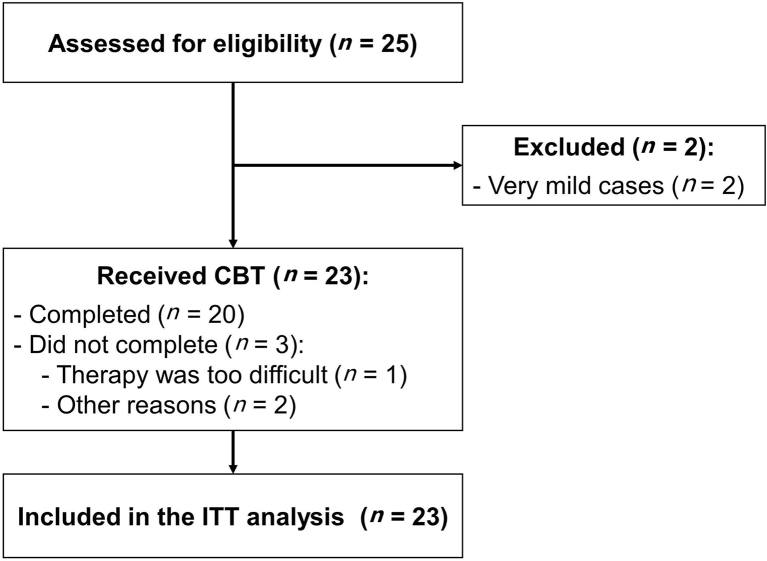
Of 25 participants screened, 23 were eligible for the study (of these, three dropped out during the trial but were included in the analysis). Nurse-led group CBT led to significant improvements in the severity of depression (BDI-II, < 0.001). The mean total BDI-II score improved from 23.1 ( = 7.56) to 12.4 ( = 8.57), and the pre-to post-effect size was large (Cohen's = 1.33). After CBT, 45% of the participants were judged to be treatment responders, and 34% met the remission criteria.
Our preliminary findings indicate that 6 weeks of nurse-led group CBT produced a favorable treatment outcome for individuals with major depression in a Japanese clinical setting. The results of this study might encourage more Asian nurses to provide CBT as a part of their nursing practice. Further controlled trials that address the limitations of this study are required.
抑郁症的患病率和疾病负担使得全球范围内都需要有效且可及的治疗方案。自2016年4月起,日本国民健康保险已涵盖由护士实施的针对情绪障碍的认知行为疗法(CBT)。然而,在亚洲国家,尤其是日本,对于护士主导的抑郁症认知行为疗法仍缺乏实证支持。这项初步研究旨在检验护士主导的团体认知行为疗法对日本抑郁症患者的可行性和可接受性。
在这项单臂研究中,我们评估了由经过培训的护士主导的为期6周的团体认知行为疗法对重度抑郁症患者的效果。主要结局指标是贝克抑郁量表第二版(BDI-II)。在干预开始和结束时进行评估。
在筛选的25名参与者中,23名符合研究条件(其中3名在试验期间退出,但纳入分析)。护士主导的团体认知行为疗法使抑郁严重程度有显著改善(BDI-II,<0.001)。BDI-II总分均值从23.1(=7.56)改善至12.4(=8.57),前后效应量较大(科恩d=1.33)。认知行为疗法后,45%的参与者被判定为治疗有反应者,34%符合缓解标准。
我们的初步研究结果表明,在日本临床环境中,为期6周的护士主导的团体认知行为疗法对重度抑郁症患者产生了良好的治疗效果。本研究结果可能会鼓励更多亚洲护士将认知行为疗法作为其护理实践的一部分。需要进一步开展针对本研究局限性的对照试验。