Loggia Marco Luciano, Segerdahl Andrew Reilly, Howard Matthew Alexander, Tracey Irene
A. A. Martinos Center for Biomedical Imaging, Department of Radiology, Massachusetts General Hospital, Harvard Medical School, Boston, MA, United States.
Wellcome Centre for Integrative Neuroimaging, FMRIB, Nuffield Department of Clinical Neuroscience, University of Oxford, Oxford, UK.
Pain Rep. 2019 May 15;4(4). doi: 10.1097/PR9.0000000000000750.
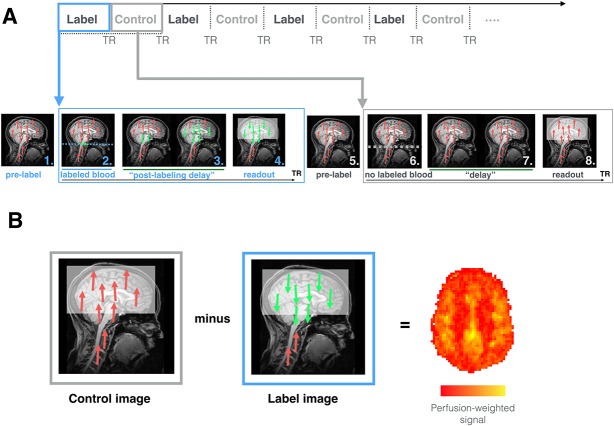
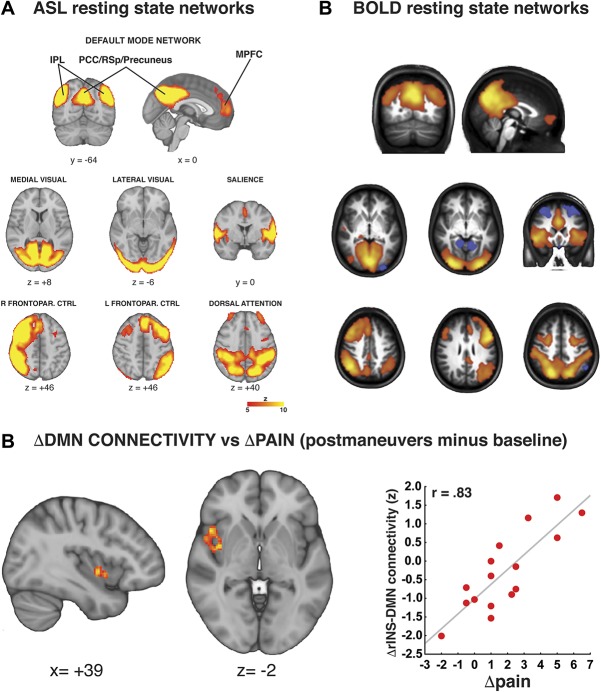
Arterial Spin Labeling (ASL) is a perfusion-based functional magnetic resonance imaging technique that uses water in arterial blood as a freely diffusible tracer to measure regional cerebral blood flow (rCBF) noninvasively. To date its application to the study of pain has been relatively limited. Yet, ASL possesses key features that make it uniquely positioned to study pain in certain paradigms. For instance, ASL is sensitive to very slowly fluctuating brain signals (in the order of minutes or longer). This characteristic makes ASL particularly suitable to the evaluation of brain mechanisms of tonic experimental, post-surgical and ongoing/or continuously varying pain in chronic or acute pain conditions (whereas BOLD fMRI is better suited to detect brain responses to short-lasting or phasic/evoked pain). Unlike positron emission tomography or other perfusion techniques, ASL allows the estimation of rCBF without requiring the administration of radioligands or contrast agents. Thus, ASL is well suited for within-subject longitudinal designs (e.g., to study evolution of pain states over time, or of treatment effects in clinical trials). ASL is also highly versatile, allowing for novel paradigms exploring a flexible array of pain states, plus it can be used to simultaneously estimate not only pain-related alterations in perfusion but also functional connectivity. In conclusion, ASL can be successfully applied in pain paradigms that would be either challenging or impossible to implement using other techniques. Particularly when used in concert with other neuroimaging techniques, ASL can be a powerful tool in the pain imager's toolbox.
动脉自旋标记(ASL)是一种基于灌注的功能磁共振成像技术,它利用动脉血中的水作为自由扩散示踪剂,以无创方式测量局部脑血流量(rCBF)。迄今为止,其在疼痛研究中的应用相对有限。然而,ASL具有一些关键特性,使其在某些范式中研究疼痛时具有独特的优势。例如,ASL对非常缓慢波动的脑信号(以分钟或更长时间为单位)敏感。这一特性使得ASL特别适合评估慢性或急性疼痛状态下的持续性实验性、手术后以及持续/不断变化的疼痛的脑机制(而血氧水平依赖性功能磁共振成像更适合检测对短暂性或相位性/诱发性疼痛的脑反应)。与正电子发射断层扫描或其他灌注技术不同,ASL无需注射放射性配体或造影剂即可估算rCBF。因此,ASL非常适合受试者内纵向设计(例如,研究疼痛状态随时间的演变,或临床试验中的治疗效果)。ASL还具有高度的通用性,可用于探索多种疼痛状态的新型范式,此外它不仅可用于同时估算与疼痛相关的灌注变化,还可用于估算功能连接性。总之,ASL可以成功应用于使用其他技术具有挑战性或无法实施的疼痛范式。特别是与其他神经成像技术联合使用时,ASL可以成为疼痛成像工具包中的强大工具。