Department of Pediatrics, Gongli Hospital, The Second Military Medical University, Shanghai, China.
Office of Education and Continuing Professional Development, Faculty of Medicine, Laval University, Quebec City, Quebec, Canada.
PLoS One. 2019 Aug 13;14(8):e0219630. doi: 10.1371/journal.pone.0219630. eCollection 2019.
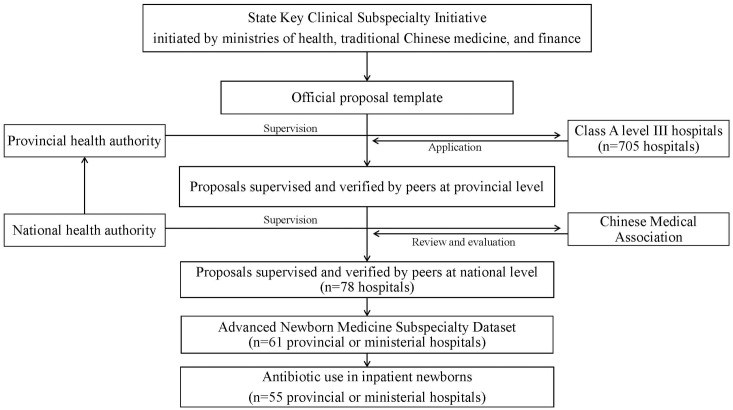
Previous surveys of neonatal medicine in China have not collected comprehensive information on antibiotic use in newborns. The goal of the present study was to assess the trends in antibiotic use in inpatient newborns from advanced hospitals in mainland China and to evaluate the contributing factors. We extracted retrospective data on newborn clinical units from a database containing key clinical subspecialty area indicators from provincial or ministerial (Class A level III) hospitals over three consecutive years (2008-2010) and in 25 of 31 provincial districts of mainland China. Fifty-five newborn units were included in the study. The results showed that two thirds (65.7% ± 23.1%) of inpatient newborns were prescribed antibiotic products. Antibiotic use rates were significantly different by newborn ward bed capacity (p = 0.023; 60.6% for d capacity (ficant65.7% ± 23-100 beds group, and 77.1% for (ficant65.7% ± 23.1%) of inpatient newb significantly different by type of hospital, geographic area, admission to physician or nurse ratio, or physician or nurse academic degree. Factors contributing significantly to antibiotic use included ward bed capacity, physician to nurse ratio, average hospital stay, and pneumonia to preterm infant ratio. Our data suggested that the use of antibiotics among inpatient newborns in advanced hospitals in mainland China was prevalent and should be subject to rigorous monitoring, and highlighted the need to explore how newborn ward bed capacity potentially impacts antibiotic use.
先前针对中国新生儿医学的调查并未收集新生儿抗生素使用的全面信息。本研究的目的是评估中国大陆先进医院住院新生儿抗生素使用的趋势,并评估其影响因素。我们从包含省级或部级(三级 A 类)医院主要临床专科领域指标的数据库中提取了新生儿临床科室的回顾性数据,涵盖了连续三年(2008-2010 年)和中国大陆 31 个省(区、市)的 25 个省(区、市)。共有 55 个新生儿科室参与了这项研究。结果表明,三分之二(65.7%±23.1%)住院新生儿使用了抗生素产品。按新生儿病房床位容量划分,抗生素使用率存在显著差异(p=0.023;60.6%为 100 张床位以下组,77.1%为 100-199 张床位组)。按医院类型、地理位置、入院医师与护士比例或医师与护士学历的不同,抗生素使用率也存在显著差异。对抗生素使用有显著影响的因素包括病房床位容量、医师与护士比例、平均住院时间和肺炎与早产儿比例。我们的数据表明,中国大陆先进医院住院新生儿抗生素使用普遍,应进行严格监测,并强调需要探讨新生儿病房床位容量如何潜在地影响抗生素使用。