Liao Xiang-Peng, Chipenda-Dansokho Selma, Lewin Antoine, Abdelouahab Nadia, Wei Shu-Qin
Centre Hospitalier Universitaire de Sherbrooke (CHUS) Research Centre, Sherbrooke, Quebec, Canada.
Department of Newborn, Wuxi Maternity and Child Health Hospital, Nanjing Medical University, Jiangsu, China.
PLoS One. 2017 Jan 18;12(1):e0169970. doi: 10.1371/journal.pone.0169970. eCollection 2017.
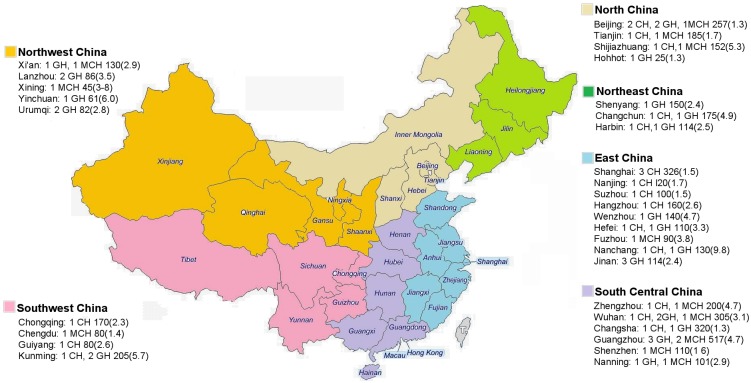
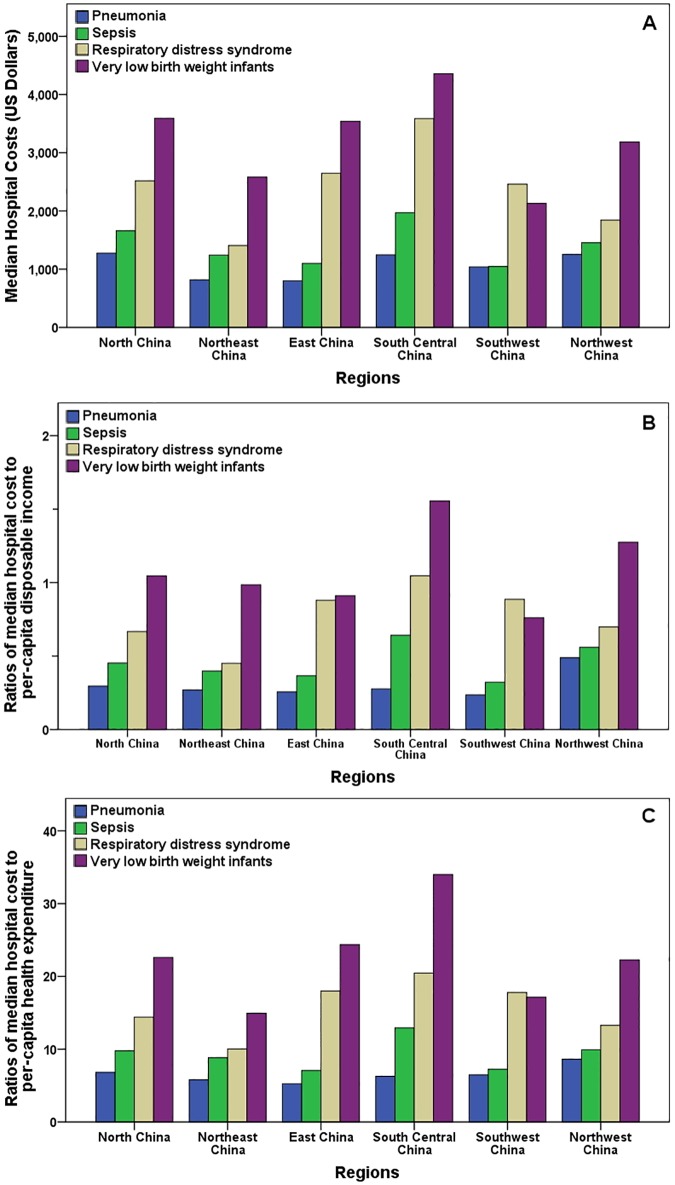
Previous surveys of neonatal medicine in China have not collected comprehensive information on workforce, investment, health care practice, and disease expenditure. The goal of the present study was to develop a national database of neonatal care units and compare present outcomes data in conjunction with health care practices and costs. We summarized the above components by extracting data from the databases of the national key clinical subspecialty proposals issued by national health authority in China, as well as publicly accessible databases. Sixty-one newborn clinical units from provincial or ministerial hospitals at the highest level within local areas in mainland China, were included for the study. Data were gathered for three consecutive years (2008-2010) in 28 of 31 provincial districts in mainland China. Of the 61 newborn units in 2010, there were 4,948 beds (median = 62 [IQR 43-110]), 1,369 physicians (median = 22 [IQR 15-29]), 3,443 nurses (median = 52 [IQR 33-81]), and 170,159 inpatient discharges (median = 2,612 [IQR 1,436-3,804]). During 2008-2010, the median yearly investment for a single newborn unit was US$344,700 (IQR 166,100-585,800), median length of hospital stay for overall inpatient newborns 9.5 (IQR 8.2-10.8) days, median inpatient antimicrobial drug use rate 68.7% (IQR 49.8-87.0), and median nosocomial infection rate 3.2% (IQR1.7-5.4). For the common newborn diseases of pneumonia, sepsis, respiratory distress syndrome, and very low birth weight (<1,500 grams) infants, their lengths of hospital stay, daily costs, hospital costs, ratios of hospital cost to per-capita disposable income, and ratios of hospital cost to per-capita health expenditure, were all significantly different across regions (North China, Northeast China, East China, South Central China, Southwest China, and Northwest China). The survival rate of extremely low birth weight (ELBW) infants (Birth weight <1,000 grams) was 76.0% during 2008-2010 in the five hospitals where each unit had more than 20 admissions of ELBW infants in 2010; and the median hospital cost for a single hospital stay in ELBW infants was US$8,613 (IQR 8,153-9,216), which was 3.0 times (IQR 2.0-3.2) the average per-capita disposable income, or 63 times (IQR 40.3-72.1) the average per-capita health expenditure of local urban residents in 2011. Our national database provides baseline data on the status of advanced neonatal medicine in China, gathering valuable information for quality improvement, decision making, longitudinal studies and horizontal comparisons.
此前针对中国新生儿医学的调查未全面收集有关劳动力、投资、医疗实践及疾病支出的信息。本研究的目的是建立一个全国新生儿护理单位数据库,并结合医疗实践和成本对当前的结果数据进行比较。我们通过从中国国家卫生部门发布的国家重点临床专科项目数据库以及公开可用数据库中提取数据,对上述内容进行了总结。中国大陆地区省级或部级最高水平医院的61个新生儿临床单位被纳入研究。在中国大陆31个省级行政区中的28个,连续三年(2008 - 2010年)收集了数据。2010年的61个新生儿单位中,有4948张床位(中位数 = 62 [四分位间距43 - 110])、1369名医生(中位数 = 22 [四分位间距15 - 29])、3443名护士(中位数 = 52 [四分位间距33 - 81])以及170159例住院出院病例(中位数 = 2612 [四分位间距1436 - 3804])。在2008 - 2010年期间,单个新生儿单位的年投资中位数为344700美元(四分位间距166100 - 585800),住院新生儿的总体住院时间中位数为9.5天(四分位间距8.2 - 10.8),住院患者抗菌药物使用率中位数为68.7%(四分位间距49.8 - 87.0),医院感染率中位数为3.2%(四分位间距1.7 - 5.4)。对于肺炎、败血症、呼吸窘迫综合征以及极低出生体重(<1500克)婴儿等常见新生儿疾病,其住院时间、每日费用、住院费用、住院费用与人均可支配收入的比率以及住院费用与人均卫生支出的比率,在各地区(华北、东北、华东、中南、西南和西北)均存在显著差异。2008 - 2010年期间,在2010年每个单位收治超过20例极低出生体重(ELBW)婴儿(出生体重<1000克)的五家医院中,ELBW婴儿的存活率为76.0%;ELBW婴儿单次住院的医院费用中位数为8613美元(四分位间距8153 - 9216),是2011年当地城市居民人均可支配收入的3.0倍(四分位间距2.0 - 3.2),或人均卫生支出的63倍(四分位间距40.3 - 72.1)。我们的全国数据库提供了中国先进新生儿医学现状的基线数据,为质量改进、决策制定、纵向研究和横向比较收集了有价值的信息。