Department of Natural Science and Environmental Health, University of South-Eastern Norway, Bø i Telemark, Norway.
Birchdale Ecological, Kaslo, Canada.
PLoS One. 2019 Aug 13;14(8):e0220746. doi: 10.1371/journal.pone.0220746. eCollection 2019.
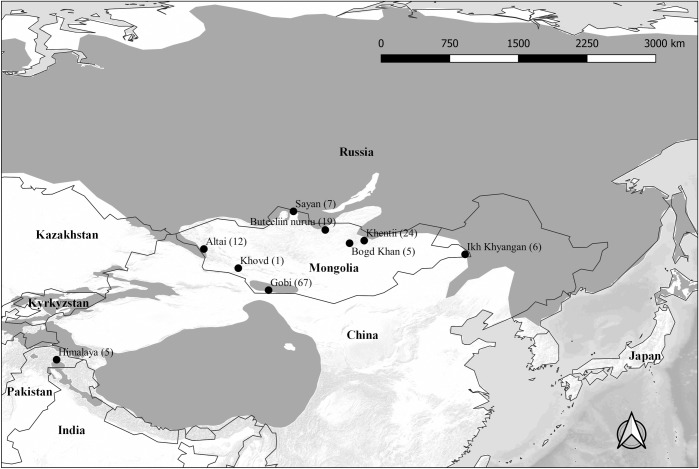
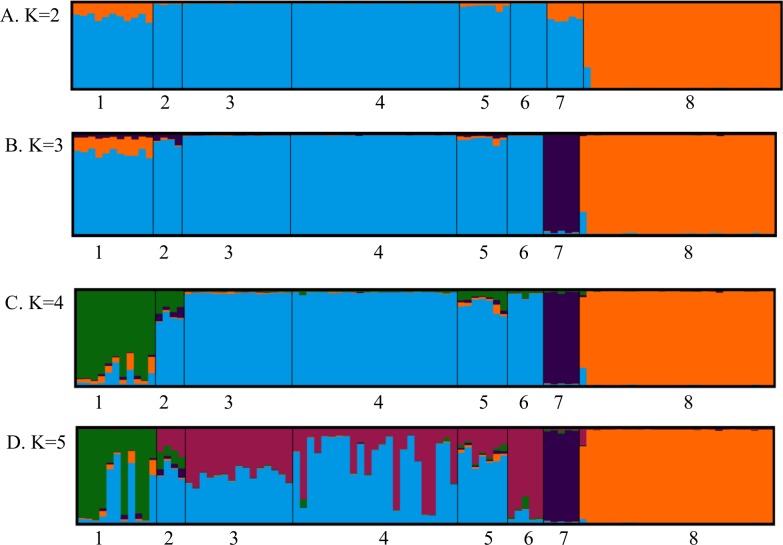
Knowledge of genetic diversity and population structure is critical for conservation and management planning at the population level within a species' range. Many brown bear populations in Central Asia are small and geographically isolated, yet their phylogeographic relationships, genetic diversity, and contemporary connectivity are poorly understood. To address this knowledge gap, we collected brown bear samples from the Gobi Desert (n = 2360), Altai, Sayan, Khentii, and Ikh Khyangan mountains of Mongolia (n = 79), and Deosai National Park in the Himalayan Mountain Range of Pakistan (n = 5) and generated 927 base pairs of mitochondrial DNA (mtDNA) sequence data and genotypes at 13 nuclear DNA microsatellite loci. We documented high levels of mtDNA and nDNA diversity in the brown bear populations of northern Mongolia (Altai, Sayan, Buteeliin nuruu and Khentii), but substantially lower diversity in brown bear populations in the Gobi Desert and Himalayas of Pakistan. We detected 3 brown bear mtDNA phylogeographic groups among bears of the region, with clade 3a1 in Sayan, Khentii, and Buteeliin nuruu mountains, clade 3b in Altai, Sayan, Buteeliin nuruu, Khentii, and Ikh Khyangan, and clade 6 in Gobi and Pakistan. Our results also clarified the phylogenetic relationships and divergence times with other brown bear mtDNA clades around the world. The nDNA genetic structure analyses revealed distinctiveness of Gobi bears and different population subdivisions compared to mtDNA results. For example, genetic distance for nDNA microsatellite loci between the bears in Gobi and Altai (FST = 0.147) was less than that of the Gobi and Pakistan (FST = 0.308) suggesting more recent male-mediated nuclear gene flow between Gobi and Altai than between Gobi and the Pakistan bears. Our results provide valuable information for conservation and management of bears in this understudied region of Central Asia and highlight the need for special protection and additional research on Gobi brown bears.
了解遗传多样性和种群结构对于物种范围内种群的保护和管理规划至关重要。中亚的许多棕熊种群数量较少且地理位置孤立,但人们对它们的系统地理学关系、遗传多样性和当代连通性知之甚少。为了填补这一知识空白,我们从蒙古的戈壁沙漠(n=2360)、阿尔泰山、萨彦岭、肯特和伊赫克桑山脉(n=79)以及巴基斯坦喜马拉雅山脉的德奥赛国家公园(n=5)收集了棕熊样本,并生成了 927 个碱基对的线粒体 DNA(mtDNA)序列数据和 13 个核 DNA 微卫星基因座的基因型。我们记录了蒙古北部棕熊种群(阿尔泰山、萨彦岭、布泰利诺湖和肯特)具有高水平的 mtDNA 和 nDNA 多样性,但在戈壁沙漠和巴基斯坦喜马拉雅山的棕熊种群中,多样性则显著降低。我们在该地区的熊中检测到了 3 个棕熊 mtDNA 系统地理学群,其中萨彦岭、肯特和布泰利诺湖的棕熊属于 3a1 支系,阿尔泰山、萨彦岭、布泰利诺湖、肯特和伊赫克桑的棕熊属于 3b 支系,而戈壁沙漠和巴基斯坦的棕熊属于 6 支系。我们的研究结果还澄清了与世界其他棕熊 mtDNA 支系的系统发育关系和分化时间。nDNA 遗传结构分析显示,与 mtDNA 结果相比,戈壁熊具有独特性,并且种群存在明显的划分。例如,戈壁和阿尔泰山熊的 nDNA 微卫星基因座的遗传距离(FST=0.147)小于戈壁和巴基斯坦熊的遗传距离(FST=0.308),这表明在戈壁和阿尔泰山熊之间,最近存在更多的雄性介导的核基因流,而在戈壁和巴基斯坦熊之间则较少。我们的研究结果为该中亚研究不足地区的熊类保护和管理提供了有价值的信息,并强调了对戈壁棕熊进行特殊保护和进一步研究的必要性。