Krautz Christian, Haase Elisabeth, Elshafei Moustafa, Saeger Hans-Detlev, Distler Marius, Grützmann Robert, Weber Georg F
Klinik für Allgemein- und Viszeralchirurgie, Friedrich-Alexander-Universität Erlangen-Nürnberg, Universitätsklinikum Erlangen, Krankenhausstrasse 12, 91054, Erlangen, Germany.
Klinik für Viszeral-, Thorax- und Gefäßchirurgie, Technische Universität Dresden, Universtitätsklinikum Dresden, Fetscherstrasse 74, 01307, Dresden, Germany.
BMC Surg. 2019 Aug 13;19(1):108. doi: 10.1186/s12893-019-0577-6.
We aimed to determine the impact of surgical experience and frequency of practice on perioperative morbidity and mortality in pancreatic surgery.
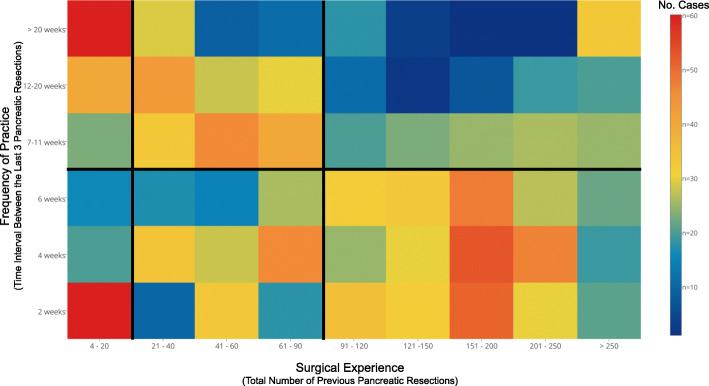
1281 patients that underwent pancreatic resections from 1993 to 2013 were retrospectively analyzed using logistic regression models. All cases were stratified according to the surgeon's level of experience, which was based on the number of previously performed pancreatic resections and the extent of received supervision (novice: n < 20 / intensive; intermediate: n = 21-90 / decreasing; and experienced surgeon: n > 90 / none). Additional stratification was based on the frequency of practice (sporadic: 3 resections > 6 weeks, frequent: 3 resections ≤6 weeks).
The novice and experienced categories were related to a decreased risk of postoperative pancreatic fistulas (odds ratio [OR] 0.46, 95% confidence interval [CI] 0.26-0.82 and 0.54, 95% CI 0.36-0.82) and in-hospital mortality (OR 0.45, 95% CI 0.17-1.16 and 0.42, 95% CI 0.21-0.83) compared to the intermediate category. Frequent practice was associated with a significantly lower risk of delayed gastric emptying (OR 0.56, 95% CI 0.38-0.83), postpancreatectomy hemorrhage (OR 0.64, 95% CI 0.42-0.98) and in-hospital mortality (OR 0.45, 95% CI 0.24-0.87).
Our results emphasize the importance of supervision within a pancreatic surgery training program. In addition, our data underline the need of a sufficient patient caseload to ensure frequent practice.
我们旨在确定手术经验和手术频率对胰腺手术围手术期发病率和死亡率的影响。
使用逻辑回归模型对1993年至2013年接受胰腺切除术的1281例患者进行回顾性分析。所有病例根据外科医生的经验水平进行分层,经验水平基于先前进行的胰腺切除术数量和接受监督的程度(新手:n < 20 / 强化监督;中级:n = 21 - 90 / 监督减少;经验丰富的外科医生:n > 90 / 无监督)。进一步的分层基于手术频率(偶尔:3次手术间隔> 6周,频繁:3次手术间隔≤6周)。
与中级类别相比,新手和经验丰富类别与术后胰瘘风险降低(优势比[OR] 0.46,95%置信区间[CI] 0.26 - 0.82和0.54,95% CI 0.36 - 0.82)以及院内死亡率降低(OR 0.45,95% CI 0.17 - 1.16和0.42,95% CI 0.21 - 0.83)相关。频繁手术与胃排空延迟风险显著降低(OR 0.56,95% CI 0.38 - 0.83)、胰十二指肠切除术后出血风险显著降低(OR 0.64,95% CI 0.42 - 0.98)以及院内死亡率显著降低(OR 0.45,95% CI 0.24 - 0.87)相关。
我们的结果强调了胰腺手术培训计划中监督的重要性。此外,我们的数据强调了需要有足够的患者病例量以确保频繁手术。