Sinha Shyam K, Khammari Amir, Picher Matthieu, Roulland Francois, Viart Nathalie, LaGrange Thomas, Banhart Florian
Université de Strasbourg, CNRS, Institut de Physique et Chimie des Matériaux, UMR 7504, 67034, Strasbourg, France.
Laboratory for Ultrafast Microscopy and Electron Scattering (LUMES), École Polytechnique Fédérale de Lausanne (EPFL), 1015, Lausanne, Switzerland.
Nat Commun. 2019 Aug 13;10(1):3648. doi: 10.1038/s41467-019-11669-w.
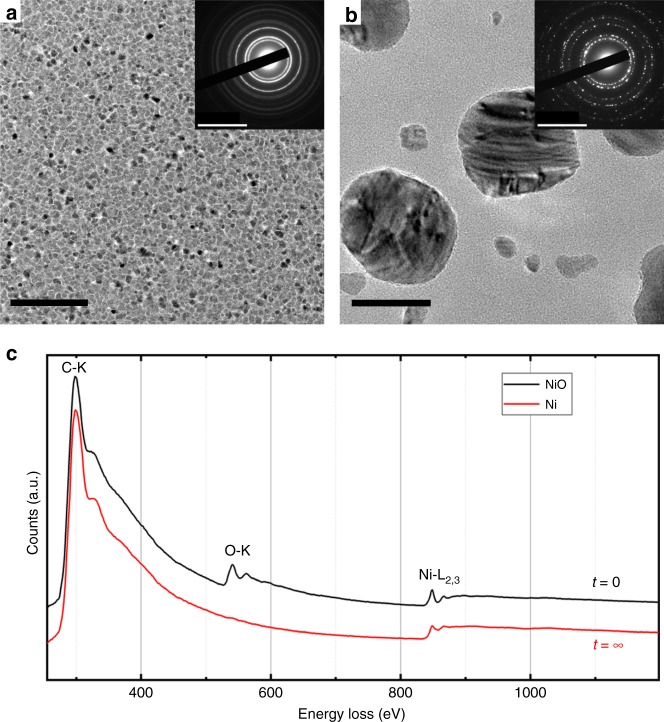
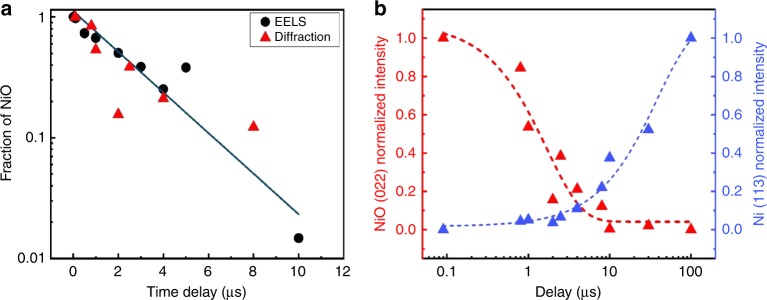
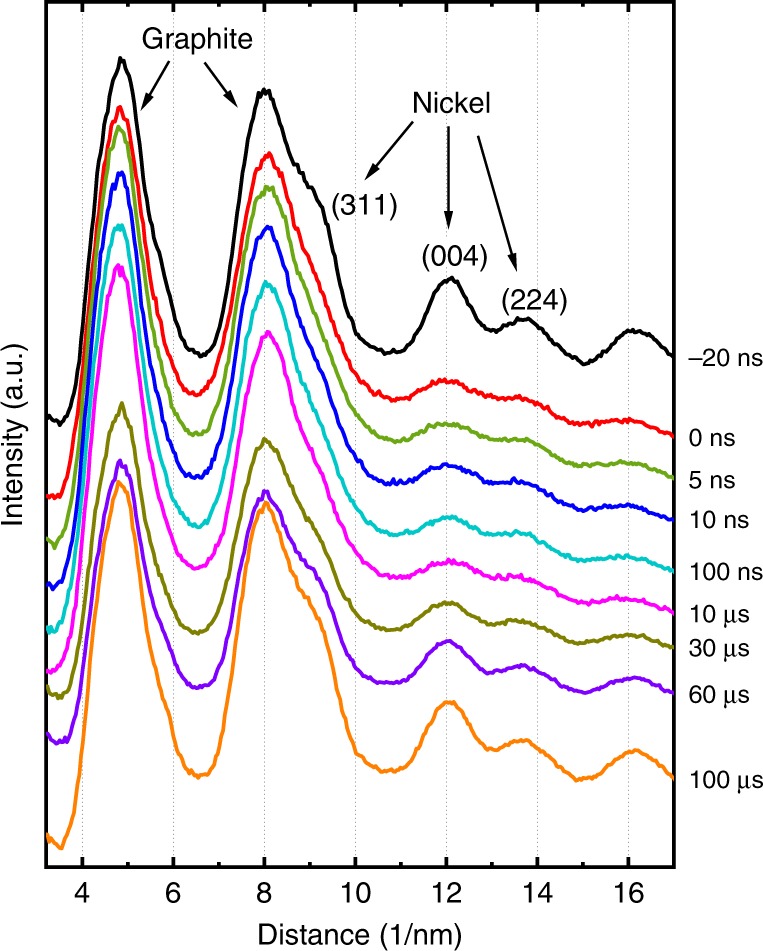
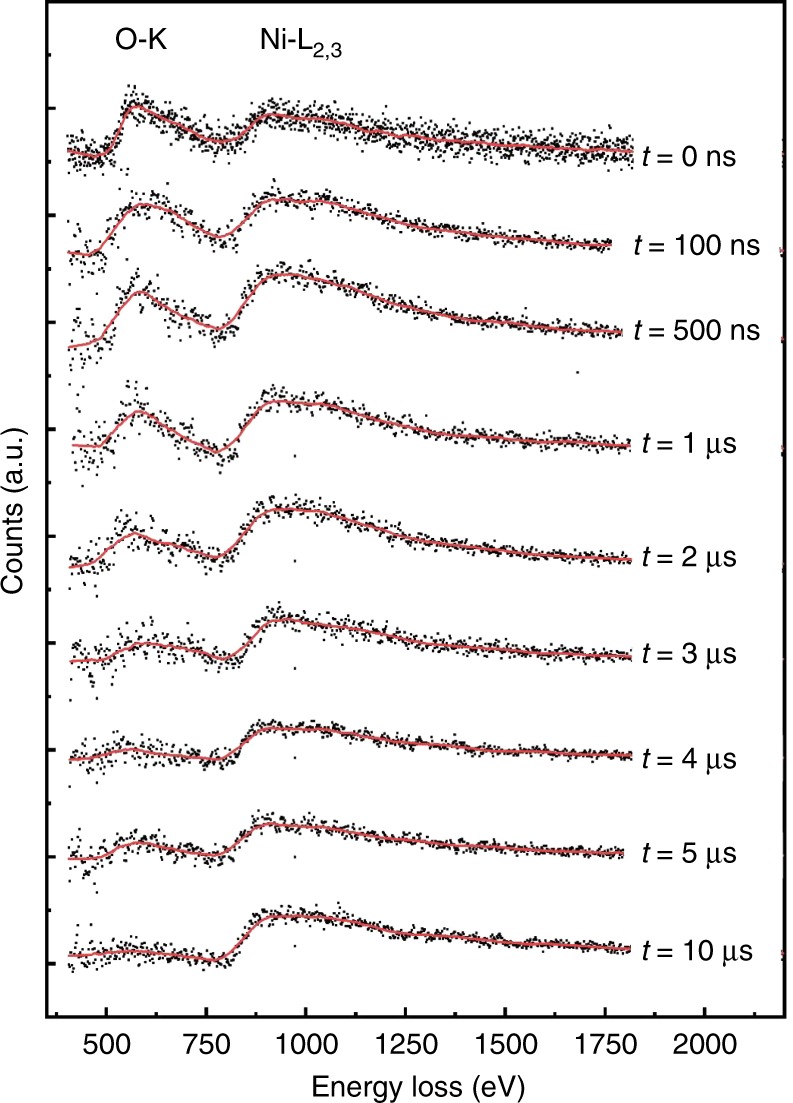
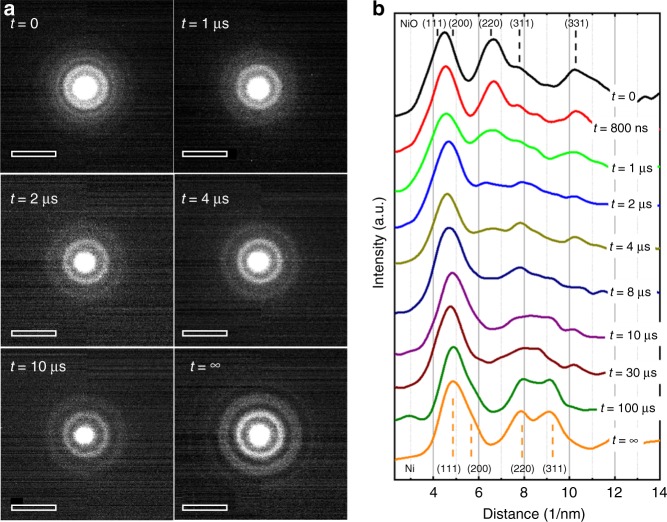
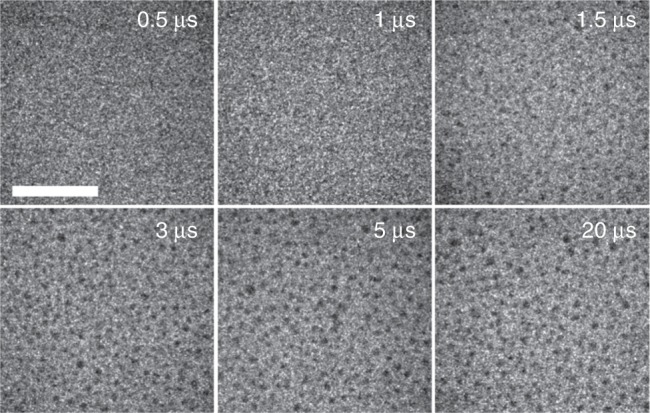
We show how the kinetics of a fast and irreversible chemical reaction in a nanocrystalline material at high temperature can be studied using nanosecond electron pulses in an electron microscope. Infrared laser pulses first heat a nanocrystalline oxide layer on a carbon film, then single nanosecond electron pulses allow imaging, electron diffraction and electron energy-loss spectroscopy. This enables us to study the evolution of the morphology, crystallography, and elemental composition of the system with nanosecond resolution. Here, NiO nanocrystals are reduced to elemental nickel within 5 µs after the laser pulse. At high temperatures induced by laser heating, reduction results first in a liquid nickel phase that crystallizes on microsecond timescales. We show that the reaction kinetics in the reduction of nanocrystalline NiO differ from those in bulk materials. The observation of liquid nickel as a transition phase explains why the reaction is first order and occurs at high rates.
我们展示了如何利用电子显微镜中的纳秒电子脉冲来研究高温下纳米晶材料中快速且不可逆化学反应的动力学。红外激光脉冲首先加热碳膜上的纳米晶氧化层,然后单个纳秒电子脉冲可用于成像、电子衍射和电子能量损失谱分析。这使我们能够以纳秒分辨率研究系统的形貌、晶体学和元素组成的演变。在此,激光脉冲后5微秒内,NiO纳米晶体被还原为元素镍。在激光加热诱导的高温下,还原首先产生液态镍相,该相在微秒时间尺度上结晶。我们表明,纳米晶NiO还原反应的动力学与块状材料中的不同。观察到液态镍作为过渡相解释了为什么该反应是一级反应且速率很高。