School of Chemistry and Molecular Biosciences, The University of Queensland, Brisbane, 4072, Queensland, Australia.
Australian Infectious Diseases Research Centre, The University of Queensland, Brisbane, 4072, Queensland, Australia.
Nat Commun. 2019 Aug 13;10(1):3643. doi: 10.1038/s41467-019-11571-5.
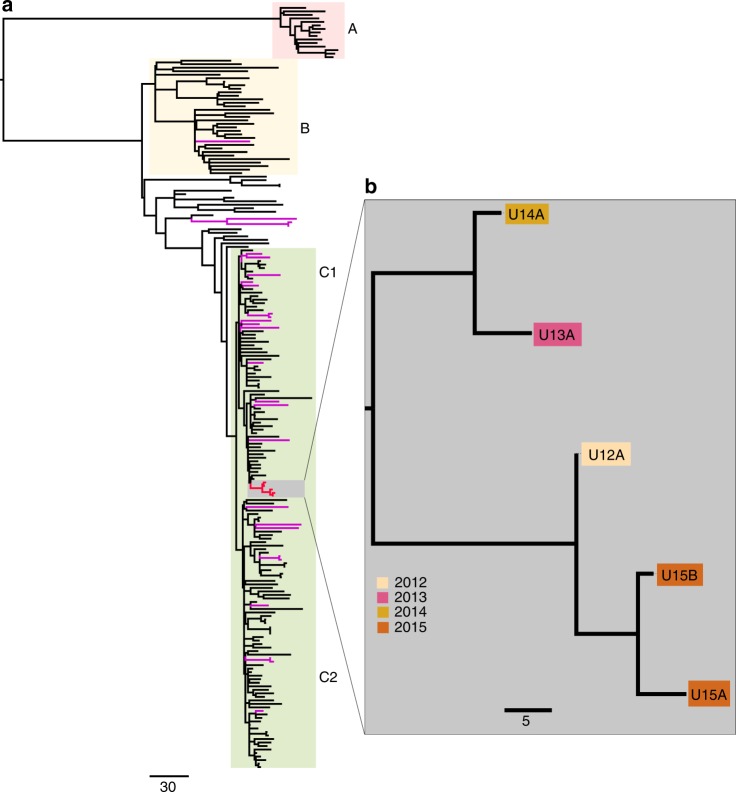
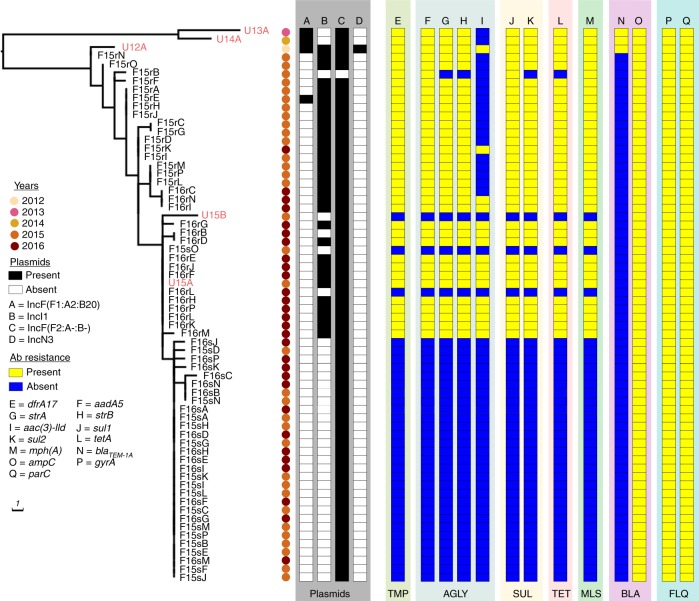
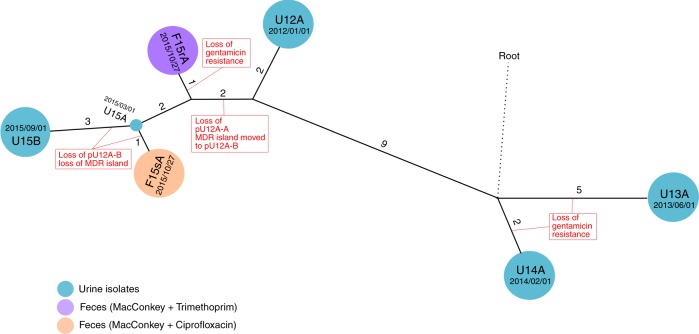
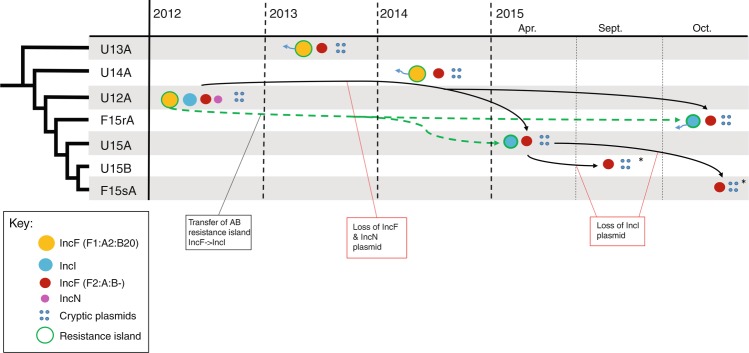
Recurrent urinary tract infections (rUTIs) are extremely common, with ~ 25% of all women experiencing a recurrence within 1 year of their original infection. Escherichia coli ST131 is a globally dominant multidrug resistant clone associated with high rates of rUTI. Here, we show the dynamics of an ST131 population over a 5-year period from one elderly woman with rUTI since the 1970s. Using whole genome sequencing, we identify an indigenous clonal lineage (P1A) linked to rUTI and persistence in the fecal flora, providing compelling evidence of an intestinal reservoir of rUTI. We also show that the P1A lineage possesses substantial plasmid diversity, resulting in the coexistence of antibiotic resistant and sensitive intestinal isolates despite frequent treatment. Our longitudinal study provides a unique comprehensive genomic analysis of a clonal lineage within a single individual and suggests a population-wide resistance mechanism enabling rapid adaptation to fluctuating antibiotic exposure.
复发性尿路感染(rUTIs)极为常见,约有 25%的女性在初次感染后 1 年内会再次感染。大肠杆菌 ST131 是一种与高复发性尿路感染率相关的全球主导的多药耐药克隆。在这里,我们展示了一名老年女性自 20 世纪 70 年代以来 rUTI 中 ST131 种群在 5 年内的动态变化。通过全基因组测序,我们确定了与 rUTI 相关的本土克隆谱系(P1A),并在粪便菌群中持续存在,为 rUTI 的肠道储库提供了令人信服的证据。我们还表明,P1A 谱系具有大量质粒多样性,尽管经常治疗,但仍存在抗生素耐药和敏感的肠道分离株共存现象。我们的纵向研究对单个个体内的克隆谱系进行了独特的全面基因组分析,并提出了一种广泛存在的耐药机制,使该机制能够快速适应波动的抗生素暴露。