Hua Shan, Zhang Xuexue
Medical College of Nanchang University, Nanchang, Jiangxi 330031, P.R. China.
Department of Pain Management, The First Affiliated Hospital of Nanchang University, Nanchang, Jiangxi 330006, P.R. China.
Exp Ther Med. 2019 Sep;18(3):1545-1550. doi: 10.3892/etm.2019.7723. Epub 2019 Jul 2.
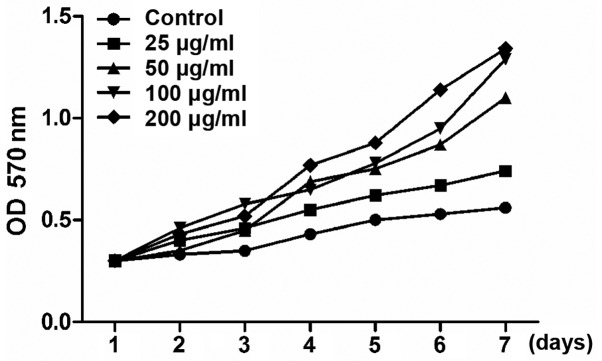
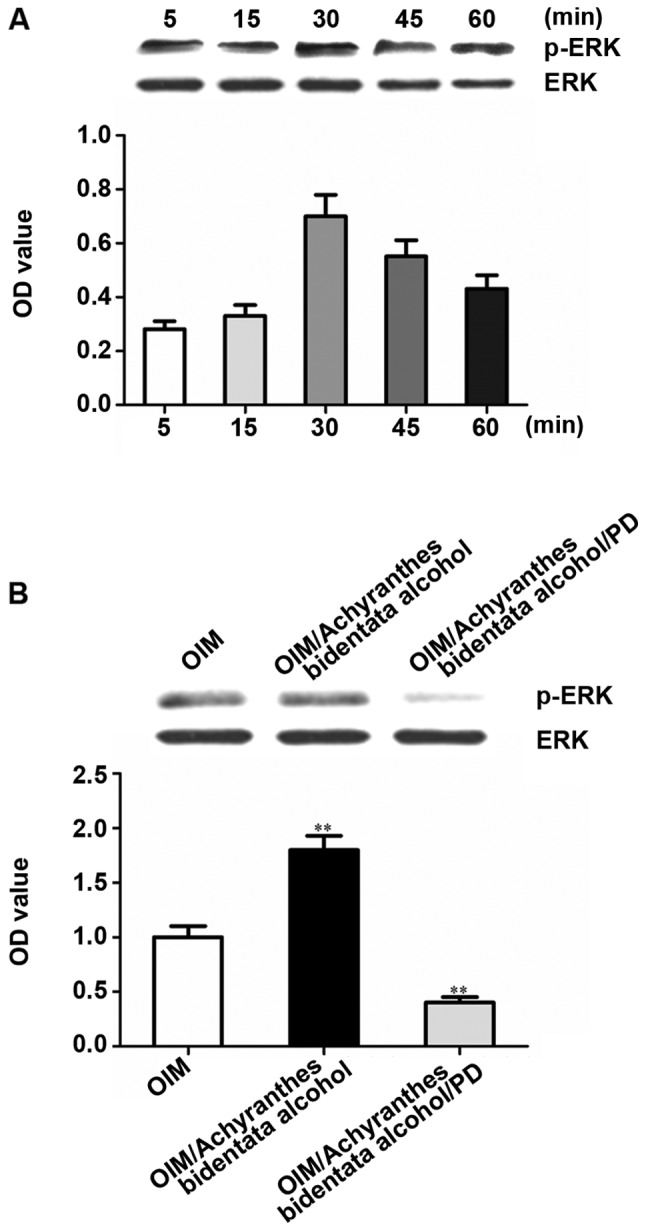
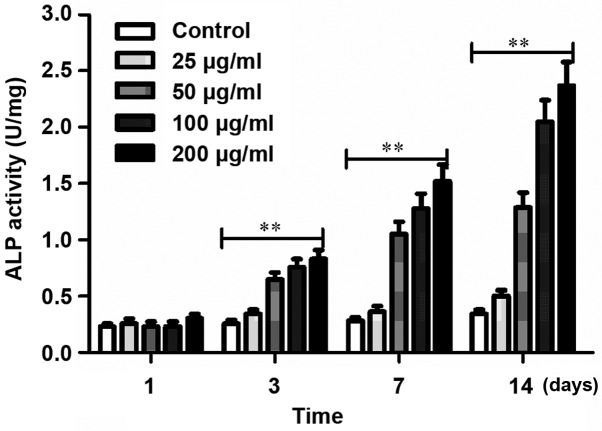
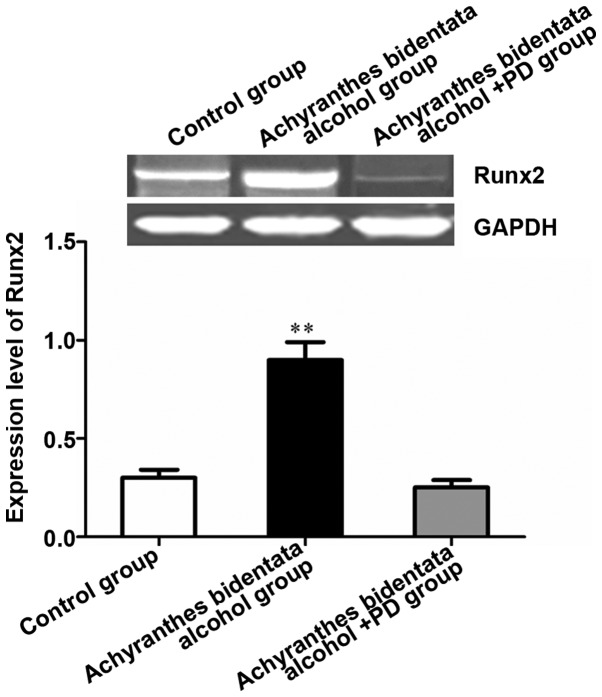
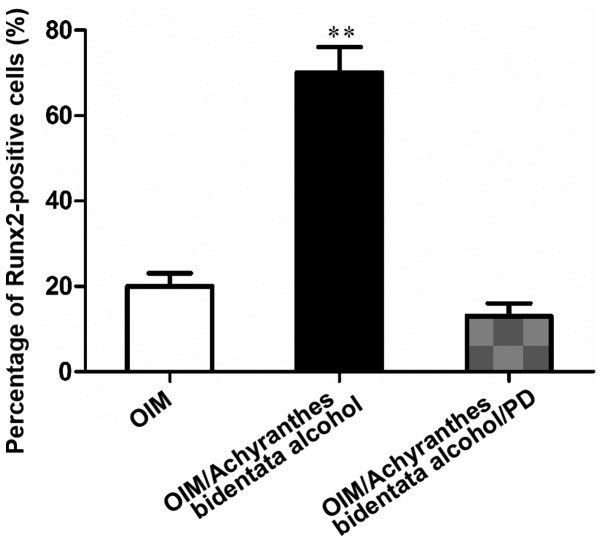
is a herbal plant commonly used in the treatment of osteoporosis and bone nonunion with traditional Chinese medicine. alcohol is a major component extracted from , which has been proved to be able to exert a variety of pharmacological effects, such as anti-inflammation, antipyresis, anti-rheumatism, diuresis and anti-osteoporosis. Thirty male Sprague-Dawley rats aged 4 weeks were used in the experiment. All primary rat osteoblasts were cultured and amplified for further experiments. The osteoblasts were divided into six groups (5 rats in each group): the culture medium control group, the 25 µg/ml achyranthol group, the 50 µg/ml achyranthol group, the 100 µg/ml achyranthol group, 200 µg/ml achyranthol group, and the 25 µM PD98059+200 µg/ml achyranthol group. In this study, the effect of alcohol on the proliferation of osteoblasts was detected via methyl thiazolyl tetrazolium (MTT) assay. The effect of alcohol on the alkaline phosphatase (ALP) activity in osteoblasts was analyzed via ALP assay. The effect of alcohol on the expression of osteoblast marker gene, Runt-related transcription factor 2 (Runx2), was detected via reverse transcription-quantitative polymerase chain reaction (RT-qPCR) and immunohistochemistry. Moreover, the phosphorylation or activation of extracellular signal-regulated kinase (ERK) in osteoblasts induced by alcohol was analyzed using western blotting. alcohol increased cell proliferation in a dose-dependent manner, increased the micro ribonucleic acid (miRNA) level in Runx2, enhanced the ALP activity in osteoblasts, and stimulated the activation of ERK (P<0.05). The expression of Runx2 with the inhibitor PD98059 was decreased significantly compared with that in the alcohol group (P<0.01). Immunohistochemical results manifested that the percentage of Runx2 positive cells in treated tissues was obviously higher than that in untreated tissues (P<0.01). Therefore, alcohol promotes the proliferation capacity of osteoblasts in a dose-dependent manner, enhances the expression of miRNA in Runx2, and stimulates the osteogenic differentiation of osteoblasts through activating the ERK signal transduction pathway.
是一种常用于中医药治疗骨质疏松症和骨不连的草本植物。 醇是从 中提取的主要成分,已被证明能够发挥多种药理作用,如抗炎、解热、抗风湿、利尿和抗骨质疏松。实验使用了30只4周龄的雄性Sprague-Dawley大鼠。所有原代大鼠成骨细胞均进行培养和扩增以用于进一步实验。将成骨细胞分为六组(每组5只大鼠):培养基对照组、25μg/ml牛膝醇组、50μg/ml牛膝醇组、100μg/ml牛膝醇组、200μg/ml牛膝醇组以及25μM PD98059 + 200μg/ml牛膝醇组。在本研究中,通过甲基噻唑基四氮唑(MTT)法检测 醇对成骨细胞增殖的影响。通过碱性磷酸酶(ALP)法分析 醇对成骨细胞中碱性磷酸酶活性的影响。通过逆转录-定量聚合酶链反应(RT-qPCR)和免疫组织化学检测 醇对成骨细胞标志物基因Runt相关转录因子2(Runx2)表达的影响。此外,使用蛋白质印迹法分析 醇诱导的成骨细胞中细胞外信号调节激酶(ERK)的磷酸化或激活情况。 醇以剂量依赖性方式增加细胞增殖,增加Runx2中的微小核糖核酸(miRNA)水平,增强成骨细胞中的碱性磷酸酶活性,并刺激ERK的激活(P<0.05)。与 醇组相比,使用抑制剂PD98059时Runx2的表达明显降低(P<0.01)。免疫组织化学结果表明,处理组织中Runx2阳性细胞的百分比明显高于未处理组织(P<0.01)。因此, 醇以剂量依赖性方式促进成骨细胞的增殖能力,增强Runx2中miRNA的表达,并通过激活ERK信号转导途径刺激成骨细胞的成骨分化。