Gong Xin, Liu Congyang, Wang Hongling, Fan Jinying, Jiang Cuihong, Zou Yong
Department of Integrated Chinese and Western Medicine, The Affiliated Yantai Yuhuangding Hospital of Qingdao University, Yantai, Shandong 264000, P.R. China.
Central Laboratory, The Affiliated Yantai Yuhuangding Hospital of Qingdao University, Yantai, Shandong 264000, P.R. China.
Exp Ther Med. 2019 Sep;18(3):1752-1760. doi: 10.3892/etm.2019.7769. Epub 2019 Jul 12.
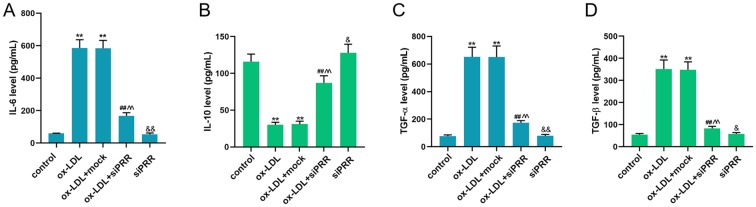
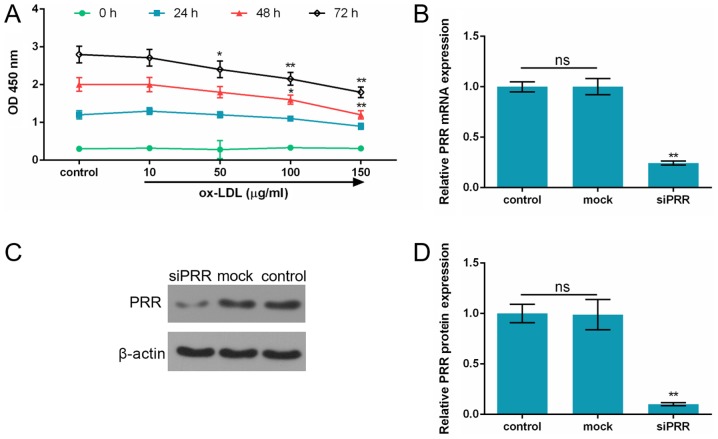
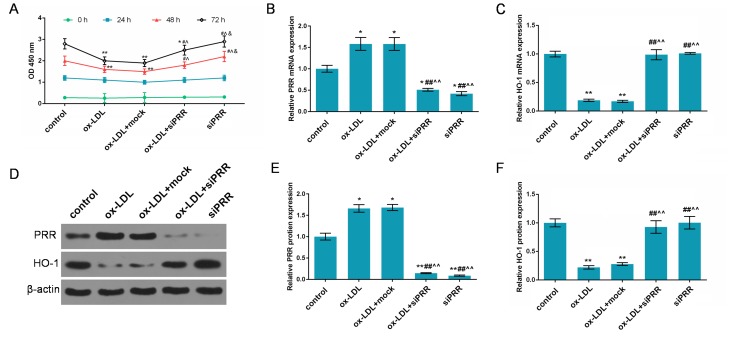
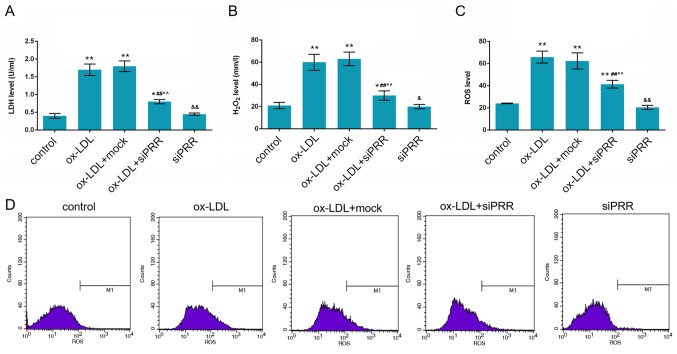
The incidence of depression has previously been correlated to hypertension. The aim of the present study was to explore the mechanisms of depression and hypertension by examining the expression and interaction of renin/prorenin receptor (PRR) and heme oxygenase 1 (HO-1) in vascular endothelial cells. A case-control study was conducted, and general data and serum factors were compared between hypertension patients complicated with depression and patients with hypertension alone. Logistic regression analysis was used to detect risk factors associated with hypertension complicated with depression. In addition, human umbilical vein endothelial cells (HUVECs) were treated with oxidized low-density lipoprotein (ox-LDL) and/or PRR gene silencing, and a Cell Counting Kit-8 (CCK-8) assay was performed to test their proliferation. The concentrations of inflammatory factors and oxidative stress factor were also detected using enzyme-linked immunosorbent assay and chemical colorimetry. Western blot analysis and reverse transcription-quantitative polymerase chain reaction were applied to detect protein and mRNA expression levels, respectively. The results revealed that HO-1 and renin precursor (Rep) were independent factors that affected hypertension complicated with depression. Serum HO-1 levels in patients with hypertension complicated with depression were significantly lower than that in hypertensive patients without depression, while Rep levels in patients with hypertension complicated with depression were significantly higher than that in hypertensive patients without depression. In HUVECs, ox-LDL reduced the cell proliferation in a dose-dependent manner, upregulated the expression of PRR gene and downregulated the expression of HO-1 gene. It was also observed that silencing of the PRR gene promoted the expression of the HO-1 gene. Furthermore, ox-LDL upregulated the inflammatory response and oxidative stress levels, while PRR gene silencing inhibited the ox-LDL-induced inflammatory factor and oxidative stress levels in HUVECs. Thus, regulating the expression levels of HO-1 and PRR to inhibit the oxidative stress and pro-inflammatory effect of ox-LDL may provide new insight for the treatment of hypertension patients with depression.
抑郁症的发病率此前已与高血压相关联。本研究的目的是通过检测肾素/前肾素受体(PRR)和血红素加氧酶1(HO-1)在血管内皮细胞中的表达及相互作用,来探索抑郁症和高血压的发病机制。进行了一项病例对照研究,比较了合并抑郁症的高血压患者和单纯高血压患者的一般资料及血清因子。采用逻辑回归分析来检测与合并抑郁症的高血压相关的危险因素。此外,用人脐静脉内皮细胞(HUVECs)进行氧化型低密度脂蛋白(ox-LDL)处理和/或PRR基因沉默,并使用细胞计数试剂盒-8(CCK-8)检测其增殖情况。还采用酶联免疫吸附测定法和化学比色法检测炎症因子和氧化应激因子的浓度。分别应用蛋白质印迹分析和逆转录定量聚合酶链反应来检测蛋白质和mRNA表达水平。结果显示,HO-1和肾素前体(Rep)是影响合并抑郁症的高血压的独立因素。合并抑郁症的高血压患者血清HO-1水平显著低于未合并抑郁症的高血压患者,而合并抑郁症的高血压患者Rep水平显著高于未合并抑郁症的高血压患者。在HUVECs中,ox-LDL以剂量依赖方式降低细胞增殖,上调PRR基因表达并下调HO-1基因表达。还观察到PRR基因沉默促进HO-1基因表达。此外,ox-LDL上调炎症反应和氧化应激水平,而PRR基因沉默抑制ox-LDL诱导的HUVECs炎症因子和氧化应激水平。因此,调节HO-1和PRR的表达水平以抑制ox-LDL的氧化应激和促炎作用,可能为合并抑郁症的高血压患者的治疗提供新的思路。