Department of Cardiology, Central Hospital of Yiwu, Yiwu, Zhejiang, China.
Braz J Med Biol Res. 2020;53(6):e9346. doi: 10.1590/1414-431x20209346. Epub 2020 May 8.
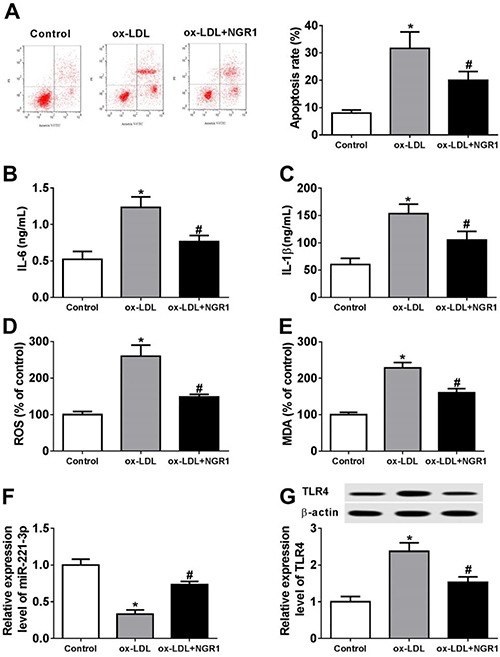
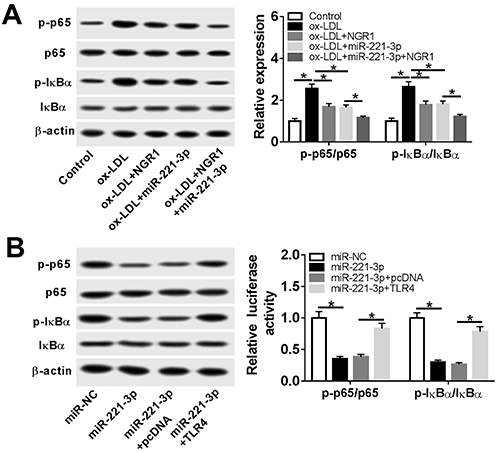
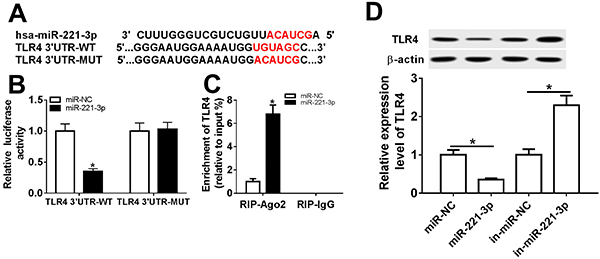
Atherosclerosis (AS) is a common vascular disease, which can cause apoptosis of vascular endothelial cells. Notoginsenoside R1 (NGR1) is considered an anti-AS drug. MicroRNAs (miRNAs) are believed to play a vital role in cell apoptosis and angiogenesis. This study aimed to explore the mechanism of NGR1 for treating AS through miRNAs. Flow cytometry was used to detect the apoptosis rate. The levels of inflammatory cytokines interleukin (IL)-6 and IL-1β were detected using ELISA. Reactive oxygen species (ROS) and malondialdehyde (MDA) levels were measured using corresponding assay kits. Quantitative real-time polymerase chain reaction (qRT-PCR) assay was performed to detect miR-221-3p expression. Dual-luciferase reporter and RNA immunoprecipitation assays were carried out to examine the relationship between miR-221-3p and toll-like receptors 4 (TLR4). Also, western blot analysis was performed to determine the levels of TLR4 and nuclear factor kappa B (NF-κB) signaling pathway-related proteins. Oxidized low-density lipoprotein (ox-LDL) induced human umbilical vein endothelial cells (HUVECs) apoptosis, inflammation, and oxidative stress. NGR1 alleviated the negative effect of ox-LDL through promoting the expression of miR-221-3p in HUVECs. TLR4 was a target of miR-221-3p, and its overexpression could reverse the inhibition effects of miR-221-3p on apoptosis, inflammation, and oxidative stress. NGR1 improved miR-221-3p expression to inhibit the activation of the TLR4/NF-κB pathway in ox-LDL-treated HUVECs. NGR1 decreased ox-LDL-induced HUVECs apoptosis, inflammation, and oxidative stress through increasing miR-221-3p expression, thereby inhibiting the activation of the TLR4/NF-κB pathway. This study of the mechanism of NGR1 provided a more theoretical basis for the treatment of AS.
动脉粥样硬化(AS)是一种常见的血管疾病,可导致血管内皮细胞凋亡。三七总皂苷 R1(NGR1)被认为是一种抗 AS 药物。microRNAs(miRNAs)被认为在细胞凋亡和血管生成中发挥重要作用。本研究旨在通过 miRNAs 探讨 NGR1 治疗 AS 的机制。流式细胞术检测细胞凋亡率。酶联免疫吸附试验(ELISA)检测白细胞介素(IL)-6 和 IL-1β 水平。用相应的检测试剂盒检测活性氧(ROS)和丙二醛(MDA)水平。采用定量实时聚合酶链反应(qRT-PCR)检测 miR-221-3p 表达。双荧光素酶报告和 RNA 免疫沉淀实验检测 miR-221-3p 与 Toll 样受体 4(TLR4)的关系。同时,采用 Western blot 分析检测 TLR4 和核因子 kappa B(NF-κB)信号通路相关蛋白水平。氧化型低密度脂蛋白(ox-LDL)诱导人脐静脉内皮细胞(HUVECs)凋亡、炎症和氧化应激。NGR1 通过促进 HUVECs 中 miR-221-3p 的表达来减轻 ox-LDL 的负性作用。TLR4 是 miR-221-3p 的靶基因,其过表达可逆转 miR-221-3p 对凋亡、炎症和氧化应激的抑制作用。NGR1 通过提高 miR-221-3p 的表达来抑制 ox-LDL 处理的 HUVECs 中 TLR4/NF-κB 通路的激活。NGR1 通过增加 miR-221-3p 的表达,减少 ox-LDL 诱导的 HUVECs 凋亡、炎症和氧化应激,从而抑制 TLR4/NF-κB 通路的激活。本研究对 NGR1 的作用机制进行了探讨,为 AS 的治疗提供了更理论的基础。