Department of Animal Sciences, D.H. Barron Reproductive and Perinatal Biology Research Program, and Genetics Institute, University of Florida, Gainesville, FL, 32611-0910, USA.
Instituto de Investigación en Ciencias de la Salud, CONICET, Córdoba, Argentina.
Sci Rep. 2019 Aug 14;9(1):11816. doi: 10.1038/s41598-019-48374-z.
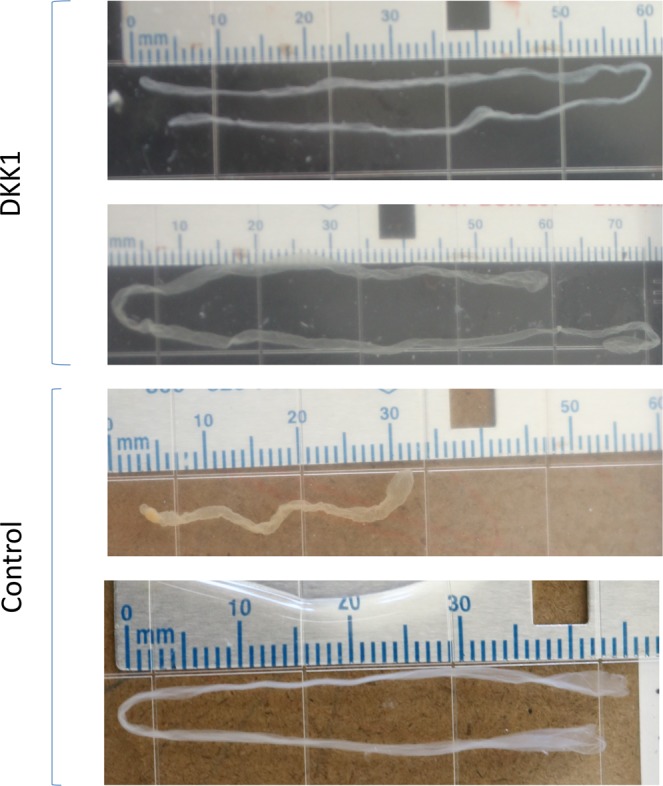
Progesterone regulates the endometrium to support pregnancy establishment and maintenance. In the ruminant, one action of progesterone early in pregnancy is to alter embryonic development and hasten the process of trophoblast elongation around day 14-15 of pregnancy, which is required for maternal recognition of pregnancy. Here we demonstrate that the WNT antagonist DKK1, whose expression is increased by progesterone treatment, can act on the bovine embryo during day 5 to 7.5 of development (the morula to blastocyst stage) to promote embryonic elongation on day 15 of pregnancy. Embryos were produced in vitro and exposed to 0 or 100 ng/ml recombinant human DKK1 from day 5 to 7.5 of culture. Blastocysts were transferred into synchronized recipient cows on day 7.5 (n = 23 for control and 17 for DKK1). On day 15, cows were slaughtered and embryos recovered by flushing the uterus. Embryo recovery was n = 11 for controls (48% recovery) and n = 11 for DKK1 (65% recovery). Except for two DKK1 embryos, all embryos were filamentous. Treatment with DKK1 increased (P = 0.007) the length of filamentous embryos from 43.9 mm to 117.4 mm and the intrauterine content of the maternal recognition of pregnancy signal IFNT (P = 0.01) from 4.9 µg to 16.6 µg. Determination of differentially expressed genes (DEG), using the R environment, revealed 473 DEG at p < 0.05 but none at FDR < 0.05, suggesting that DKK1 did not strongly modify the embryo transcriptome at the time it was measured. However, samples clustered apart in a multidimensional scaling analyisis. Weighted gene co-expression analysis of the transcriptome of filamentous embryos revealed a subset of genes that were related to embryo length, with identification of a significant module of genes in the DKK1 group only. Thus, several of the differences between DKK1 and control groups in gene expression were due to differences in embryo length. In conclusion, DKK1 can act on the morula-to-blastocyst stage embryo to modify subsequent trophoblast elongation. Higher pregnancy rates associated with transfer of DKK1-treated embryos may be due in part to enhancements of trophoblast growth and antiluteolytic signaling through IFNT secretion. Given that progesterone can regulate both timing of trophoblast elongation and DKK1 expression, DKK1 may be a mediator of progesterone effects on embryonic development.
孕激素调节子宫内膜以支持妊娠的建立和维持。在反刍动物中,孕激素在妊娠早期的作用之一是改变胚胎发育并加速滋养层在妊娠第 14-15 天的伸长过程,这是母体识别妊娠所必需的。在这里,我们证明了 WNT 拮抗剂 DKK1 的表达在孕激素处理后增加,可以在牛胚胎发育的第 5 天至 7.5 天(桑葚胚至囊胚阶段)发挥作用,以促进妊娠第 15 天的胚胎伸长。胚胎在体外产生,并在培养的第 5 天至 7.5 天暴露于 0 或 100ng/ml 重组人 DKK1。囊胚在第 7.5 天(对照组为 23 个,DKK1 为 17 个)转移到同步受体牛中。在第 15 天,牛被屠宰并通过冲洗子宫回收胚胎。对照组胚胎回收 n=11(48%回收),DKK1 组 n=11(65%回收)。除了两个 DKK1 胚胎外,所有胚胎均为丝状。用 DKK1 处理后,丝状胚胎的长度从 43.9mm 增加到 117.4mm(P=0.007),妊娠识别信号 IFNT 的子宫内含量从 4.9μg 增加到 16.6μg(P=0.01)。使用 R 环境确定差异表达基因(DEG)显示,p<0.05 时有 473 个 DEG,但 FDR<0.05 时没有,这表明 DKK1 在测量时并未强烈改变胚胎转录组。然而,样本在多维尺度分析中聚类分开。对丝状胚胎转录组的加权基因共表达分析显示了一组与胚胎长度相关的基因,仅在 DKK1 组中鉴定到一个显著的基因模块。因此,DKK1 组和对照组之间在基因表达上的一些差异是由于胚胎长度的差异。总之,DKK1 可以作用于桑葚胚至囊胚期胚胎,以改变随后的滋养层伸长。与转染 DKK1 处理的胚胎相关的更高妊娠率可能部分归因于通过 IFNT 分泌增强滋养层生长和抗溶黄体作用信号。鉴于孕激素既能调节滋养层伸长的时间,又能调节 DKK1 的表达,DKK1 可能是孕激素对胚胎发育影响的介质。